

 NEWS
NEWS
NEWS
NEWS
NEWS

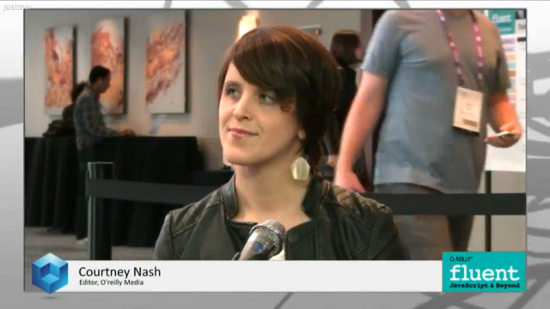
Courtney Nash, Editor at O’Reilly Media, discussed the future Velocity Conference with theCube host John Furrier, live at the O’Reilly Fluent Conference 2013. Organized under the “Building a faster and stronger web,” the Velocity Conference “is about speed and power on the web,” Nash said.
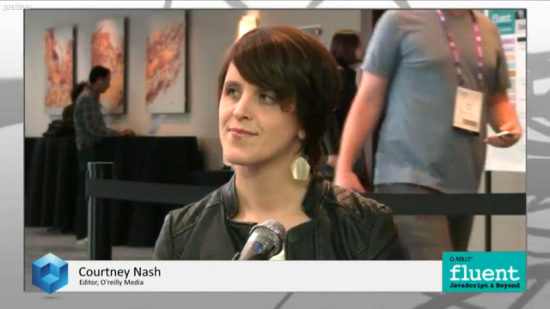
With the influx of mobile devices and all kind of devices, people’s expectation of speed for web and mobile devices is always increasing. And there is real revenue here, “if your site is slow, you’re going to lose money.” As an example of how speed impacts financial aspects, speed increased donations in the Obama campaign. “Speed connects with fiscal reality.”
Talking about the Velocity market, Nash said: “I think that the reality is that there is still a fragmented market place. The reality is there are still a lot of silos out there.” The web also needs strength, and that is where DevOps comes into play. “It’s not just speed, you need a base on which you can go fast. The strength is the foundation of the speed, and DevOps is about people, it’s a cultural phenomenon.” When you can look at the people involved, you can make your operations, web, everything faster. “It is a piece of that Velocity culture and world.”
Commenting on the software defined networking/storage/data center trend, Nash pointed out that “everything is code. Velocity is starting to look at the boundaries of humans in software. The singularity is not approaching, everything will not all be software. There are these intersections of people and software, you cannot automate everything, software will not solve all your problems.”
Build failure into your software
“Unlike other conferences, Velocity has a history of sharing our mistakes,” Nash added, speaking of the conference focusing on using failure as a learning tool. People are building failure into their software now. “When I look at software, I can’t not look at people aspect.”
Identifying the biggest challenges and opportunities, Nash said “the web is only marginally getting faster.” Everyone agrees it should get faster, but the people who have been driving the increase in speed on the web have been browsers and ISPs. “At the developer level, things aren’t really getting faster. There is a lot still that developers could be doing to make their sites faster,” while sites tend to get bigger. Video is going to be a big piece of that challenge.
Enterprise is an area for Velocity that has a lot of challenges, but also opportunities, Nash explained. “You can’t change the technology in an organization, without changing the culture, the people.” Mobile is becoming a much bigger deal for Velocity; there is a mobile track at this year’s edition. “Mobile is the web, web is mobile, there are things you should be doing across both.” There are also aspects that are harder to control, but there are things that people can be doing to optimize for mobile, and responsive design is a part of the solution.
Asked which are the uncharted areas for Velocity, Nash again brought up the topic of failure, which is tied to the idea of risk. “A lot of interesting people in academia are starting to look at risk,” and there are a lot of interesting things coming if you embrace risk and have a different model of resilience at what your site can do, having sites that can flex with chaos. But that aspect is still a couple of years out for people to start getting into it.
Support our mission to keep content open and free by engaging with theCUBE community. Join theCUBE’s Alumni Trust Network, where technology leaders connect, share intelligence and create opportunities.
Founded by tech visionaries John Furrier and Dave Vellante, SiliconANGLE Media has built a dynamic ecosystem of industry-leading digital media brands that reach 15+ million elite tech professionals. Our new proprietary theCUBE AI Video Cloud is breaking ground in audience interaction, leveraging theCUBEai.com neural network to help technology companies make data-driven decisions and stay at the forefront of industry conversations.