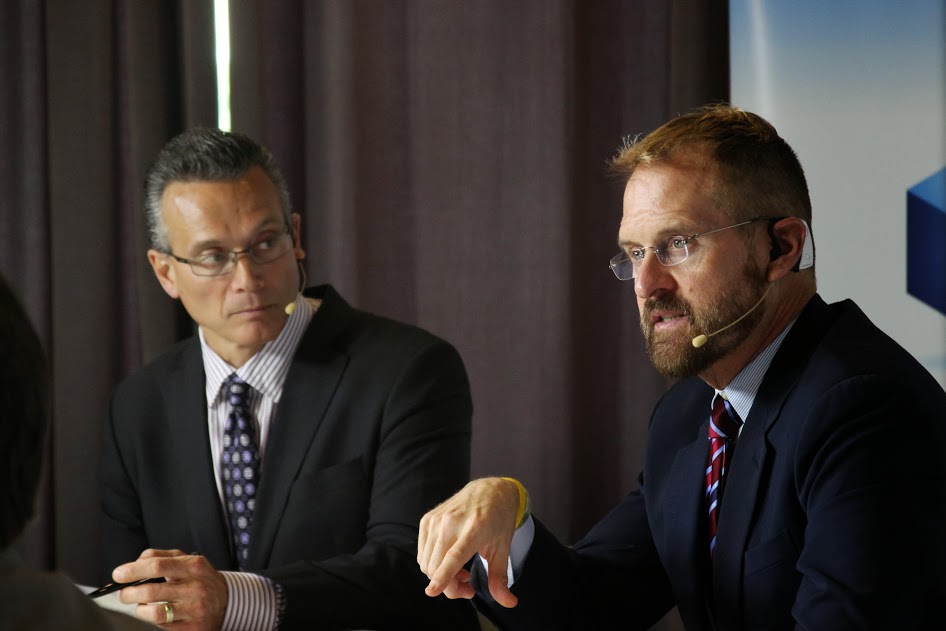









 Live from #theCUBE at Mandalay Bay in Las Vegas, John Furrier and Dave Vellante brought their regular viewers exclusive coverage from IBM Information on Demand 2013. Our co-hosts got hold of Fred Balboni, Global Lead for Business Analytics and Optimization with IBM, to talk about Services and roadmapping.
Services matter because it’s great gross profit for helping customers implement solutions that they asked for. The market is exploding with demand, people know it’s a game changer with Big Data analytics, cloud, and mobile devices. People want to be in every channel of the social business.
“Services is important; it’s the last mile. Without that you can’t ever deliver the value. The really interesting challenge that every executive faces is not the Big Data technology but articulating what’s possible to a client,” said Balboni.
He had a very interesting observation regarding customers: “Clients think in terms of processes, not data. The first part of services is being able to articulate the value of analytics and Big Data to a client in the businesses terms – it becomes a boardroom conversation, quickly populated with use cases.”
“The speed thing allows you to go rapidly to places, but you’d better have a navigation roadmap. You want to make sure you’re getting leverage and going somewhere. Roadmapping becomes really important for every technology side of the business,” believes Balboni.
Vellante wanted to find out how Balboni deals with the blind spot of the customer (thinking in business terms, not data). “Should clients increasingly be thinking in terms of data, or should our industry evolve to make the data map to business processes?”
“I just take it as a fact. I don’t choose to question why, I just accept it,” admitted Balboni. “The paradigm under which modern computing was invented was that we invented computers to automate tasks. Over the last 40 years we’ve conditioned businesses to think about using technology to gain business efficiency. They’ve always thought in terms of processes.”
There are two ways of addressing this problem, according to Fred Balboni: “At the end of the day, it’s data. The question is how you articulate that,” said Balboni. “I like to use a metaphor to describe the data. If it’s customer, the metaphor is DNA and DNA strands.
“Number 1 is using a language that the business can relate to. Number 2 is talking about a collection of use cases. You use them as a vehicle to have the process conversation and talk business outcomes, benefits, in the form of a story,” Balboni explained. “Talking about the data as a DNA chain makes customers understand. The data enriches the conversation when you talk about the business outcomes that are created as part of the use case.”
Support our mission to keep content open and free by engaging with theCUBE community. Join theCUBE’s Alumni Trust Network, where technology leaders connect, share intelligence and create opportunities.
Founded by tech visionaries John Furrier and Dave Vellante, SiliconANGLE Media has built a dynamic ecosystem of industry-leading digital media brands that reach 15+ million elite tech professionals. Our new proprietary theCUBE AI Video Cloud is breaking ground in audience interaction, leveraging theCUBEai.com neural network to help technology companies make data-driven decisions and stay at the forefront of industry conversations.