




 NEWS
NEWS
NEWS
NEWS
NEWS

Faced with more than half of all its search queries now coming from mobile devices, Google Inc. today is announcing what it calls the biggest changes to its iconic search ads since they were launched 15 years ago.
Search ads, which powered most of the company’s $67.4 billion in 2015 revenues, essentially will be bigger and bolder to match somewhat larger screens that are increasingly popular — and, not incidentally, to bring in more revenues. The main subsidiary of Alphabet Inc. is introducing the changes to several hundred advertisers and partners at its annual Google Performance Summit in San Francisco today.
Google has been focusing on improving mobile ads for several years now, not least because advertisers still pay less per mobile ad than per desktop ad. That’s for several reasons, including uncertain effectiveness of existing types of ads on a tiny screen and difficulty in measuring results, especially store visits and purchases.
Executives have insisted that eventually, mobile ads should be more lucrative than desktop ads because of the location and other data inherent in the use of mobile devices. But it has become clear that simply running downsized versions of desktop ads doesn’t work very well.
“Six months ago asked ourselves if we were starting over with text ads in mobile, what would we do?” Sridhar Ramaswamy (pictured), senior vice president of ads and commerce at Google, said at a press briefing Monday. That’s why Google, which recently eliminated the right-hand ads on Web pages viewed on computers to make them consistent with the mobile screen experience, today is announcing a raft of changes to its ads.
For one, the ads, which will roll out later this year to advertisers in its AdWords system, will have slightly longer headlines that now can run two lines instead of one. From the current two 35-character lines, the description now will be one 80-character line. And Google will automatically extract the displayed website address rather than require URLs to be manually entered.
In early testing, some advertisers have gotten increases of up to 20 percent in the rate at which people click on the ads, according to Google.
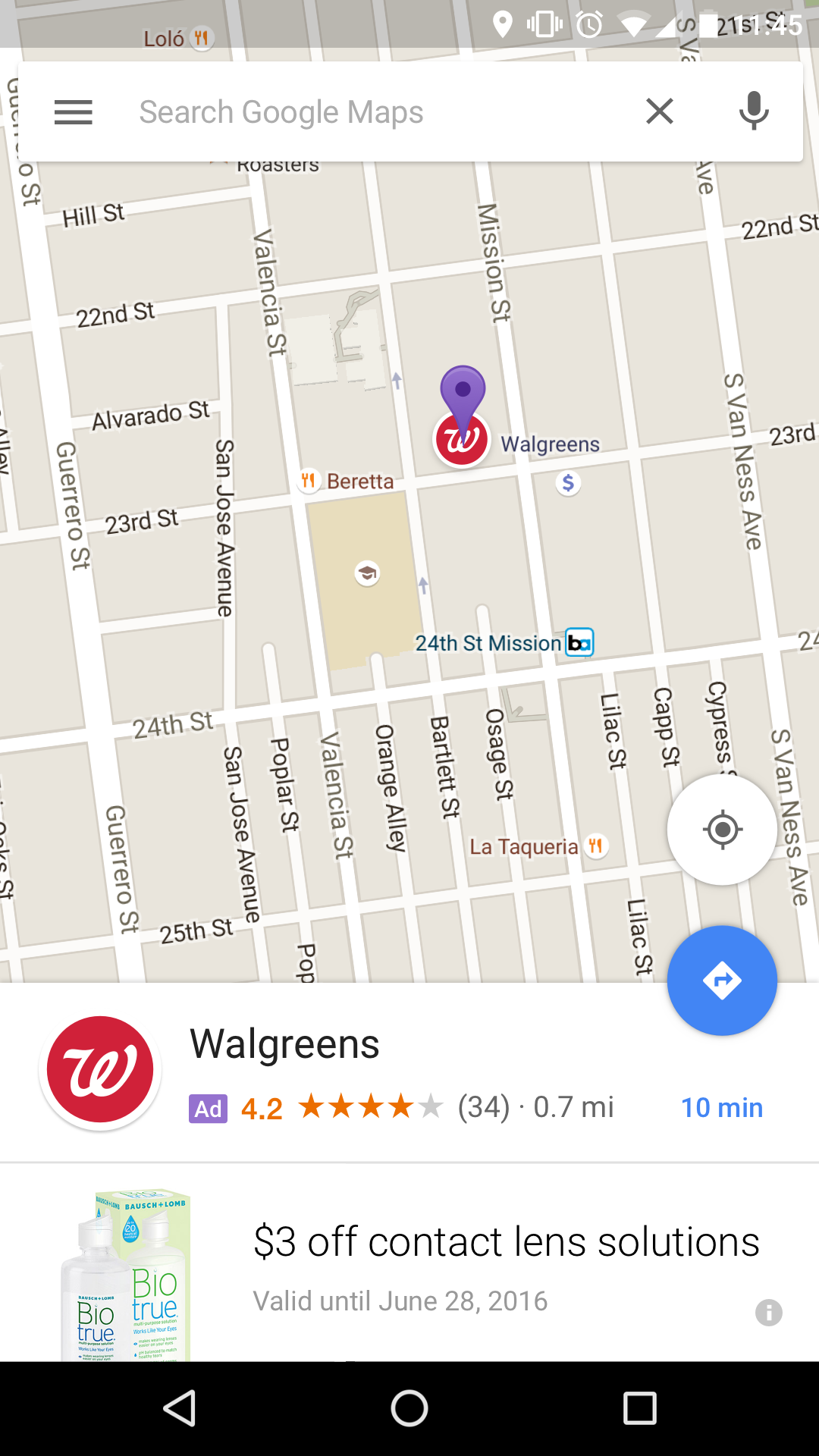
Google’s “promoted pin” ads on its Maps app (Photo: Google)
Google also is experimenting with new kinds of ads on its Maps app, a key entry point for mobile users on the go. “Promoted pins” will selectively place paid icons for gas stations, coffee shops and other locations on Google Maps. And the company is revamping local business pages to allow businesses to make offers or browse products in stock at a nearby store.
In addition, Google is introducing new local search ads that can run on Google.com and Google Maps. Nearly a third of mobile searches relate to location.
Advertisers may be even more interested in a key change in how Google is allowing them to bid on ads in its auction system. Two years ago, it essentially forced advertisers to buy ads on both the desktop Web and mobile screens instead of allowing them to bid separately on ads that run on desktop computers, smartphones and tablets.
That change to “Enhanced Campaigns,” rankled many advertisers, who craved greater control over where to run ads to get the best results. But partly independent of Google, mobile advertising has taken off as advertisers realized that’s where people now spend most of their time.
Now, Google is returning more control to advertisers, allowing them to set bid adjustments individually for smartphones, tablets and computers. Advertisers can bid for ads on the device they find most valuable and then adjust ad bids for other devices by up 900 percent, a wider range than before.
Why the change? Jerry Dischler, vice president of product management for AdWords, said many advertisers were now bidding on mobile ads first instead of as an afterthought, and “we saw mobile-first use cases that really weren’t well-handled by the current bidding process. Mobile ads are no longer an add-on, they’re an imperative.”
Most advertisers are likely to welcome the “overdue” changes, Tim Krozek, chief executive of Google ad partner Boost Media. “Google will absolutely win…more characters and real estate for marketers to convey their message to consumers and clicks and conversions will follow,” he said. But smaller advertisers may struggle with the cost of changing the formats of all their ads.
There’s also a new look coming to display ads that run on its Google Display Network of some 2 million other websites. “Responsive ads” will adapt their appearance based on the look and feel of different kinds of websites, a nod to so-called “native advertising” that looks more like the content of websites. Advertisers can input headlines, a description, an image and a Web address and Google will automatically design the ads.
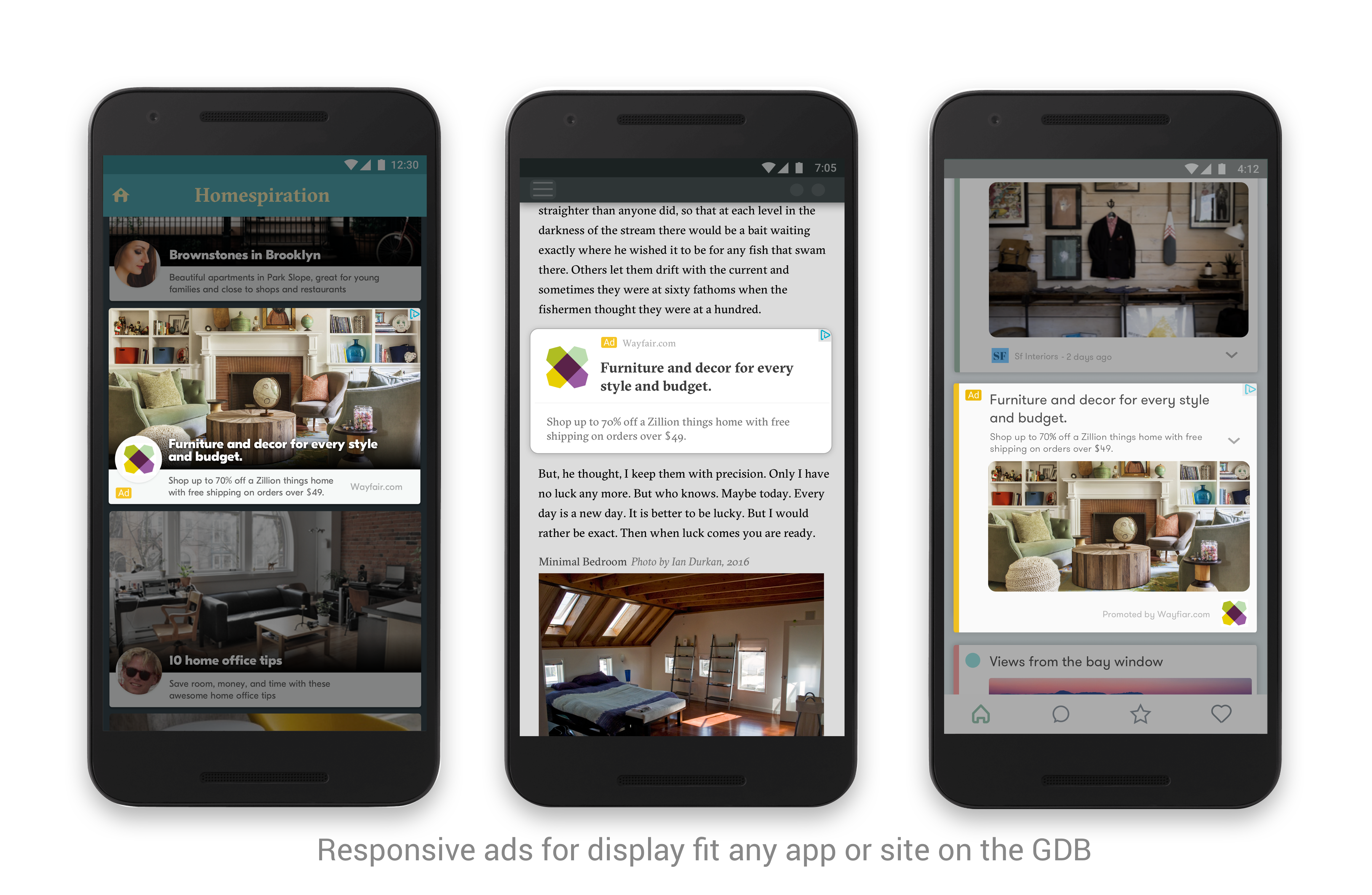
Google’s new “responsive” display ads (Photo: Google)
Key to Google’s mobile push is providing analytics for advertisers to measure visits to stores, not just online activity. It currently provides store visit data to some 1,000 advertisers in 11 countries, with plans for expansion to more companies that can provide loyalty program and other data that matches ad viewing to store visits. The company attributes some 1 billion store visits to its ads. Dischler said it will start using in-store beacons to help target ads more precisely.
Already, though, mobile access to information has changed shopping. The average car shopper makes only two dealership visits before buying a car because they use mobile searches first, Dischler said. Nissan UK, for instance, could see that 6 percent of mobile ad clicks drove people to its showrooms, resulting in a 25 to 1 return on investment.
Seven & i Holdings Co., a large retailer in Japan, found that 10 percent of mobile searches led to a store visit. According to Google, the cost per visit was 40 percent lower on mobile than with desktop ads.
Overall, the changes appear likely to give Google a boost, analysts said. “It is apparent that these announced changes are likely quite significant and should prove net positive versus last year,” Macquarie Securities analyst Ben Schachter wrote in a note to clients.
Google also released a new stat as well, saying there are trillions of searches a year on Google.com. The last figure it provided last year was more than 100 billion a month, which worked out to 1.2 trillion a year.
Support our mission to keep content open and free by engaging with theCUBE community. Join theCUBE’s Alumni Trust Network, where technology leaders connect, share intelligence and create opportunities.
Founded by tech visionaries John Furrier and Dave Vellante, SiliconANGLE Media has built a dynamic ecosystem of industry-leading digital media brands that reach 15+ million elite tech professionals. Our new proprietary theCUBE AI Video Cloud is breaking ground in audience interaction, leveraging theCUBEai.com neural network to help technology companies make data-driven decisions and stay at the forefront of industry conversations.