









 NEWS
NEWS
NEWS
NEWS
NEWS

Along with the waves and excitement being created by innovations in cloud utilities, other sides to the evolution of storage solutions are being shown off at VMworld 2016, and vendors coming from a heterogeneous product background are finding a warm reception by VMware loyalists.
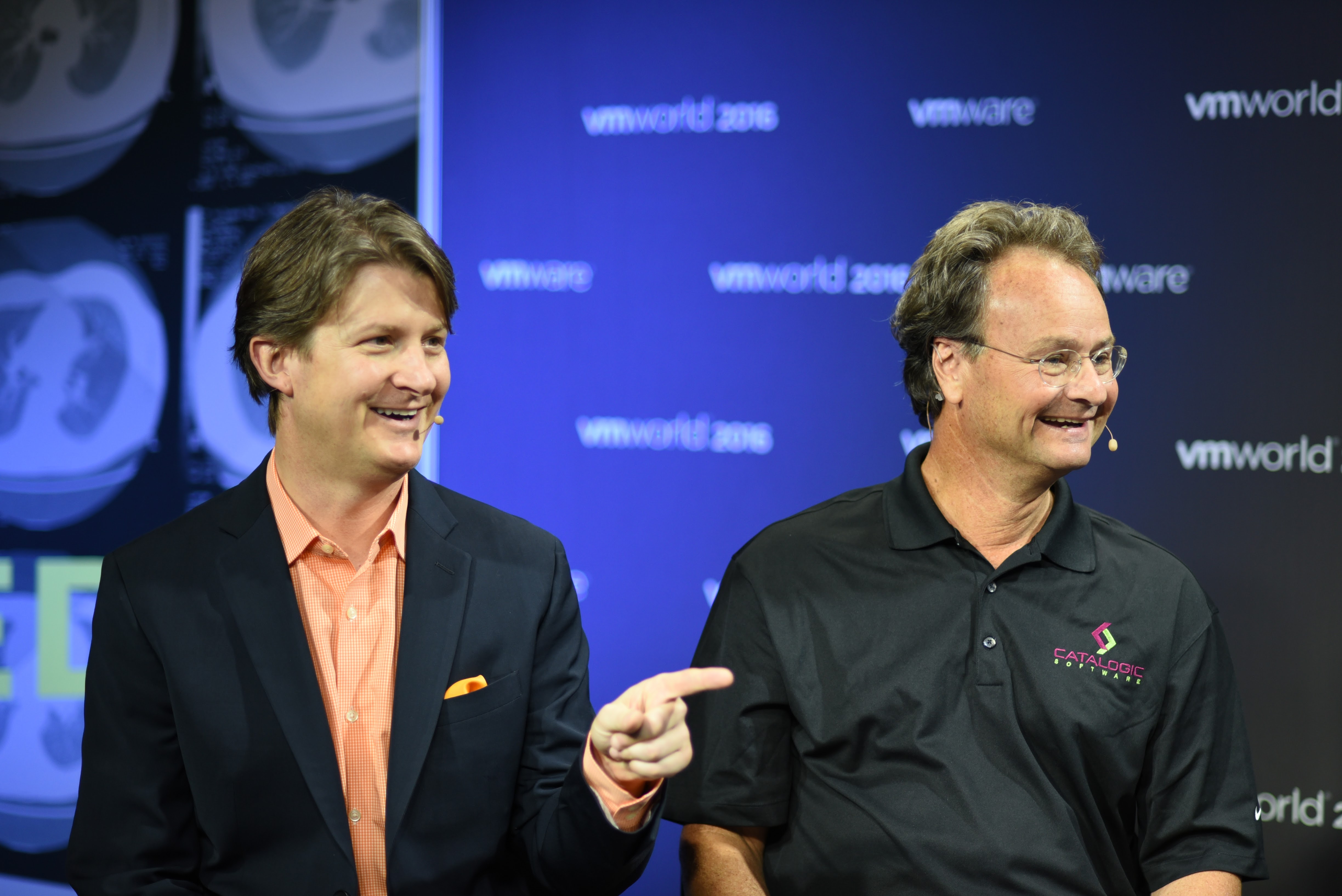
Vaughn Stewart, VP and enterprise architect at Pure Storage, Inc., and Ken Barth, CEO of Catalogic Software, Inc., joined John Walls (@JohnWalls21) and Marc Farley (@gofarley), cohost and guest host of theCUBE, from the SiliconANGLE Media team, to discuss how the team-up of their two companies is changing the storage game for both.
Stewart described Pure Storage as an “all-flash storage vendor” that had “really allowed flash to be consumed by the masses,” while Barth summarized Catalogic as “in-place copy-data management.” Barth also praised the quick connection that had formed between the two companies: “Why that’s important is because we get to pick our partners, and it’s a lot easier to build a technology if the partners cooperate. And these guys [Pure Storage] have been so cooperative; that’s what made this thing tick.”
Describing the advantage of the Pure Storage-Catalogic connections, Barth pointed out, “When you marry copy-data management to flash technology, you drive some really serious opex and capex savings for customers.”
As Stewart put it, the key advantages of this union were the speed, agility and consistency provided to customers, with a sense of this being something that many of its customers had been anticipating, but not quite ready to take on until this point.
“We have a large number of joint customers, as well as customers that are interested in purchasing the other technology, but we’re waiting for a point of integration,” Stewart said.
But with the two companies now joining forces, those needs are being more than met. “There was this need for taking the data-management constructs that we had and enabling an end-to-end ecosystem enablement so that dev teams could just, at the push of a button, refresh their datasets, move their development efforts forward and get rid of all the old legacy, time-centric-based provisioning model,” Stewart described.
And as flash becomes more affordable, its appeal is being more widely felt. “Everybody that we’ve talked to is either moving to flash or thinking about moving to flash simply for their primary applications … databases, virtualization, filers, SharePoints,” Barth stated.
“This is a real nice pairing of technologies,” Stewart asserted, though he noted that customers looking to get involved with the workings of it would see more benefits than the hands-off users. “The performance capabilities within a flash array allows you to scale a large number of instances; the instant ability to clone the dataset gives you agility, but it’s just an engine.”
Stewart and Barth did note that this was no deterrent to more casual customers looking to get the base functionality; however, as the nature of the solutions allows for out-of-the-box running, with consistent copies of datasets.
Barth felt that for many customers, the biggest draw would be found in the financial savings. “Once flash comes on the scene, and particularly flash vendors who can do what they do, that have got a huge capex or opex savings for the customer, then you can start working in their workflow and their processes and saving them even more money.”
Watch the full interview below, and be sure to check out more of SiliconANGLE and theCUBE’s coverage of the VMworld 2016.
Support our mission to keep content open and free by engaging with theCUBE community. Join theCUBE’s Alumni Trust Network, where technology leaders connect, share intelligence and create opportunities.
Founded by tech visionaries John Furrier and Dave Vellante, SiliconANGLE Media has built a dynamic ecosystem of industry-leading digital media brands that reach 15+ million elite tech professionals. Our new proprietary theCUBE AI Video Cloud is breaking ground in audience interaction, leveraging theCUBEai.com neural network to help technology companies make data-driven decisions and stay at the forefront of industry conversations.