












 AI
AI
AI
AI
AI

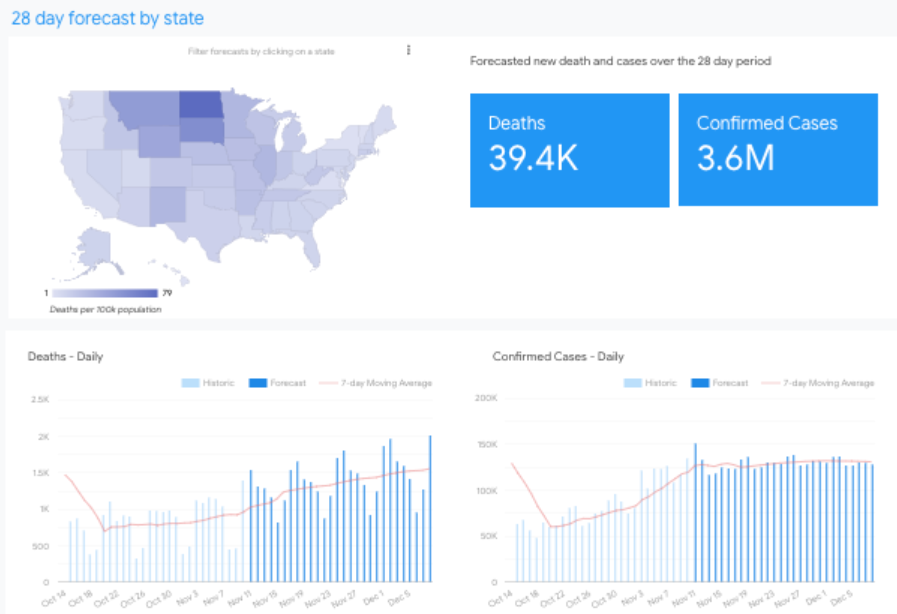
Google LLC and the Harvard Global Health Institute have made some big improvements to their artificial intelligence-generated COVID-19 Public Forecasts that are used by healthcare organizations and first responders to help plan their response to the ongoing coronavirus pandemic.
In a blog post today, Tomas Pfister, head of Google Cloud AI Research, said the COVID-19 Public Forecasts have been adopted by dozens of organizations since they were first launched in August, and they’re being used to project COVID-19 cases, deaths and other important metrics.
The forecasts have now been improved in five important ways, Pfister said. Perhaps the most important update is that the models now provide longer forecasts of key metrics of up to 28 days, instead of just 14 days. Google has also added “confidence intervals” into the mix, because longer forecasts means those predictions invariably become less certain.
Moreover, the quality of the AI models used to make forecasts have been improved substantially.
“A dedicated team has been continuously improving the model quality with cutting-edge AI research,” Pfister said. “A white paper detailing some of these innovations was published in the premier machine learning conference, NeurIPS 2020. The accuracy of the model has continuously improved over time and is retrained daily as more data becomes available.”
Meanwhile, the model has expanded to include Japan as well as the U.S. The Japanese forecasts are based on free and publicly available data, such as the COVID-19 Situation Report in Japan, and predict confirmed cases, deaths, recoveries and hospitalizations per day, for up to 28 days in the future. Moreover, the forecasts can dig down to provide individual predictions for each of Japan’s prefectures, Pfister said.
Organizations can now customize the forecasts too. Pfister said that many of the organizations that use the COVID-19 Public Forecasts would like to add their own datasets to the mix. Google has transformed its initial forecasting model into a customizable system that will enable healthcare organizations to create more specific forecasts for their own hospitals and at the state level.
Finally, Pfister said, Google has created a “novel AI-driven what-if model” that’s designed to help first responders and healthcare organizations to better inform their policy decisions. So an organization can use this model to can predict how the COVID-19 forecasts for their jurisdiction might change if they mandate masks are to be worn at all times, or if they alter business reopening plans, for example.
“We hope that it will be helpful for organizations interested in doing vaccine rollout planning and other important decision making that may impact COVID-19 outcomes,” Pfister said.
Support our mission to keep content open and free by engaging with theCUBE community. Join theCUBE’s Alumni Trust Network, where technology leaders connect, share intelligence and create opportunities.
Founded by tech visionaries John Furrier and Dave Vellante, SiliconANGLE Media has built a dynamic ecosystem of industry-leading digital media brands that reach 15+ million elite tech professionals. Our new proprietary theCUBE AI Video Cloud is breaking ground in audience interaction, leveraging theCUBEai.com neural network to help technology companies make data-driven decisions and stay at the forefront of industry conversations.