

 AI
AI
AI
AI
AI

Salesforce Inc. today announced the release of new deep observability tools to handle the growing need to provide management and maintenance of artificial intelligence agents after deployment.
The new capabilities are included in the Agentforce 360 Platform, an enterprise-wide solution that embeds agents into almost every application the company provides. With Agentforce 360, companies can spin up fleets of AI agents to work alongside humans or communicate with each other to get work done.
This release is part of Salesforce’s ongoing evolution to provide enterprises the tools that they need to build, deploy and manage agents on larger and larger scales.
“As AI adoption accelerates, the biggest enterprise challenge will no longer be about building an organization’s first agent; it will become how to best manage a fleet of agents that are making real-world business decisions,” said Adam Evans, executive vice president and general manager of Salesforce AI.
According to Salesforce, visibility into agentic workflows and the activities of AI agents is becoming increasingly fundamental. Autonomous AI systems operate with little or no human oversight, while more companies integrate them into essential workflows. The company noted a 282% increase in enterprise adoption, cited from its recent report on AI impact.
“You can’t scale what you can’t see,” Evans said.
The new observability platform tackles three main areas: refinement, traceability and reliability.
Underpinning the tools, Agentforce 360 now includes a new session tracing data model that logs every interaction, including user inputs, agent responses, reasoning steps, large language model calls and guardrail checks. This is paired with MuleSoft Agent Fabric, a new centralized capability for registering, orchestrating, governing and observing every agent in an organization.
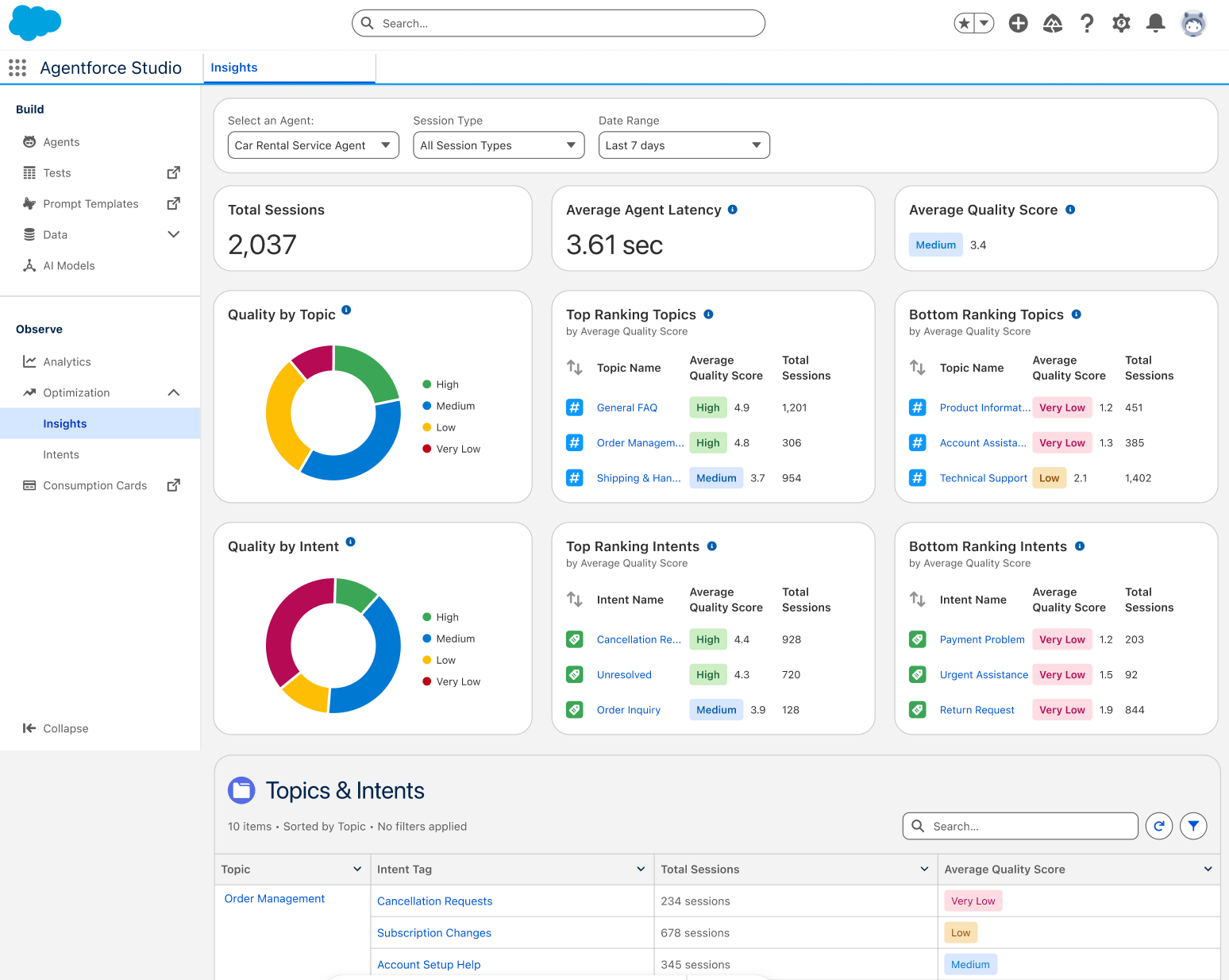
Using deep analytics, users can track agent usage and effectiveness, examine trends in key performance indicators and surface efficiency gains with insights into conversational flows. Teams can optimize performance by grouping similar requests to reveal patterns and by examining configuration details that may affect how agents communicate or take action.
Large-scale health monitoring provides near-real-time metrics with continuously updated dashboards. With persistent monitoring, potential issues can be spotted before they degrade performance or cause errors.
Pilot customers of the new Agentforce 360 observability tools reported deeper access to data, improved governance over deployed agents and the ability to refine autonomous workflows by opening up what is often treated as a black box.
Before today’s launch, Salesforce piloted the new tools with others such as 1-800Accountant, Hotel Engine Inc. and Nexo Inc.
Hotel Engine handles more than 530,000 customer inquiries a year. Demetri Salvaggio, vice president of customer experience and operations at the travel experience company, revealed that platform-led insights provided visibility not only into whether tasks were completed successfully but also into how the AI itself was making decisions.
“Observability is the foundation that turns AI from a tool into a trusted, continuously improving teammate,” Salvaggio said.
Salesforce said that agent analytics and optimization capabilities are available today in Agentforce Studio, the company’s centralized Agentforce 360 dashboard. Health monitoring will become generally available in spring 2026.
Support our mission to keep content open and free by engaging with theCUBE community. Join theCUBE’s Alumni Trust Network, where technology leaders connect, share intelligence and create opportunities.
Founded by tech visionaries John Furrier and Dave Vellante, SiliconANGLE Media has built a dynamic ecosystem of industry-leading digital media brands that reach 15+ million elite tech professionals. Our new proprietary theCUBE AI Video Cloud is breaking ground in audience interaction, leveraging theCUBEai.com neural network to help technology companies make data-driven decisions and stay at the forefront of industry conversations.