

 AI
AI
AI
AI

AI

Agentic infrastructure is quickly becoming the backbone of how enterprises scale artificial intelligence-driven systems, reshaping expectations for automation, governance and real-world performance.
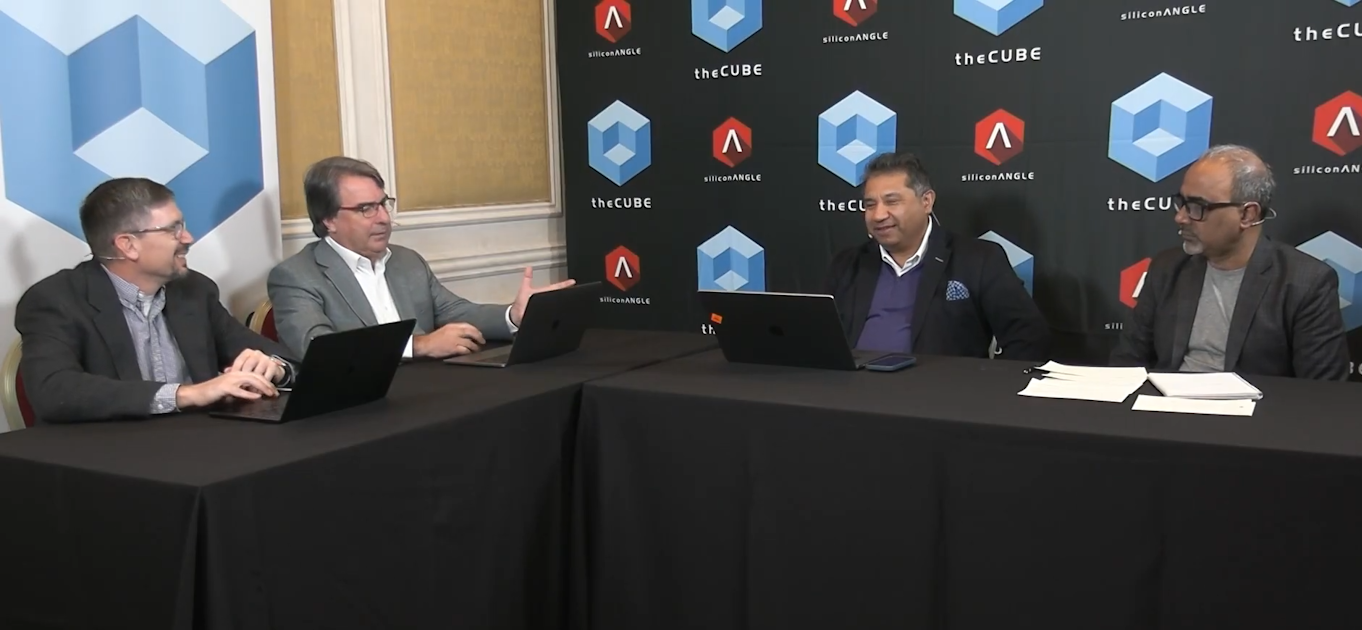
The industry is shifting toward architectures that unify chips, models, governance layers and developer tooling, creating a clearer path for organizations that want to move from experimentation to production. This evolution shows how the cloud is transitioning from abstracting infrastructure to abstracting work outcomes themselves, according to Zeus Kerravala (pictured, second from right), founder and principal analyst at ZK Research.
“AI gave AWS in some ways a unifying theme for the show,” Kerravala said. “When we’ve come in the past, it’s a lot of random product announcements … it was tough to find a thread that you could weave through all of them. AI is obviously that thread. I don’t know if we’ll ever expect AWS to be on the leading edge of things, but they tend to roll out products when the market’s ready to scale.”
Kerravala was joined by Sarbjeet Johal (right), founder and chief executive officer of Stackpane, in a discussion with John Furrier (second from left) and Paul Nashawaty (left) at AWS re:Invent, during an exclusive broadcast on theCUBE, SiliconANGLE Media’s livestreaming studio. They discussed how agentic infrastructure is transforming enterprise AI adoption by unifying automation, governance, cloud-native systems and developer workflows into a more scalable, integrated model.
Companies now face an environment where agent-based systems, policy frameworks and cloud-native architectures need to function as a single integrated stack. This shift is accelerating demand for AI platforms that automate development tasks, streamline governance and deliver measurable gains in performance, Johal explained.
“At the end of the day, when the dust settles, economics matters the most,” he said. “The price to performance matters the most. If you are doing things at scale, milliseconds matter, the pennies matter. Amazon is gearing toward that.”
As enterprises evolve their AI blueprints, agentic infrastructure becomes a catalyst for both professional developers and emerging citizen developers. The blending of cloud-native and AI-native approaches means organizations can reduce complexity while accelerating outcomes, especially as guardrails strengthen across the ecosystem, Nashawaty noted.
“One of the things that we’re seeing in the developer world is the professional developer and the citizen developer is really bifurcated in the developing community,” he said. “AI is allowing for lines of businesses to create their own applications. Amazon is definitely enabling those lines of businesses to do that.”
The rise of agent frameworks, long-running agents and policy engines is also pushing enterprises to rethink how they manage risk and scale securely. Security-by-default models are proving essential as teams adopt faster development workflows and more distributed responsibilities, Nashawaty emphasized.
“The other big factor that we drilled down on … was the guardrails for security, compliance and governance,” he said. “If you’re going to open up development to the lines of business users, you have to have those guardrails in place.”
This evolution is also reshaping analyst perspectives, expanding how research teams examine the interplay between infrastructure, cloud-native systems and AI-driven development. As one expert emphasized, the shift requires a more integrated view of the stack, according to Furrier.
“We’ve been talking about AI factors now for over a year, large-scale systems,” he said. “You saw the Google announcement with AWS a couple [of] days ago. In a way, agents are an extension of the cloud. You have a lot of cloud infrastructure. I won’t say replatforming, but it kind of feels like the same game.”
Here’s the complete video interview, part of SiliconANGLE’s and theCUBE’s coverage of AWS re:Invent:
Support our mission to keep content open and free by engaging with theCUBE community. Join theCUBE’s Alumni Trust Network, where technology leaders connect, share intelligence and create opportunities.
Founded by tech visionaries John Furrier and Dave Vellante, SiliconANGLE Media has built a dynamic ecosystem of industry-leading digital media brands that reach 15+ million elite tech professionals. Our new proprietary theCUBE AI Video Cloud is breaking ground in audience interaction, leveraging theCUBEai.com neural network to help technology companies make data-driven decisions and stay at the forefront of industry conversations.