
 AI
AI
AI
AI
AI

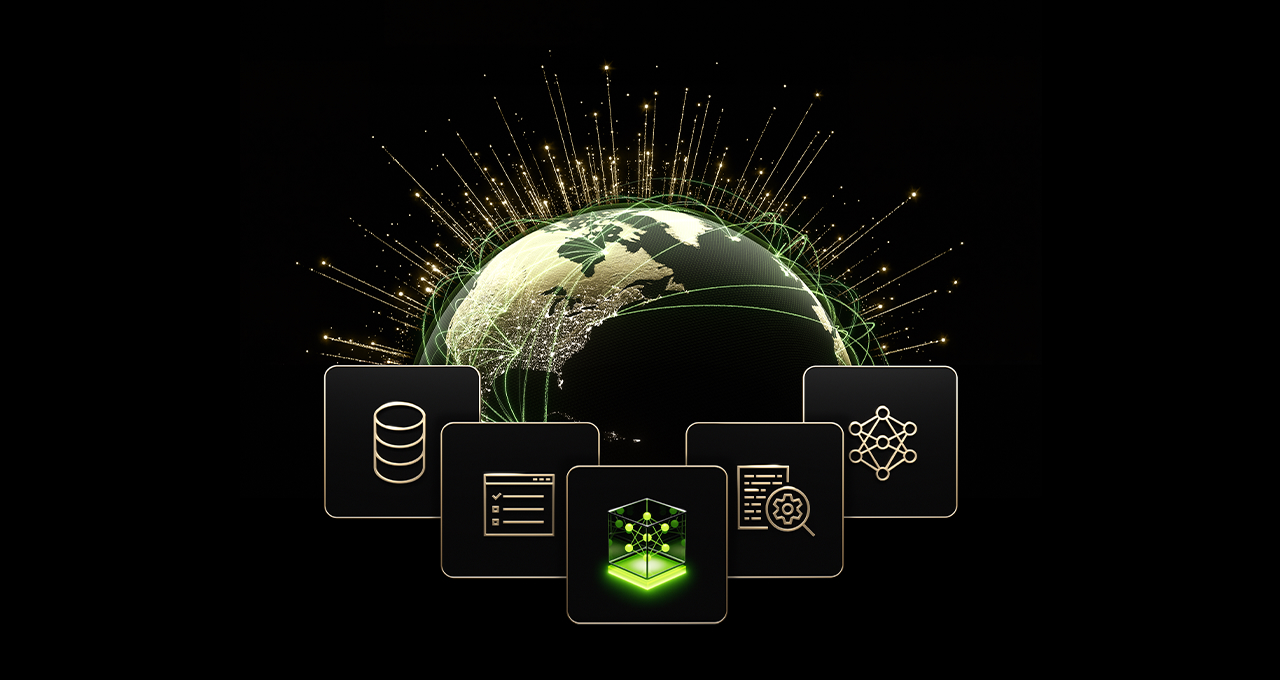
Nvidia Corp. today announced the launch of Nemotron 3, a family of open models and data libraries aimed at powering the next generation of agentic artificial intelligence operations across industries.
The new family of models will consist of three sizes: Nano, Super and Ultra. The company built them using a breakthrough architecture using a hybrid latent mixture-of-experts method to compress memory needs, optimize compute and deliver exceptional intelligence for size.
According to the company, the smallest model, Nemotron 3 Nano, delivers four times throughput than its predecessor while maintaining high performance.
“Open innovation is the foundation of AI progress,” said Jensen Huang, founder and chief executive of Nvidia Corp. “With Nemotron, we’re transforming advanced AI into an open platform that gives developers the transparency and efficiency they need to build agentic systems at scale.”
The company said the release of these AI models addresses the aggressive acceleration of industry adoption of agentic AI applications that require reasoning and tool orchestration. The era of single-model chatbots is giving way to orchestrated AI applications that automate multiple models to power proactive and intelligent agents.
The Nemotron 3 launch also positions Nvidia more directly against a growing field of open and semi-open reasoning models, as competition shifts from raw parameter counts toward orchestration, reliability and agent-centric performance.
Using its new architecture, Nvidia said it will help drive costs down, while still providing high-speed, reliable reasoning and intelligence.
Launching today, Nano is a small 30 billion-parameter model with 3 billion active parameters, aimed at targeted, highly efficient tasks. The next larger model, Super, combines 100 billion parameters with 10 billion active parameters and is designed to provide mid-range intelligence for multi-agent applications. Finally, Ultra, a large reasoning engine weighing in at 500 billion parameters with 50 billion active, delivers reasoning for complex AI applications and agentic orchestration.
Nemotron Super excels at applications that bring together multiple AI agents collaborating on complex tasks with low latency. Nemotron Ultra, by contrast, is positioned as a powerhouse “brain” at the center of demanding AI workflows that require deep research and long-horizon strategic planning.
Nano is available now, Super will arrive during the first quarter of 2026, and Ultra is expected in the first half of next year.
Using the company’s ultra-efficient 4-bit NVPF4 training format, developers and engineers can deploy the models on Nvidia’s Blackwell architecture across smaller numbers of graphics processing units, with a significantly reduced memory footprint. The efficient training process also allows the models to scale down through distillation without notable losses to accuracy or reasoning capability.
Early adopters of the Nemotron family include Accenture plc, CrowdStrike Holdings Inc., Oracle Cloud Infrastructure, Palantir Technologies Inc., Perplexity AI Inc., ServiceNow Inc., Siemens AG and Zoom Communications Inc.
“Perplexity is built on the idea that human curiosity will be amplified by accurate AI built into exceptional tools, like AI assistants,” said Perplexity CEO Aravind Srinivas. “With our agent router, we can direct workloads to the best fine-tuned open models, like Nemotron 3 Ultra.”
With the release of these models, Nvidia is betting heavily on ecosystem-driven adoption to create a mutually beneficial symbiosis. Although the new models do not require Nvidia hardware to run, they are highly optimized for Nvidia-designed platforms and graphics cards thanks to internal architectural optimizations.
The company also emphasized its intention to maintain a reliability roadmap for model releases. Though the current cadence of AI model launches can feel relentless, with new releases appearing almost monthly, Nvidia said it aims to provide developers with clearer expectations around model maturity and long-term support within each open-source family.
In addition to the new models, Nvidia is releasing a collection of training datasets and state-of-the-art reinforcement learning libraries for building specialized AI agents.
Reinforcement learning is a method of training AI models by exposing them to real-world questions, instructions and tasks. Unlike supervised learning, which relies on predefined question-and-answer datasets, reinforcement learning places models in uncertain environments, reinforcing successful actions through rewards and penalizing mistakes. The result is a reasoning system capable of operating in complex, dynamic conditions while learning rules and boundaries through active feedback.
The new dataset contains 3 trillion tokens of new Nemotron pretraining, post-training and reinforcement to supply rich reasoning, coding and multistep workflow examples. These provide the framework for building highly capable, domain-specialized agents. In addition, Nvidia released the Nemotron Agentic Safety Dataset, a real-world telemetry dataset that allows teams to evaluate and strengthen safety in complex and multi-agent systems.
Building on that, Nvidia released the NeMo Gym and NeMo RL open-source libraries. Gym and RL provide training environments and a post-training foundation for Nemotron models. Developers can use them together as scaffolding to accelerate development by running models through test environments using RL training loops and interoperate with existing training environments.
The release of the open-source Nemotron models and datasets further cements Nvidia’s outreach to the broader AI ecosystem.
The company said the data addresses a growing industry challenge: developers struggle to trust the behavior of models deployed into production. By providing transparent datasets and tooling, Nvidia aims to help teams define operational boundaries, train models for specific tasks and more rigorously evaluate reliability before deployment.
Support our mission to keep content open and free by engaging with theCUBE community. Join theCUBE’s Alumni Trust Network, where technology leaders connect, share intelligence and create opportunities.
Founded by tech visionaries John Furrier and Dave Vellante, SiliconANGLE Media has built a dynamic ecosystem of industry-leading digital media brands that reach 15+ million elite tech professionals. Our new proprietary theCUBE AI Video Cloud is breaking ground in audience interaction, leveraging theCUBEai.com neural network to help technology companies make data-driven decisions and stay at the forefront of industry conversations.