













 AI
AI
AI
AI

AI

Enterprise AI has entered a new phase — one defined less by experimentation and more by execution. Across industries, organizations are discovering that moving AI from pilot projects into production-grade systems is not a modeling problem, but an operational one shaped by infrastructure readiness, data governance and organizational discipline.
That execution gap is where Hewlett Packard Enterprise Co. is increasingly focusing its strategy, positioning AI infrastructure, hybrid cloud and operational tooling as the foundation for turning experimentation into repeatable, production-grade enterprise outcomes. As enterprises push AI deeper into core workflows, constraints around data locality, regulation, latency and cost are making platform choices unavoidable.
This feature is part of SiliconANGLE Media’s ongoing coverage of how enterprises are operationalizing AI, using HPE’s approach — alongside analyst and executive perspectives — to examine how infrastructure, platforms and execution models are evolving for the AI era. (* Disclosure below.)
For HPE, the challenge of moving AI from the laboratory into operational reality is fundamentally an execution problem. Enterprises must integrate data across environments, secure increasingly autonomous workloads and align teams around business outcomes rather than proofs of concept — pressures that are reshaping how infrastructure is designed and operated.
Overhauling infrastructure has become a critical factor as enterprises confront the limits of traditional data center designs.
“The data center as we know it is being reimagined as an ‘AI factory’ — a power- and data-optimized plant that turns energy and information into intelligence at industrial scale,” wrote a team of analysts at theCUBE Research last fall.
An AI maturity strategy is increasingly essential as systems move from providing answers to taking actions, with semi-autonomous agents automating workflows that mirror — and sometimes replace — human processes.
The AI factory represents an evolution of the traditional data center into a specialized resource designed for continuous AI production. These environments rely on automated, end-to-end pipelines for training, inference, deployment and monitoring — and require far tighter integration across compute, networking, storage and orchestration.
Unlike traditional CPU-centric systems optimized for virtualization, AI factories depend on accelerated computing, massive parallelism and high-performance network fabrics that support disaggregated storage and agentic controls.
The transition is happening rapidly. TheCUBE Research estimates total spending on AI factories will eclipse $1 trillion by 2031, growing 38% annually, while traditional data center investments decline by 12%.
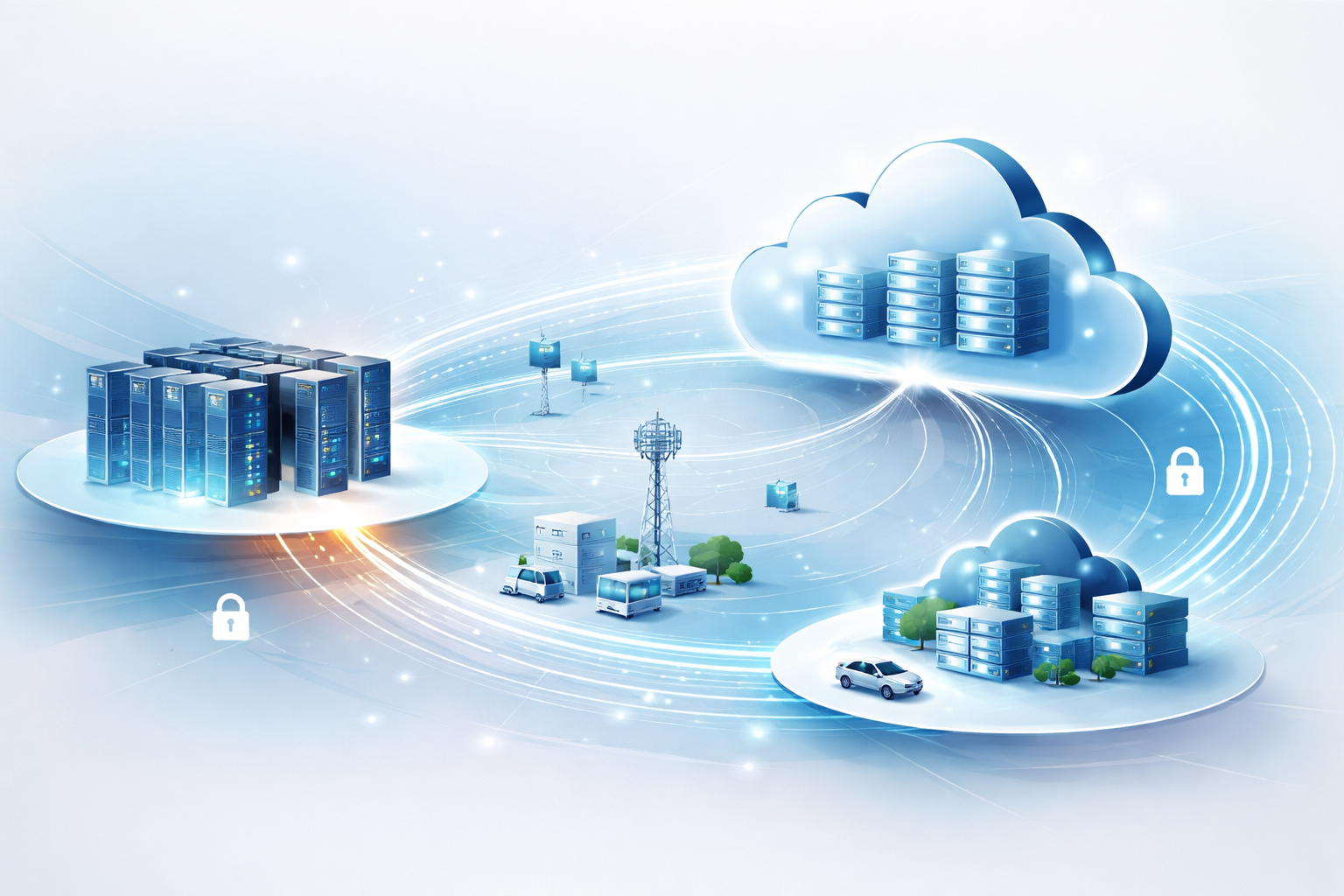
As AI workloads mature, hybrid cloud strategies are becoming a structural requirement rather than a design preference. Enterprises increasingly need to deploy models where data resides — on-premises, at the edge and in public cloud environments — to manage latency, comply with data sovereignty rules and control cost.
Most organizations also want flexibility in how they train, deploy and operate models across environments.
“They may not want to build a 100,000-GPU cluster, so they’ll choose to do some of the training in the cloud and bring the model back to owned infrastructure,” said theCUBE Research’s Rob Strechay. “Hybrid cloud is a must in that scenario.”
Recent enhancements to HPE OpsRamp Software and GreenLake composable infrastructure bring together telemetry from HPE Compute Ops Management, HPE Aruba Networking Central and HPE Juniper Networking Apstra to give IT operations teams a hybrid command center with a single point of control across their environment.
HPE is strategically positioned to accelerate this shift with a portfolio of AI factory solutions that streamline the entire training and deployment lifecycle. Its focus is on “delivering production-ready enterprise AI with the governance, security and scale organizations need to be able to jump over that gap” between pilot and production, said Robin Braun, HPE’s vice president of AI business development, in an interview on theCUBE.
Its strategic partner in this initiative is GPU market leader Nvidia Corp., whose technology anchors the Nvidia AI Computing by HPE portfolio. The partnership has delivered three core types of tailored AI factories:
What operational AI looks like in practice can be seen in places where scale, resource constraints and governance requirements intersect. Vail, Colorado, is a charming town of just 4,300 residents for much of the year, but during ski season, the population can surge sevenfold. Addressing the multiple logistical and public-safety challenges that growth presents requires automation so the town’s full-time municipal employees can focus on serving visitors.
Vail recently adopted an agentic smart city solution from Hewlett Packard Enterprise Inc. and its partners to handle its unusual capacity needs. A digital AI civic ambassador now answers residents’ and visitors’ questions by coordinating multiple agents to scour records. Agents have also taken on tedious bureaucratic tasks, such as reviewing over 1,000 handwritten deed restrictions for affordable housing.
Smart cameras scan the horizon for early signs of wildfires. AI coordinated an automatic inventory of the town website and document archive to ensure compliance with accessibility regulations. The entire AI platform runs on a data center powered largely by renewable energy, a critical factor in meeting sustainability initiatives.
Vail illustrates how hybrid cloud, scalable infrastructure and a vetted partner ecosystem can make production-grade AI achievable even in resource-constrained environments — a pattern increasingly visible across both public and private sectors.
Security and data governance are becoming defining challenges as AI systems ingest and reuse massive volumes of data. An HPE survey of 1,775 IT leaders found that 74% rated AI dataset security as a critical issue.
The importance of protecting sensitive data is amplified by the iterative nature of AI models, which ingest large volumes of data from multiple sources to achieve acceptable accuracy. In traditional applications, data is processed and then stored or discarded. In AI, though, training data can be implicitly embedded in model parameters and used repeatedly. Weak governance can cause models to replicate and spread bad information, even with a small amount of “poisoned” input data, skewing outcomes, introducing bias or creating unpredictable behavior.
Platforms such as HPE Private Cloud AI are designed for sovereign AI, ensuring data and model residency and audit capabilities are maintained behind a firewall. Confidential Computing practices with partners Nvidia, AMD, Intel and others encrypt data, models and operations. The ProLiant Gen12 portfolio embeds protection from silicon to software, supporting Silicon Root of Trust and quantum-resistant encryption algorithms.
“It’s not a matter of whether you need a more secure system,” said John Carter, vice president of server product, quality and technical pursuit at HPE, in an exclusive interview with theCUBE. “It’s a matter of when you’re going to need it.”
GPUs may get all the glory, but the foundation of robust AI infrastructure is networking and storage. As AI systems scale and become more autonomous, governance alone isn’t enough — the underlying infrastructure must also be designed for continuous performance and control.
Classic scale-up and scale-out architectures have now expanded to include a new paradigm called “scale-across” that spreads workloads across regions. “Together, they’re going to form the backbone of tomorrow’s distributed AI infrastructure,” said Bob Laliberte, principal analyst at theCUBE Research, in a recent podcast.
Solutions such as the HPE Juniper Networking QFX5250 switch ensure the fabric is optimized for performance, power efficiency and simplified operations.
“Customers need networks that are purpose-built for AI to handle the rapid growth of connected devices, complex environments and increasing security threats,” said Rami Rahim, executive vice president and general manager of networking at HPE, introducing new AIOps and observability capabilities in December.
Storage infrastructure needs to shift from its traditional passive role to an active data layer that enriches information in real time for AI pipelines. HPE’s Alletra Storage MP X10000 Data Intelligence Nodes do this by integrating Nvidia accelerated computing and the Nvidia AI Data Platform reference design directly into the data path to enrich unstructured data so AI agents can process and classify it.
Cloud platforms have demonstrated the value of ecosystems in enhancing customer value. Partners extend core functionality, protecting customer investments and strengthening a platform’s staying power. Ecosystems are emerging as an even more important factor in AI, where complexity complicates the task of integrating diverse software elements safely and reliably.
HPE’s Unleash AI partner program delivers production-ready enterprise AI with governance, security and scale. It’s anchored in a curated ecosystem of vetted independent software vendors in areas such as cybersecurity, orchestration and compliance.
The goal is to create an “easy button” for execution that helps customers move from AI experiments to tangible outcomes, said HPE’s Braun. “We can help our customers move from AI experiments to AI outcomes fast, safely and within their own firewalls,” she said.
For example, the town of Vail’s smart city solution uses agentic technology from Unleash AI partner Kamiwaza Corp. to analyze handwritten deed restrictions and overhaul the town website to comply with accessibility guidelines. Vail’s digital ambassador was developed by SHI International Corp., also an Unleash AI partner.
“The goal is to make generative AI adoption repeatable and predictable,” said Fidelma Russo, HPE’s chief technology officer and general manager of hybrid cloud. “With curated use cases and tested frameworks, we’re taking the guesswork out of AI.”
Enterprise AI is evolving beyond proofs-of-concept to production-grade systems. The structural shift from general-purpose data centers to AI factories demands a new infrastructure template. Through its deep co-engineering partnership with Nvidia and vetted partner network, HPE is delivering turnkey and composable AI factory solutions built on the full-stack architecture necessary for enterprises to confidently convert their AI ambitions into governed and scalable business outcomes.
(* Disclosure: TheCUBE is a paid media partner for HPE’s “Unleash AI Momentum” interview series. Neither HPE, the sponsor of theCUBE’s event coverage, nor other sponsors have editorial control over content on theCUBE or SiliconANGLE.)
Support our mission to keep content open and free by engaging with theCUBE community. Join theCUBE’s Alumni Trust Network, where technology leaders connect, share intelligence and create opportunities.
Founded by tech visionaries John Furrier and Dave Vellante, SiliconANGLE Media has built a dynamic ecosystem of industry-leading digital media brands that reach 15+ million elite tech professionals. Our new proprietary theCUBE AI Video Cloud is breaking ground in audience interaction, leveraging theCUBEai.com neural network to help technology companies make data-driven decisions and stay at the forefront of industry conversations.