 AI
AI
AI
AI

AI

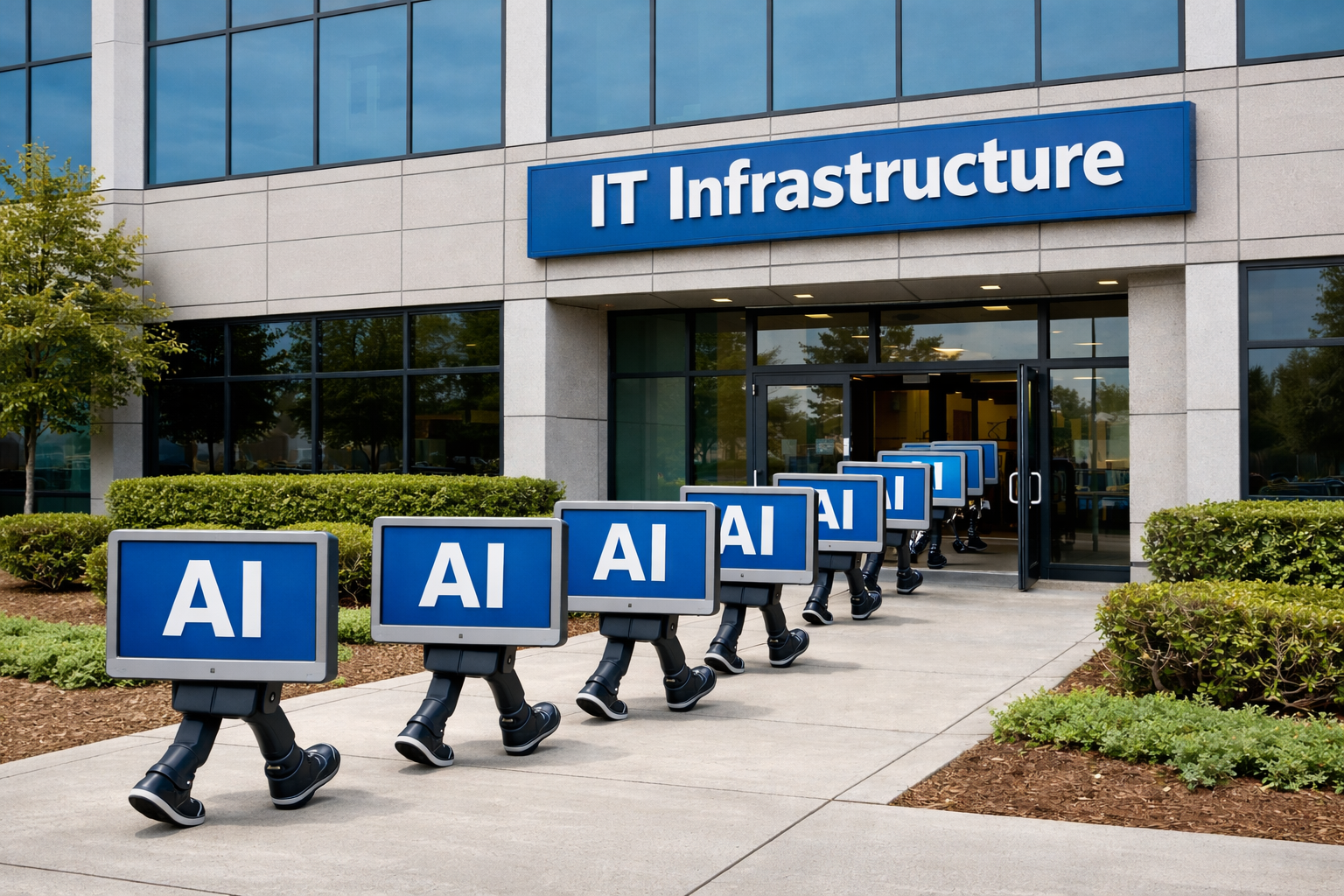
What happens when two of the world’s most valuable companies combine forces to make AI the new baseline for enterprise infrastructure?
We are about to find out, because Dell Technologies Inc. and Microsoft Corp. are moving beyond servers, storage and software and advancing a compelling narrative around infrastructure, data strategy and AI adoption. Throughout much of this year, and more recently at the Microsoft Ignite conference in November, both companies launched a series of initiatives designed to influence the way enterprises approach digital transformation. AI and data workloads are becoming first-class citizens in corporate IT strategy.
“Artificial intelligence is more than AI servers,” said Arthur Lewis, president of Infrastructure Solutions Group at Dell, in a recent interview with theCUBE, SiliconANGLE Media’s livestreaming studio. “It is a fundamental revolutionary technology that’s going to modernize how customers take advantage of their most valuable asset, which is their data. In order to do so, you have to have a fully integrated system, which includes the compute, the network, the storage and the software, a full-stack solution.”
This feature is part of SiliconANGLE Media’s ongoing exploration into AI innovation and the modern data stack. (* Disclosure below.)
A key ingredient in Dell’s vision for this emerging new infrastructure model is the AI Factory. The company launched its AI Factory concept in May 2024 by positioning it as “new IT infrastructure” to meet the specific demands of AI. As this concept has evolved, it has essentially become the “data center of the future,” according to Dave Vellante, chief analyst at theCUBE Research.
“An AI factory is a system, and that system is purpose-built for AI production,” Vellante explained. “The purpose of this is to transform raw data into versatile AI outputs, things like text, images, code and other forms of intelligence including tokens. And it’s doing so through automated processes that integrate data pipelines, model training, inference, deployment, ongoing monitoring and continuous improvement to produce intelligence at a massive scale.”
Enterprises are drawn to the AI Factory because its full operating model offers a path to move AI proof-of-concepts to scalable deployment without having to jump through time-consuming, costly hoops. By piecing together servers, storage and networking to drive AI, the Factory can remove complexity through high-performance training servers and scalable storage for large datasets.
“From theCUBE Research perspective, Dell’s AI Factory represents a meaningful shift by positioning AI as a full operating model rather than a collection of point solutions,” said Paul Nashawaty, principal analyst with theCUBE Research. “By combining infrastructure, data services, orchestration and professional services into a cohesive platform, Dell is directly addressing the friction that has kept enterprises stuck in perpetual experimentation rather than operational AI deployment.”
To more fully realize operational AI deployment, Dell implemented a public preview of PowerScale on Azure in November. Organizations are using PowerScale to build next-gen applications for AI, machine learning workloads and advanced analytics. With policy-based replication across Azure regions, customers can implement disaster recovery strategies and maintain resilience for lifecycle management on-premises or in the cloud.
“Customers are unlocking new possibilities by bringing their file data to Azure without compromise, combining the performance of Dell PowerScale with the scalability of the cloud,” said Rachna Lalwani, senior consultant, director and product manager at Dell, in conversation with theCUBE. “We have industries like media and entertainment, EDA, life sciences that depend on high-throughput and low-latency file access. PowerScale delivers that, and all of that managed through a familiar interface whether the data resides on-premises or in Azure.”
These industries are also leveraging general availability of Microsoft’s Sovereign Private Cloud enabled by Azure Local. What has made this an attractive solution is the ability to leverage security, compliance and consistent tooling provided in the public cloud, while maintaining control over data residency and operations.
“We are seeing tremendous demand and increasingly sophisticated use cases for Sovereign Private Cloud,” said Meena Gowdar, senior director of product management at Microsoft, during an appearance on theCUBE. “Organizations want public cloud capabilities, but with the guarantees around data residency, operational control and regulatory compliance. This is where Azure Local has become the foundation for that strategy. It’s how we deliver Azure innovation while respecting the boundaries and requirements that matter the most to our customer, whether those are driven by regulations or industry standards or even corporate policies.”
What will be the true impact of a unified Dell-Microsoft stack? A hint of what this could entail can be found in enterprise adoption of agentic AI.
The rearchitecting of IT for AI is motivated by the need to take complexity off the enterprise plate. Having to juggle multiple vendors, storage layers, networking, cloud services and AI tools is too much if organizations are going to focus on feeding agents valuable proprietary data for measurable results.
More importantly, the promise of AI hinges on its ability to generate a return on investment. Dell and Microsoft are building infrastructure for agents in the data layer to help companies realize this vision.
“The agent itself is just a software system, and it has a number of components … it has LLMs, it has knowledge graphs, it has protocols,” said John Roese, global chief technology officer and chief AI officer of Dell, in a December interview with theCUBE. “That data layer is not magic. It’s a real thing. You have to actually build it, you have to build an infrastructure that supports knowledge graphs and maintains them and can feed them, that also can do things like agentic.”
The goal for many enterprises today is to get to a place where information can be connected to desired behaviors using AI tools. This will require a structure that can process key intelligence using the right data. As Roese noted, companies that ignore this end state can find themselves in a losing battle between automation and human effort.
“We know a lot about infrastructure and, therefore, we’re creating the embodiment of that intelligence as an autonomous entity, called an agent, as part of our overall portfolio and offerings,” Roese said. “It is really the connection between your information, understanding what behaviors you want and using tools that are relatively straightforward to use today. The only thing that prevents you from using autonomous agents to scale your intelligence, your special skills, to a much larger population of customers and users is quite frankly being able to control your data and connect it into these systems and then start to express them into your market as part of your offering, and that’s exactly what we did.”
Before the AI wave washed over the IT world, enterprises were focused on the data mesh and the future of data lakes and data warehouses as exemplified by the competition between Databricks Inc. and Snowflake Inc.
That agenda has changed. AI and data workloads have become first-class citizens in corporate IT strategy, and this has transformed the customer model even for major tech providers such as Dell. New-generation AI-focused businesses, such as neoclouds and specialty AI processor firms, have added to this shift.
“We are starting to see different types of customers,” said Geeta Vaghela, strategy and planning for AI and technical computing at Dell, in an interview with theCUBE. “There’s enterprises who have been in data stewardship, security, looking at all these things for many years, and then you’ve got this new breed, the neoclouds, GPU service providers, Tier 2 cloud solution providers, and they’re quite different with what we’re finding with their thinking process.”
The strategic messaging behind Dell and Microsoft’s build-out of this next-gen infrastructure foreshadows a sea change in the enterprise IT market. The explosion of AI adoption has wrought profound change, in both the technologies employed and the messaging that accompanies them. The combined work of both companies on building a full-stack solution for AI could signal a major shift in how IT organizations build computing platforms.
“If the Dell–Microsoft approach continues to resonate with large enterprises, it could nudge the market toward a model of ‘infrastructure as an AI platform’ rather than ‘infrastructure plus AI tools,’” said theCUBE Research’s Nashawaty. “Such a shift would have lasting implications for procurement decisions, enterprise roadmaps and vendor positioning, rewarding those who can deliver operational AI outcomes at scale rather than isolated components.”
Dell and Microsoft, with their prominent positions in the enterprise technology world, have a prime seat to observe the significance of this transition. It is playing out in three major shifts, according to Vrashank Jain, director of product management at Dell.
“Number one, I’m seeing separate stacks moving to unified platforms,” Jain said. “I mean unified platforms with a choice of composability, but having a common control plane because enterprises don’t want one system for analytics, another for AI and another for applications. Number two, I would say data access is really shifting to intelligent orchestration. The third big shift is infrastructure to maybe more management, meaning data platforms are not just meant to manage storage and queries.”
In this model, the data platform functions as the control plane for enterprise intelligence, bringing human judgment and AI-driven systems together within a single, trusted foundation.
(* Disclosure: TheCUBE is a paid media partner for Microsoft Ignite. Sponsors of theCUBE’s event coverage do not have editorial control over content on theCUBE or SiliconANGLE.)
Support our mission to keep content open and free by engaging with theCUBE community. Join theCUBE’s Alumni Trust Network, where technology leaders connect, share intelligence and create opportunities.
Founded by tech visionaries John Furrier and Dave Vellante, SiliconANGLE Media has built a dynamic ecosystem of industry-leading digital media brands that reach 15+ million elite tech professionals. Our new proprietary theCUBE AI Video Cloud is breaking ground in audience interaction, leveraging theCUBEai.com neural network to help technology companies make data-driven decisions and stay at the forefront of industry conversations.