


 EMERGING TECH
EMERGING TECH
EMERGING TECH
EMERGING TECH

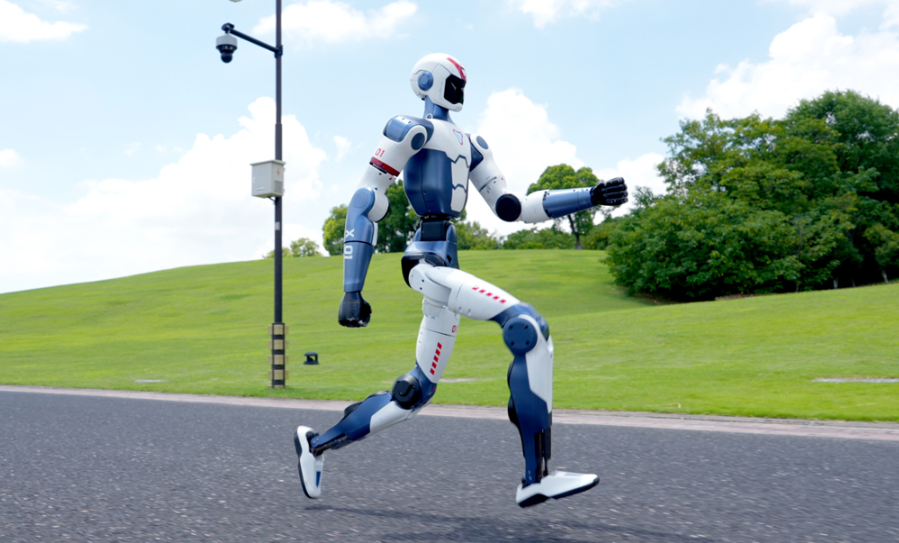
China is trying to address a key bottleneck in its national push for embodied artificial intelligence by employing human laborers to train humanoid robots.
Local governments have reportedly established dozens of “robot training centers” as part of a concerted effort to generate much-needed movement data for autonomous humanoid machines.
In an exclusive report, Rest of World paints a rather bleak picture of what goes on inside these facilities, including one that’s operated by a Shanghai-based robotics startup. The company reportedly employs hundreds of young workers as “cyber-laborers,” who spend their days wearing virtual reality headsets and exoskeletons while engaging in repetitive tasks such as folding clothes, opening and closing the door of a microwave and stacking blocks, hundreds of times. These movements are captured in granular detail and compiled into movement data sets that can then be used to train humanoid robots to perform household chores and manual labor.
“We call ourselves cyber-laborers,” said one employee, a 20-year-old computer science major who works at the facility part-time. “It’s a fine gig, though it’s a bit boring.”
China has identified “embodied intelligence,” which refers to AI manifested in physical form, as a key national priority, sparking an investment boom that has seen dozens of robotics startups emerge in the last few years. Many of these companies believe that by scaling up data collection, they’ll be able to unlock the full potential of autonomous robots, similar to how massive datasets fueled the success of AI chatbots.
But the challenge is that there isn’t enough robotics data to go around, because robots are much more difficult to train than large language models. They require extremely complex datasets, including visual information, joint motion and rotation data, and this information cannot just be scraped from the internet.
The solution is state-funded training centers, and Rest of World says that more than 40 of them have sprung up across the country over the last year, with about two dozen of them considered to be fully operational.
The facilities are typically huge, with one of the largest in Beijing spanning more than 10,000 square meters. There, hundreds of cyber laborers are employed to train robots how to perform 16 specific tasks, including operating machinery at car assembly lines and elderly-care. Meanwhile, at a second facility in Hubei, one company has tasked around 100 employees with teaching robots how to complete chores such as ironing shirts and cleaning up and wiping down tables.
What’s unusual about these facilities is the level of government support they’ve received, in direct contrast to the venture capital-driven robotics industry taking shape in the U.S. Aside from building training centers, local governments have also established dedicated funds for embodied AI, offering startups and entrepreneurs subsidies for cloud computing resources and access to specialized university courses. The model is inspired by China’s previous success in growing its electric vehicle industry through state-directed support, Rest of World said.
Some U.S. companies, notably Tesla Inc., have also recruited humans to generate data for robotic training, but those initiatives are far smaller in scale.
Ken Goldberg, a robotics researcher at the University of California, said China’s approach is intriguing, but he questioned how successful it will be given the “inherent slowness” of creating training data through manual effort. “Even if you have hundreds of people working, it’s going to take time to get enough data,” he said. He added that China is also exploring alternative methods, such as digital simulations to generate synthetic data and on-the-job data collection.
China’s enthusiasm for robotics is understandable given the potential impact of embodied AI in future. According to one estimate from Goldman Sachs, the worldwide market for humanoid robots could grow to more than $38 billion by 2025. It’s thought that China is now home to more than 150 startups developing humanoid robots, including unicorns such as AgiBo Innovation Technology Co. Ltd., Unitree Robotics Co. Ltd. and Galaxy General Robot Co., also known as Galbot.
Support our mission to keep content open and free by engaging with theCUBE community. Join theCUBE’s Alumni Trust Network, where technology leaders connect, share intelligence and create opportunities.
Founded by tech visionaries John Furrier and Dave Vellante, SiliconANGLE Media has built a dynamic ecosystem of industry-leading digital media brands that reach 15+ million elite tech professionals. Our new proprietary theCUBE AI Video Cloud is breaking ground in audience interaction, leveraging theCUBEai.com neural network to help technology companies make data-driven decisions and stay at the forefront of industry conversations.