

 AI
AI
AI
AI
AI

Cisco Systems Inc. has long been regarded as the market leader in networking, but over the past few years, the company has strived to position itself as “critical infrastructure for the artificial intelligence era.” It now seems to be making headway with that as the stock hits an all-time high.
This week at Cisco Live EMEA, in Amsterdam, Cisco delivered another payload of innovation targeted at helping customers move their AI from the “chatbot phase,” and jump into the agentic era. Agentic AI will create a marked improvement in productivity as it goes far beyond humans asking AI questions but enables autonomous agents to perform complex tasks, reason through workflows, and interact with enterprise data at large scale.
Though the vision of agentic AI paints a rosy future, it’s important to note that traditional infrastructure wasn’t cut out for the rigors of AI and most companies will be looking to do the most significant technology refresh since the early days of the internet. Cisco has been methodically upgrading its portfolio to meet these new demands. Here are the five most significant announcements from Cisco Live EMEA:
The lead product item was the debut of the Cisco Silicon One G300. This switching silicon capable of a massive 102.4 Tbps of bandwidth, optimized for scaling out networks. As AI clusters scale toward “gigawatt-scale,” the network often becomes the bottleneck. The G300 tackles this with Intelligent Collective Networking, which provides 2.5 times better burst absorption than other alternatives.
For AI, the ability to handle bursts of traffic is critical to ensure data is delivered to the AI systems consistently and reliably, even over long distance. The Intelligent Collective Networking uses a combination of network features including shared packet buffering, path-based load balancing and network telemetry to improve performance.
In real-world terms, Cisco claims the new silicon can deliver 33% increased network utilization and a 28% reduction in job completion time when compared to non-optimized path selection, which would lead to more tokens generated at a lower cost. Based on my familiarity with off-the-shelf Ethernet, these claims seem reasonable, if not a bit conservative.
Perhaps the most ambitious shift for Cisco is the expansion of AgenticOps. Cisco is moving from AI that merely observes to AI that reasons, decides, and acts. This isn’t just one tool; it’s a suite of autonomous capabilities integrated across networking, security and observability.
Key innovations include:
The concept of a “self-driving network” is something that the industry has bandied about for years, but historically IT pros have been cool on the idea. Over the past year, I’ve noticed a significant change in attitude as engineers are now starting to understand that AI is here to be a tool and allows them to work faster and smarter. I expect Cisco to continue to add more and more agentic capabilities while road mapping to fully autonomous somewhere in the next 24 to 36 months.
As agents become more autonomous, the security risks become more “semantically complex.” To address this, Cisco launched the biggest update to its AI Defense solution since it was initially announced. The highlight with this release is the AI Bill of Materials, which provides visibility into AI software assets and third-party dependencies. This is significant because it shifts security from tracking code to tracking “intent,” providing the visibility needed to manage the unique risks of autonomous agents. By documenting models and data dependencies, it allows enterprises to secure the AI supply chain against semantic threats that traditional firewalls simply can’t see.
Furthermore, Cisco is introducing Advanced Algorithmic Red Teaming. Unlike traditional security that looks for a single “bad” prompt, this uses adaptive multi-turn testing to see how an agent behaves over a long conversation. It’s designed to stop “poisoned tools” or prompts that try to hijack an agent’s authority.
At Cisco’s AI Summit, Amazon Web Services Inc. Chief Executive Matt Garman offered an analogy which highlighted the importance of guardrails. He explained that if one puts a board across a canyon, that person would crawl or walk very slowly across. That same board with handrails allows you to run. AI Defense gives companies confidence that their AI is doing what it should do and enables them to adopt it much faster.
In an industry-first move, Cisco announced full-stack PQC protections within its new IOS XE 26 operating system. This is a “harvest now, decrypt later” defense strategy.
As AI workflows increasingly involve long-lived, sensitive data, the threat of future quantum computers cracking today’s encryption is real. Cisco is embedding PQC across its new 8000 Series Secure Routers and C9000 Smart Switches, aligning with evolving global regulatory guidance and ensuring that data remains encrypted even in the quantum age.
This should have appeal with regulated industries, governments or any organization where the time value of their data is several years. The timeline around quantum is still uncertain but it’s good Cisco offers some protection today in for when it arrives.
To simplify the sheer complexity of these new technologies, Cisco is unifying its data center strategy under Nexus One. This is an integrated solution that brings together silicon, systems (such as the new N9000), optics and software under a single operating model.
A notable feature is the Native Splunk Platform Integration, expected in March, which allows customers to analyze network telemetry directly where it resides. This is critical for sovereign cloud deployments where data locality and compliance are paramount. Essentially, Cisco is giving enterprises a “single pane of glass” to manage everything from traditional workloads to massive AI training clusters.
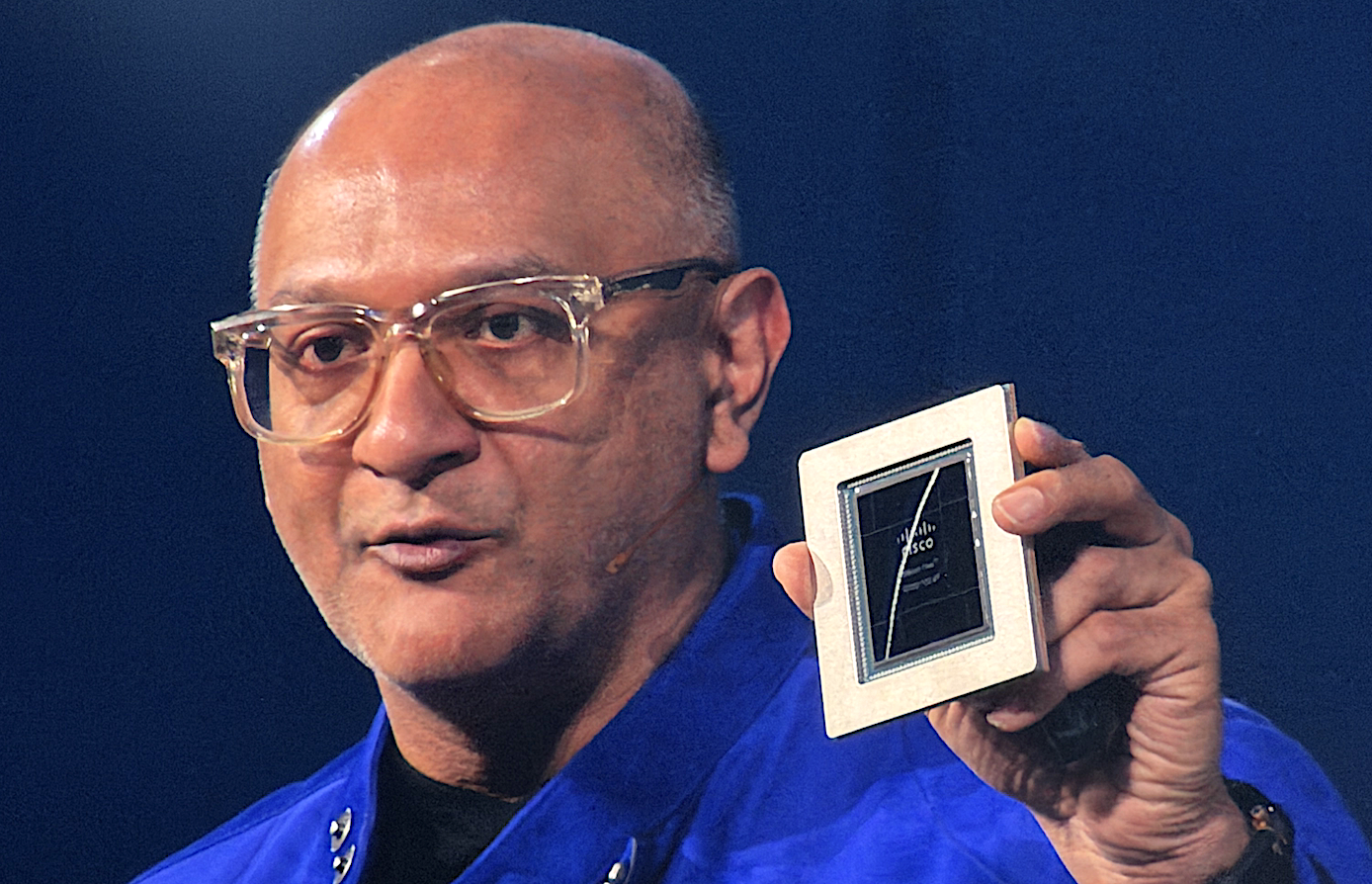
During his Q&A with analysts, President and Chief Product Officer Jeetu Patel (pictured) talked about Cisco’s evolution to a platform or systems company. This is a good example, as Cisco historically had good technology but much of it was deployed in silos. Since Patel took over product, Cisco has been much more focused on delivering value at “Cisco” level rather than individual products.
Coming out of Cisco Live EMEA 2026 this week and AI Summit last week, it’s easy to see that the era of AI as a feature is coming to an end. We have entered the era of AI as the infrastructure.
By combining massive 100T silicon with autonomous “AgenticOps” and post-quantum security, Cisco is betting that the winner of the AI race won’t just be the company with the best model, but the company with the most resilient, secure and automated network to run it on. When ChatGPT burst on the scene, few thought of Cisco as an AI company, but it has delivered products consistently to help its customers move from AI vision to reality.
Zeus Kerravala is a principal analyst at ZK Research, a division of Kerravala Consulting. He wrote this article for SiliconANGLE.
Support our mission to keep content open and free by engaging with theCUBE community. Join theCUBE’s Alumni Trust Network, where technology leaders connect, share intelligence and create opportunities.
Founded by tech visionaries John Furrier and Dave Vellante, SiliconANGLE Media has built a dynamic ecosystem of industry-leading digital media brands that reach 15+ million elite tech professionals. Our new proprietary theCUBE AI Video Cloud is breaking ground in audience interaction, leveraging theCUBEai.com neural network to help technology companies make data-driven decisions and stay at the forefront of industry conversations.