








 AI
AI
AI
AI
AI

Nvidia Corp. announced today that it’s partnering with global robotics leaders, including robot “brains” developers, industrial humanoid makers and others to advance the production-scale of physical AI, the technology that bridges the gap between the digital and the real world.
The company also unveiled new frameworks within Isaac for robotic simulation, Cosmos for world generation and the GR00T foundation AI model providing intelligence to humanoid robots at its GTC conference running this week in San Jose.
“Physical AI has arrived — every industrial company will become a robotics company,” said Nvidia founder and Chief Executive Jensen Huang.
The company said industry leaders are already building on its platform, including ABB Robotics, AGIBOT, Agility, FANUC, Franka Robotics, Figure, Hexagon Robotics, KUKA, Skild AI, Universal Robots, World Labs and YASKAWA.
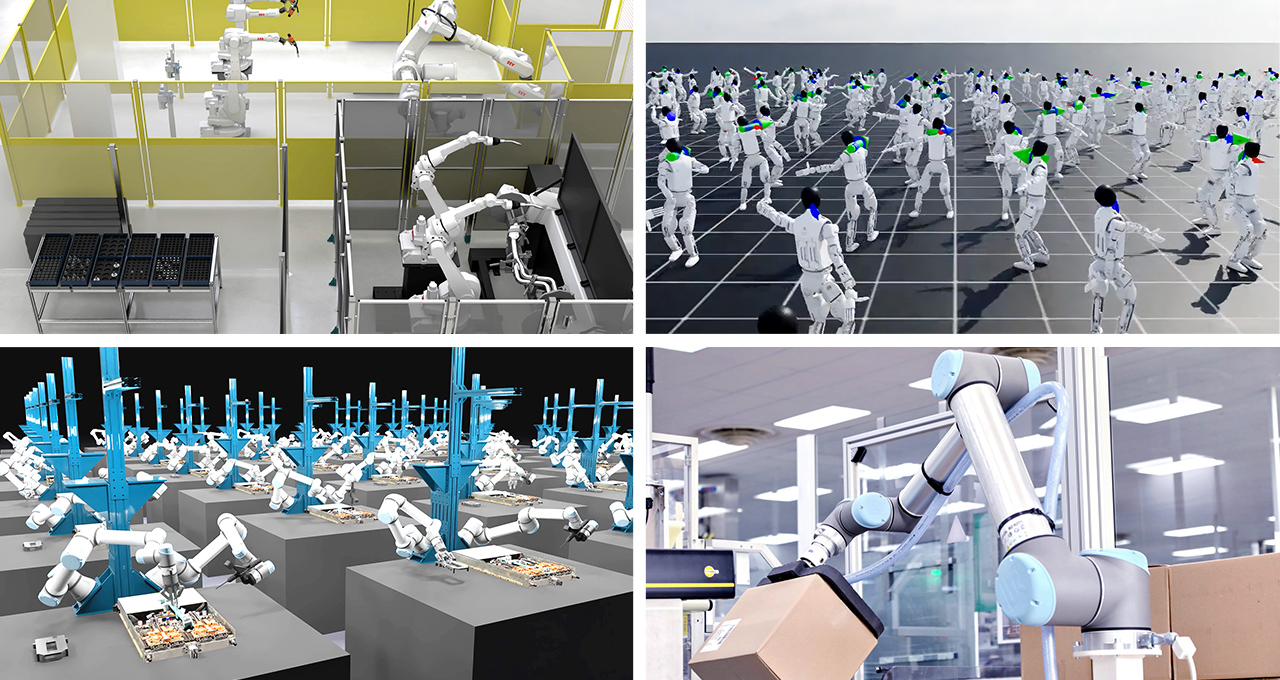
Nvidia noted that industrial robotics is at the cusp of becoming more AI-driven. The effects of physical AI and enhancements to robotics automation have been clearly seen in the past few years. This evolution means that manufacturing lines need physically accurate, high-fidelity simulation to design, test and optimize systems before deployment.
Globally, there is an install base of robots exceeding 2 million. Nvidia said its Omniverse libraries, which provide high-precision world simulation, and Issac robotics frameworks are already being implemented by FANUC, ABB Robotics and YASKAWA as solutions to validate complex robot AI applications along industrial production lines.
Most industrial robots are arms, loaders and movers, but the public is currently being wowed by robots that can walk. The humanoid variant “feels” good, but they’re less common in the industrial landscape because of their experimental and pilot nature. They tend to have a greater promise for working alongside people naturally, because they look and act similarly to humans.
To address the challenge of bringing more humanoid robots to industry and everyday life, Nvidia introduced Isaac Lab 3.0 today in early access. It allows faster, large-scale robot learning using its platform. To achieve this, the new version builds in a new Newton physics engine and the company’s PhysX software development kit to simulate the real world.
The company also previewed the next generation GR00T N2, a robot foundation model that will serve as the “brain” for future humanoid robots. Built on a new world action model architecture, the model will help robots succeed at new tasks, in unseen environments, more than twice as often as leading action vision models. The company said it intends to launch the new model by the end of the year. GR00T N2 currently ranks No. 1 on MolmoSpaces and RoboArena for generalist robot policies.
Up until this point, much of the discussion of physical AI has been about the industrial setting or the domestic: how robots will affect the day-to-day lives of people. For years, robots have been used in healthcare to reduce errors, increase precision and increase safety.
Now, Nvidia is bringing domain-specific physical AI models to healthcare robotics for surgical assistance alongside leaders and innovators in healthcare.
Robotics makers, including CMR Surgical, Johnson & Johnson MedTech, Moon Surgical and Rob Surgical, are adopting the company’s healthcare-specific physical AI tools to build their own robotic models and toolsets. These include synthetic data generation, robotic policy evaluation and digital twins.
PeritasAI, a company developing surgical robotics in a humanoid form factor that can see and act, is integrating Nvidia’s technologies into a physical AI platform that can coordinate in real-time.
Among the tools Nvidia announced at GTC this year include Open-H, the world’s largest healthcare robotics dataset; Cosmos-H, an open model family including a surgical model based on the company’s world foundation model Cosmos, for physics-based data generation; and GR00T-H, a vision language action model that processes text commands describing clinical tasks and generates motion commands.
Finally, a developer blueprint called Rheo, which is available within the Isaac for Healthcare framework for AI healthcare robotics, lets developers create physically accurate simulations of hospitals. It can be used to safely develop and test automations by simulating medical device interactions, human movements and other hospital logistics.
Support our mission to keep content open and free by engaging with theCUBE community. Join theCUBE’s Alumni Trust Network, where technology leaders connect, share intelligence and create opportunities.
Founded by tech visionaries John Furrier and Dave Vellante, SiliconANGLE Media has built a dynamic ecosystem of industry-leading digital media brands that reach 15+ million elite tech professionals. Our new proprietary theCUBE AI Video Cloud is breaking ground in audience interaction, leveraging theCUBEai.com neural network to help technology companies make data-driven decisions and stay at the forefront of industry conversations.