 INFRA
INFRA
INFRA
INFRA





INFRA

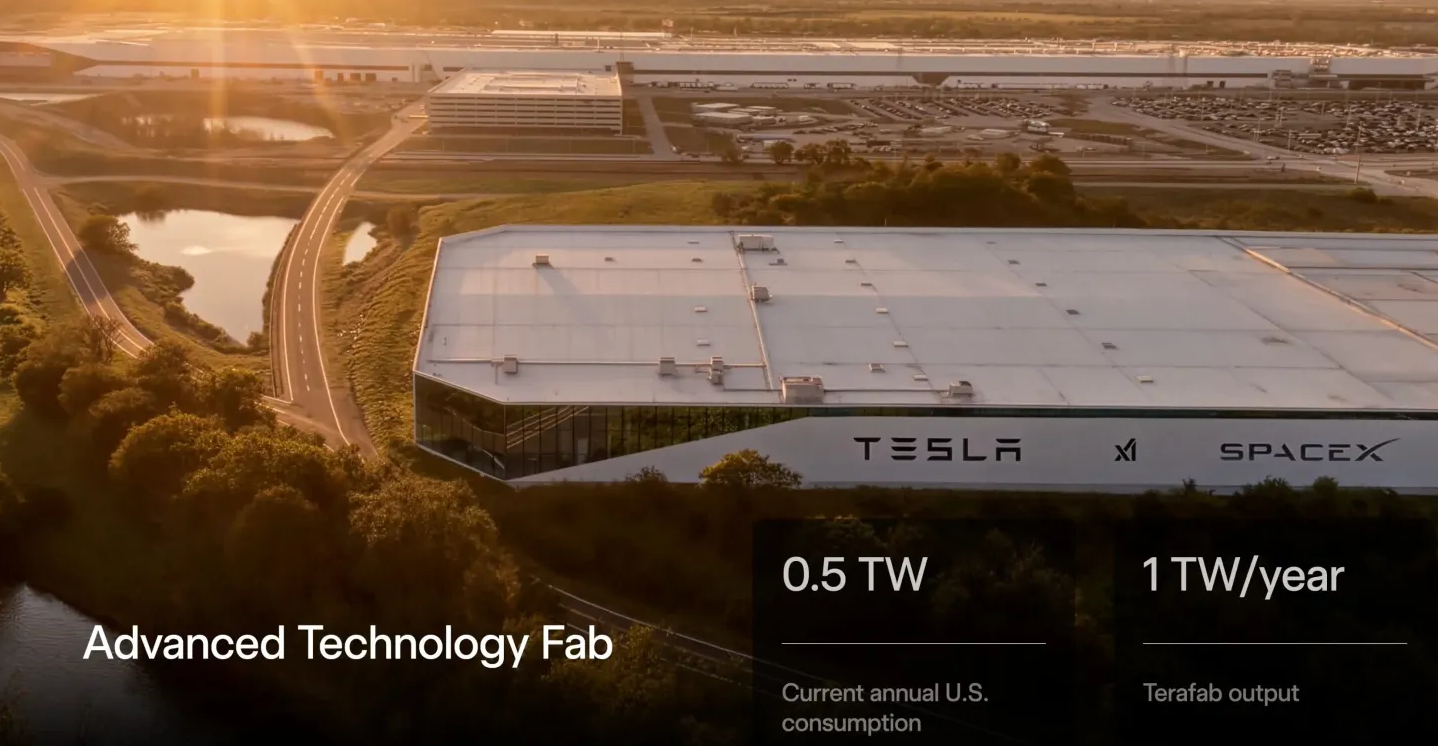
Billionaire technology entrepreneur Elon Musk announced Saturday that his companies will collaborate on a new, $25 billion chip fabrication plant called “Terafab” that aims to manufacture up to 1 terawatt of computing power annually.
When it comes online, it will be the largest semiconductor fab ever built, by an incredibly wide margin. Musk announced Terafab at a special event at the defunct Seaholm Power Plant in Austin, where he said the project will be “the most epic chip building exercise in history by far.”
Terafab is officially a joint venture of Musk’s companies Tesla Inc., SpaceX Corp. and xAI Corp. The facility, which will be located at Gigafactory Texas in Travis County, Texas, near Austin, will consolidate every stage of the semiconductor manufacturing process under one roof, including chip design, lithography, fabrication, memory production, advanced packaging and testing, Musk said.
The factory will manufacture two-nanometer chips, which is the most advanced process node currently in commercial production. At present, only one company, Taiwan Semiconductor Manufacturing Co., is capable of producing two-nanometer chips, having spent decades and hundreds of billions of dollars to achieve that capability.
Musk also announced some staggering production targets for Terafab. He said it’s designed to start manufacturing 100,000 wafers per month, but will ultimately scale up to 1 million per month when it reaches full capacity. It’s an extremely ambitious number that would amount to 70% of TSMC’s current global output – all from a single facility operated by three companies that have never fabricated chips before.
The factory will eventually be capable of producing between 100 billion and 200 billion custom artificial intelligence memory chips per year, Musk promises. The chips will be used to power Tesla’s self-driving cars, its Cybercab robotaxis, the Optimus humanoid robots and data centers for xAI’s Grok. Millions of Optimus robots will help to build and run the Terafab facility, he added.
Announcing TERAFAB: the next step towards becoming a galactic civilization https://t.co/IDKey07mJa
— Tesla (@Tesla) March 22, 2026
The world’s richest man said his companies need Terafab to fulfill his vision of a world that’s populated by billions of robots, where interplanetary travel is commonplace. “We want to be a civilization that expands to the galaxy with spaceships, that anyone can go anywhere they want at any time,” he said. “And have a city on the moon, cities on Mars, populate the solar system and send spaceships to other star systems.”
To create that civilization, Musk said, his companies will need “more chips than all the chip manufacturers in the world combined can provide today.”
The Terafab facility will initially make two categories of chips: inference chips that will be used to power Tesla’s cars and Optimus robots, and D3 chips that are custom-designed to power orbital AI satellites. Musk is keen to accelerate the delivery of his next generation A15 inference chips, which are slated to enter volume production in 2027, as well as the A16 chips currently in development.
TERAFAB: the next step to becoming a galactic civilization
Together with @SpaceX & @xAI, we’re building the largest chip manufacturing facility ever (1TW/year) – combining logic, memory & advanced packaging under one roof.
To harness as much power as possible from the Sun, we… https://t.co/QYfGR8XsJx
— Tesla (@Tesla) March 22, 2026
Considering that neither Tesla, SpaceX or xAI have ever designed and manufactured chips before, the Terafab project is right up there alongside the most challenging projects Musk has ever taken on, said Constellation Research analyst Holger Mueller. But he believes that if there’s one person you should never bet against pulling off something of this ambition and scale, it would be the legendary tech entrepreneur.
“Musk has never been shy about announcing audacious goals and making good on his promises, and vertical integration of the AI chips he needs for all of his major companies is about as big as it gets,” Mueller said. “Starting with an advanced 2nm facility will be no easy task, but Musk is better placed than most beginners to pull it off.”
Mueller said Musk has a unique track record of achieving the impossible. For instance, he only launched his startup xAI in July 2023, some eight or nine months into the AI boom, but its foundational model Grok has already caught up with the best that OpenAI can offer, the analyst said. He also built xAI’s extensive network of data centers in record-breaking time, and no one really knows how he pulled it off. That’s why Mueller believes AI chipmakers like Nvidia Corp., Advanced Micro Devices Inc., Intel Corp. and Qualcomm Inc. will all be watching nervously to see how this venture progresses.
“If Musk can deliver on this project, it will be really bad news for AI chipmakers,” the analyst said. “Not just because they’ll lose a big customer, but because it will encourage other top tech titans to do the same thing. On an economic level, success would be welcomed by the U.S. government because it would mean a lot of semiconductor manufacturing gets done at home, which is a key goal of the Trump administration. Another key question is if Musk intends for Terafab to only make chips for his own companies or if he will consider selling them on the open market.”
To begin with, much of Terafab’s capacity will be directed at Musk’s space computing vision. He said he wants 80% of its total output to be dedicated to building chips for orbital AI satellites, with just 20% to be used here on Earth. He argues that solar irradiance in space is about five-times greater in orbit than it is on Earth’s surface, which should make space-based data centers much cheaper to run. In addition, heat rejection means thermal scaling is viable. That’s why Musk argues that orbital AI compute could become cheaper than terrestrial data centers within just three years.
Tesla Chief Financial Officer Vaibhav Taneja said at the event that he estimates Terafab will cost between $20 billion and $25 billion to construct, and this amount has not yet been incorporated into the company’s capital expenditures plan for fiscal 2026, which already exceeds $20 billion.
No timeline was given for the project, so it’s not clear when its first chips will go into production.