



 EMERGING TECH
EMERGING TECH
EMERGING TECH
EMERGING TECH

Tel Aviv-based quantum computing startup Q-Factor announced itself to the world today after closing on a $24 million seed funding round.
The company’s mission is to develop a neutral atom-based quantum computer that can scale to one million qubits and beyond. Today’s oversubscribed round was led by NFX and TPY Capital, and saw participation from Intel Capital, Korea Investment Partners, Deep33 and the Matias family. Funds were also provided by the Israel Innovation Authority via a grant, as well as Technion Israel Institute of Technology and the Weizmann Institute of Science.
Q-Factor is going after the problem of scaling “qubits,” which are the fundamental units of computing in quantum machines. Quantum computers have supposedly been on the horizon for years, promising to revolutionize areas such as drug discovery, weather forecasting and financial modeling, but the industry’s progress has been almost glacial. At present, the most powerful quantum computers in operation today only have a few hundred or thousand qubits, yet they will need to scale to millions to become truly useful.
To get past this scaling “wall,” Q-Factor is betting on an approach called neutral atoms, where individual atoms are trapped and manipulated by laser beams, often referred to as “optical tweezers.” It’s very different from the methods used by quantum pioneers such as IBM Corp. and Google LLC, which rely on superconducting qubits that must be kept at temperatures close to absolute zero and require extremely expensive cryogenic infrastructure. It’s also different from the “trapped ions” technique used by IonQ Inc., which struggles with overwhelmingly complex wiring bottlenecks.
In contrast, neutral atoms are naturally inert, which means they’re extremely stable and can hold their “states” for long periods of time. Q-Factor isn’t the only company looking at neutral atoms, but even these systems have struggled to scale past a few hundred qubits.
Existing neutral atom systems are constrained by architectural bottlenecks that make it almost impossible to manage the required volume of atoms and lasers for large-scale computing. But Q-Factor’s founders believe they have found a way to overcome these problems. By drawing on decades of research into Rydberg physics and ultracold atoms, they have designed a system that they claim will be able to scale effortlessly.
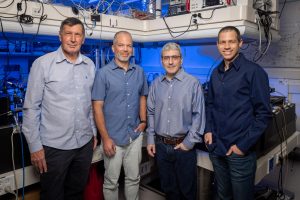
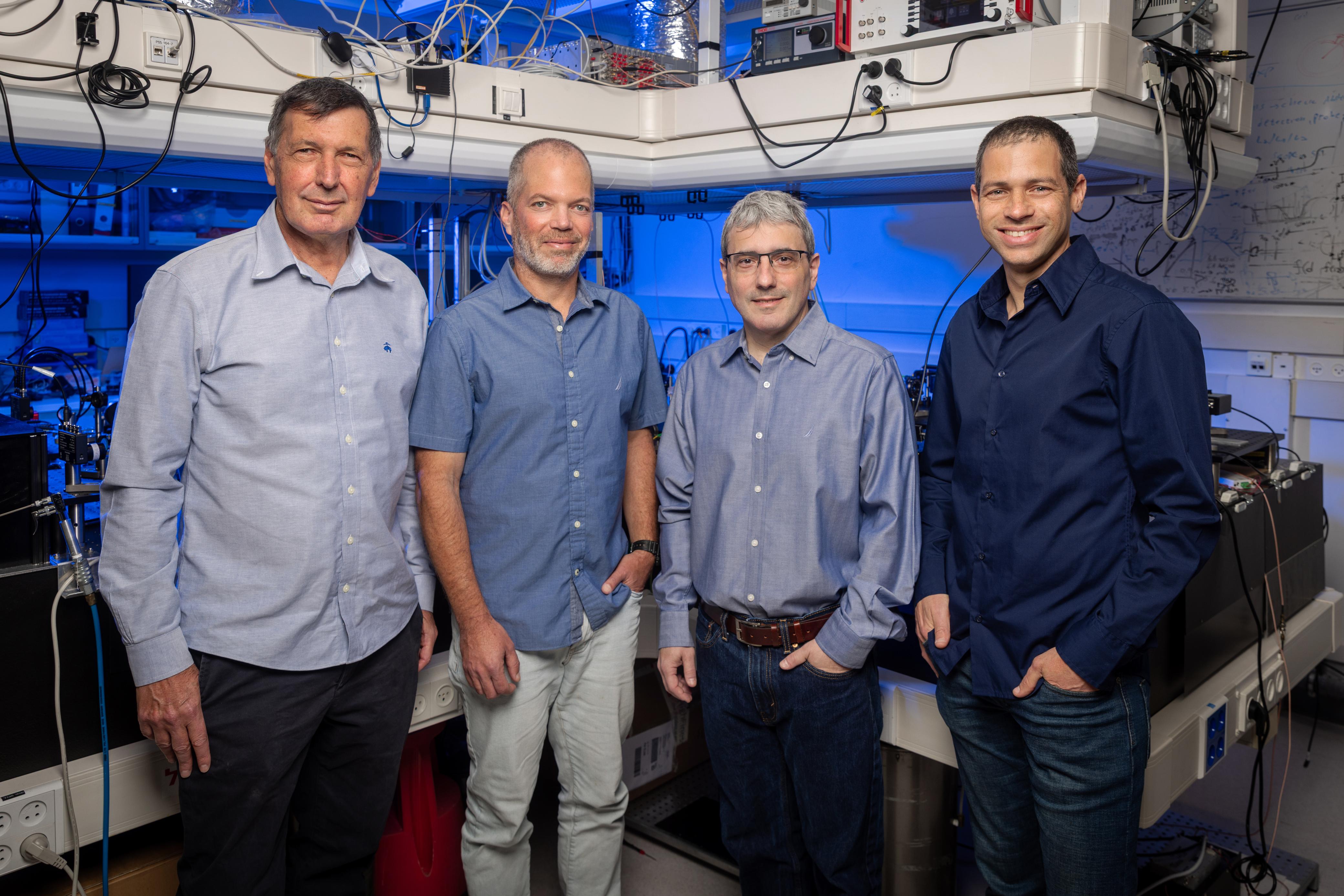
Co-founder and Chief Executive Guy Raz (pictured, second from right) said scaling neutral atom-based systems is challenging because of the difficulty in maintaining precise control of the individual qubits as the size of the processor grows. At larger scales, the optics, calibration, readouts and resources needed for keeping everything stable becomes extremely demanding, and the architecture for doing all of this simply doesn’t exist, he explained.
Raz said he’s not yet able to disclose the details of the company’s approach, but said it’s focused on scaling neutral atoms at the architectural level. “Instead of incrementally extending today’s small-scale designs and relying on quantum interconnects, we are building a neutral-atom architecture that’s intended for much larger systems from day one,” he said. “We believe this is what’s required to move from laboratory demonstrations to truly large-scale and useful quantum machines.”
One of the key challenges in maintaining quantum stability is noise and “crosstalk,” or the risk of individual qubits interfering with one another, and Q-Factor has paid special attention to these issues from the outset, Raz added. “Efficient quantum error correction is an integral part of that design,” he said. “We cannot yet share the detailed implementation, but the essence is that we are addressing scaling at the architectural level so the system can grow without losing control, fidelity or practicality.”
Q-Factor’s next step is to build on its lab research and create a functional, large-scale prototype of its new quantum computing architecture. The backing of Intel Capital could be significant, as the company possesses the expertise in manufacturing and scaling experimental hardware.
The question is whether Q-Factor will finally deliver the so-called “quantum advantage,” which is the point at which quantum machines reach the scale that allows them to surpass the capabilities of classical computers. The likes of IBM, Google, IonQ and many others have struggled for years to achieve this goal, so far without success.
Q-Factor will likely be hard pressed to go any further, but it has a few things in its favor. For one thing, neutral atoms are recognized as one of the most promising approaches to achieving higher qubit counts, because they’re less complex than other systems.
Moreover, its founders are considered to be among the world’s foremost authorities in atomic physics. For instance, Raz is a physicist with 20 years of experience in growing deep tech startups. Chief Scientist Ofer Firstenberg (right) is a professor at the Weizmann Institute and an expert in quantum optics and Rydberg atoms, while, Nir Davidson (left) is considered to be one of the world’s leading experts in ultracold atoms, having published more than 280 peer reviewed papers on the topic. Finally, Yoav Sagi (second from left), a professor at Technion, is an expert in neutral-atom manipulation.
Lisa Cohen of Intel Capital said Q-Factor’s founding team has a “clear-eyed understanding” of what’s required to build a commercially viable quantum computer based on neutral atoms. “They’ve watched the field evolve, learned from the challenges others have encountered, and assembled the right expertise to tackle the hardest remaining problem in quantum computing: scale,” she said.
Support our mission to keep content open and free by engaging with theCUBE community. Join theCUBE’s Alumni Trust Network, where technology leaders connect, share intelligence and create opportunities.
Founded by tech visionaries John Furrier and Dave Vellante, SiliconANGLE Media has built a dynamic ecosystem of industry-leading digital media brands that reach 15+ million elite tech professionals. Our new proprietary theCUBE AI Video Cloud is breaking ground in audience interaction, leveraging theCUBEai.com neural network to help technology companies make data-driven decisions and stay at the forefront of industry conversations.