







 INFRA
INFRA
INFRA
INFRA

INFRA

Shared reality is collapsing the gap between digital content and physical experience. The shift is moving beyond traditional streaming toward systems built for real-time capture, processing and immersion at scale.
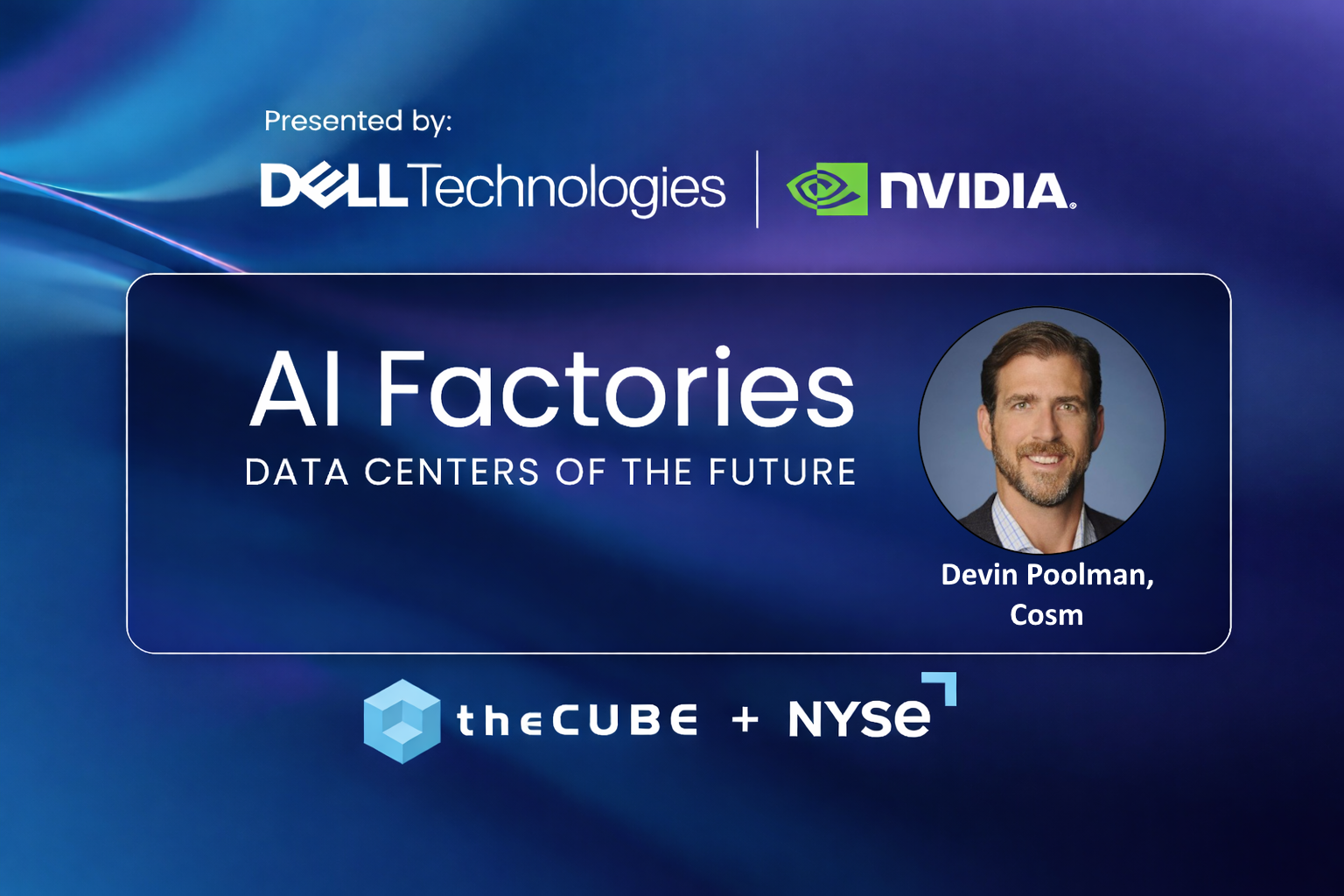
Immersive media company Cosm Inc. is blending high-resolution video, GPU-driven rendering and venue-scale environments to make digital events feel physical and shared. Cosm is relying on Dell Technologies Inc. for core infrastructure and Nvidia Corp. for the compute power behind it — the same kind of GPU-rich systems now defining AI factories, according to Devin Poolman (pictured), chief product and technology officer of Cosm.
“You feel like you’re there — that’s the best way to describe it,” Poolman said. “I could tell you how great it is, but when you get there, you’re still going to be blown away. It’s like walking into the game. You’re buying a ticket, you’re coming to the game and you’re coming to the match. That sort of experience is really what Cosm is all about.”
Poolman spoke with theCUBE’s Gemma Allen for theCUBE + NYSE Wired: AI Factories – Data Centers of the Future interview series, during an exclusive broadcast on theCUBE, SiliconANGLE Media’s livestreaming studio. They discussed how Cosm uses Dell and Nvidia-powered infrastructure to deliver immersive, shared live experiences.
Delivering shared reality requires a fundamentally different architecture than traditional broadcast systems. Instead of optimizing for reach, the focus shifts to resolution, latency and synchronization across physical environments. Cosm’s model, appropriately called Shared Reality, highlights how capturing, processing and rendering immersive media at scale requires a tightly integrated pipeline built for performance from the ground up, Poolman explained.
“Our team is traveling around on the ground. It’s our own production kits. It’s our own cameras,” he said. “These are incredible cameras; they’re eight and 10.5K resolutions. [It’s] way more resolution than what you’re used to on your television broadcast … you’re seeing completely around you. That is a unique video stream that comes and is produced for our venues, and then we layer in the TV feed. While you feel like you’re sitting there baseline at the basketball game, you actually have the TV broadcast feed and all the storytelling as part of that experience.”
That data-intensive capture feeds directly into a GPU-heavy processing layer where Dell infrastructure and Nvidia GPUs handle the load across production, cloud and venue environments. The experience depends on moving and rendering massive video streams in real time, far beyond the requirements of traditional media delivery, Poolman noted.
“Dell is our hardware partner,” he said. “Really the infrastructure for what we do with Nvidia GPU, and that’s on the ground, the production, that’s through the cloud, and that’s also down into our venues. When we play it out across this giant 100-foot LED dome, it’s distributed rendering, meaning there is 50 different machines that are driving this incredible experience, Dell Precision hardware that’s driving that experience. That is really key to making this all work.”
The challenge is not just scale, but consistency. These systems must ingest live feeds from around the world, synchronize them and render them seamlessly in a shared physical space. That raises the bar for reliability and orchestration, bringing media delivery closer to the expectations placed on enterprise and AI infrastructure, Poolman explained.
“Any time you’re dealing with live events in the scale of live events that we’re doing, that resiliency is critical,” he said. “That’s where the foundation that we’ve been able to build through that acquisition … that foundation is the right jumping off point where we have great confidence in our tech stack to be able to drive this night in and night out from our venues.”
As immersive media expands beyond sports into film and other formats, the underlying infrastructure becomes the defining factor. Shared Reality depends on the ability to combine real-world capture with digital augmentation and deliver it in a way that feels immediate, social and believable, Poolman pointed out.
“I think it’s important to think about VR, not just about VR in a headset scenario, but really think about immersive media more broadly, which effectively is capturing the real world and giving people a way to experience that real world,” he said. “Our focus is on transporting you there with other people, putting you in the Shared Reality experience. That’s where there’s this connectivity between VR and Shared Reality, which is transporting people. But, for us, it’s making sure we do so in a communal way that is a shared experience, no headsets involved, that sort of thing.
Here’s the complete video interview, part of SiliconANGLE’s and theCUBE’s coverage of theCUBE + NYSE Wired: AI Factories – Data Centers of the Future interview series:
Support our mission to keep content open and free by engaging with theCUBE community. Join theCUBE’s Alumni Trust Network, where technology leaders connect, share intelligence and create opportunities.
Founded by tech visionaries John Furrier and Dave Vellante, SiliconANGLE Media has built a dynamic ecosystem of industry-leading digital media brands that reach 15+ million elite tech professionals. Our new proprietary theCUBE AI Video Cloud is breaking ground in audience interaction, leveraging theCUBEai.com neural network to help technology companies make data-driven decisions and stay at the forefront of industry conversations.