 CLOUD
CLOUD
CLOUD
CLOUD








CLOUD

Among the three companies that dominate the global cloud infrastructure market, Google Cloud remains in third place — behind Amazon Web Services Inc. and Microsoft Corp. — with 12% to 14% market share. That story may be about to change.
Google parent Alphabet Inc. reported 48% revenue growth year-over-year for its cloud operations in the fourth quarter of 2025, a number that represented the fastest growth rate among the “Big Three” hyperscalers. Cloud backlog also surged 55% quarter-over-quarter. These are signs that AI may be delivering sustained acceleration for Google Cloud’s business, as Google seeks to capitalize on Gemini, Alphabet’s key frontier AI model. Google Cloud’s Vertex AI and BigQuery ML platforms have positioned it as solid resource for deployment of AI application workloads at scale.
“Google has all the components of the emerging AI stack to deliver real value to customers, from silicon, compute, storage, networking and security, up to the data platforms and application layers,” said Dave Vellante, co-founder and chief analyst of theCUBE Research. “Importantly, it’s the only hyperscaler to also possess a leading frontier model, which gives it an advantage. At Next, I want to hear how Google plans to put the pieces together and tightly integrate its substantial assets.”
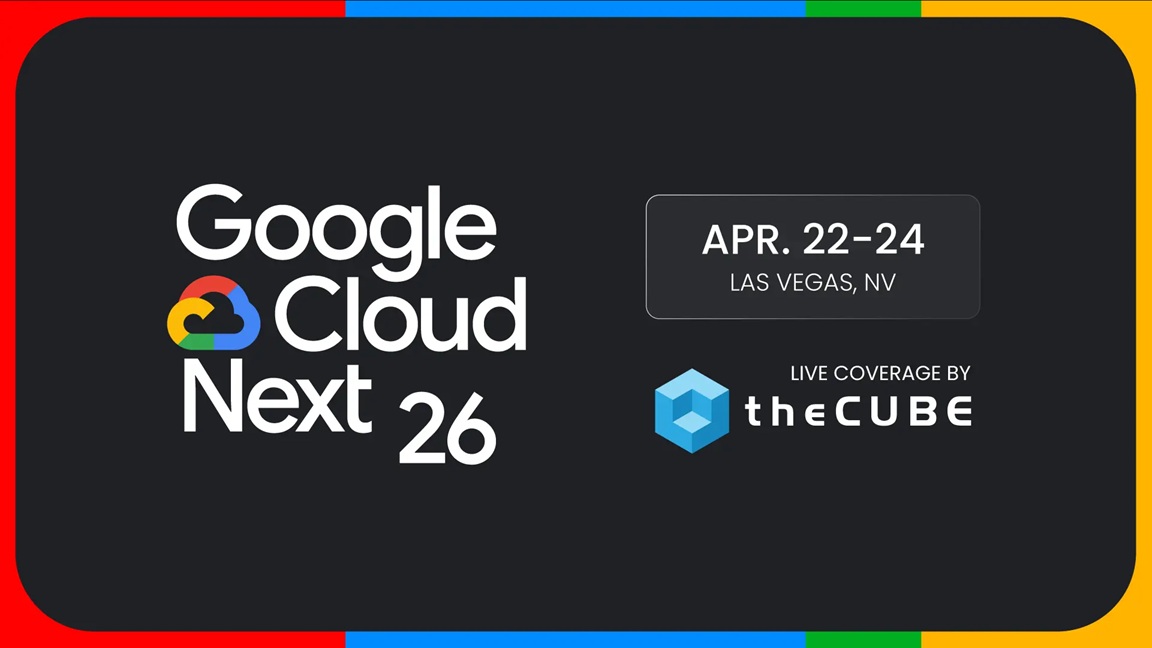
TheCUBE, SiliconANGLE Media’s livestreaming studio, will be covering the latest news and announcements at Google Cloud Next in Las Vegas, from April 22-24. Tune in for on-site reporting and exclusive interviews as theCUBE’s analysts talk with industry leaders from Google, Advanced Micro Devices, F5, United Healthcare, PwC and McKinsey & Co., among many others. Coverage will explore how agentic systems are being engineered at scale, from autonomous workflows to infrastructure defense, as well as how Gemini and the AI hypercomputer are shaping what “AI-native” actually means in practice. (* Disclosure below.)
One key trend to look for at Google Cloud Next this month will be the emergence of Google Kubernetes Engine or GKE as the backbone for high-performance AI inference and training. This is an area where Google has a strong technical foundation, with an opportunity to evolve GKE into a next-gen AI supercomputing platform.
Over the past year, Google has been steadily fine-tuning GKE to meet the need for simplified cloud infrastructure configuration and intelligent load balancing for inference. Enhancements such as GKE Autopilot and Inference Gateway have positioned container orchestration as a driver for intelligent infrastructure.
In December, the company revealed a Kubernetes cluster with 130,000 nodes in a demonstration that the container orchestrator was ready for the large-scale, compute-heavy workloads of AI. More recently, Google introduced GKE Cloud Storage FUSE Profiles, designed to automate performance tuning and accelerate data access for AI/ML workloads such as training, checkpointing or inference, with minimal operational overhead.
“Google Cloud Next highlights a clear shift toward platform consolidation, with GKE emerging as the control plane for modern application development,” said Paul Nashawaty, principal analyst at theCUBE Research. “With 82% of organizations now running Kubernetes in production and 84% expecting to build most new apps on it, the future of AppDev is no longer multi-platform. It’s Kubernetes-centric and increasingly managed.”
GKE’s evolving role in enterprise workloads also highlights Kubernetes’ central role in the AI developer stack. If Google can increase developer mindshare, it could set itself apart in AI-native application development.
Google’s launch of Application Design Center and Cloud Hub enabled developers to design entire applications via a canvas-style interface, generate infrastructure-as-code and monitor applications through unified dashboards. Google Cloud and Nvidia Corp. have also partnered on the deployment of generative AI models with Nvidia Inference Microservices on GKE.
Advances in coding tools for AI have made it increasingly more apparent that programming will not be a roadblock for developers, yet complex and cumbersome infrastructure remains an issue. Google is seeking to address this pain point by leveraging GKE to simplify development.
“Google Cloud Next reinforces that developer velocity is now constrained by platform complexity, not code,” Nashawaty said. “With over 60% of enterprises already adopting Kubernetes and adoption projected to exceed 90% by 2027, GKE’s role is to abstract that complexity, enabling teams to focus on building applications while the platform handles scale, security and operations.”
Building AI applications in today’s world requires serious processing power. Demand for Tensor Processing Units or TPUs has become a key part of Google Cloud’s go-to-market story. Google Cloud’s TPUs are custom designed AI accelerators optimized for training and inference of models.
The company has been capitalizing on demand for its processors, announcing a series of deals for its TPUs over the past six months. These have included a multibillion-dollar arrangement with Anthropic PBC for access to 1 million Google TPUs to train and run large language models. In February, Meta Platforms Inc. reached a similar deal to rent the company’s popular chips.
While the growing influence of TPUs will be a storyline to follow during Google Cloud Next, theCUBE Research analysts Vellante and David Floyer caution that the current tailwind is more about supply and demand than shifting silicon market dynamics in an area where Nvidia has dominated.
“We believe the recent TPU enthusiasm is less about a structural shift away from Nvidia and more about the fact that volumes are constrained, demand is outstripping supply and every hyperscaler is operating under scarcity,” they noted. “In this environment, buyers and builders will use whatever credible compute they can get — and that dynamic is amplifying the availability and capabilities of TPUs, as well as other alternatives.”
Don’t miss theCUBE’s coverage of Google Cloud Next, April 22-24. Plus, you can watch theCUBE’s exclusive content on-demand after the event.
We offer you various ways to watch theCUBE’s coverage of Google Cloud Next, including theCUBE’s dedicated website and YouTube channel. You can also get all the coverage from this year’s events on SiliconANGLE.
SiliconANGLE’s “theCUBE Pod” is available on Apple Podcasts, Spotify and YouTube, which you can enjoy while on the go. During each podcast, SiliconANGLE’s John Furrier and Dave Vellante unpack the biggest trends in enterprise tech — from AI and cloud to regulation and workplace culture — with exclusive context and analysis.
SiliconANGLE also produces our weekly “Breaking Analysis” program, where Dave Vellante examines the top stories in enterprise tech, combining insights from theCUBE with spending data from Enterprise Technology Research, available on Apple Podcasts, Spotify and YouTube.
During Google Cloud Next, theCUBE analysts will talk with industry leaders from Google, AMD, F5, United Healthcare, PwC and McKinsey & Co., among many others. Coverage will explore how agentic systems are being engineered at scale, from autonomous workflows to infrastructure defense, as well as how Gemini and the AI hypercomputer are shaping what “AI-native” actually means in practice.
Here’s an exclusive Google Cloud Next preview with Hyperscience CEO Andrew Joiner:
(* Disclosure: TheCUBE is a paid media partner for Google Cloud Next. Sponsors of theCUBE’s event coverage do not have editorial control over content on theCUBE or SiliconANGLE.)
Support our mission to keep content open and free by engaging with theCUBE community. Join theCUBE’s Alumni Trust Network, where technology leaders connect, share intelligence and create opportunities.
Founded by tech visionaries John Furrier and Dave Vellante, SiliconANGLE Media has built a dynamic ecosystem of industry-leading digital media brands that reach 15+ million elite tech professionals. Our new proprietary theCUBE AI Video Cloud is breaking ground in audience interaction, leveraging theCUBEai.com neural network to help technology companies make data-driven decisions and stay at the forefront of industry conversations.