 INFRA
INFRA
INFRA
INFRA


INFRA

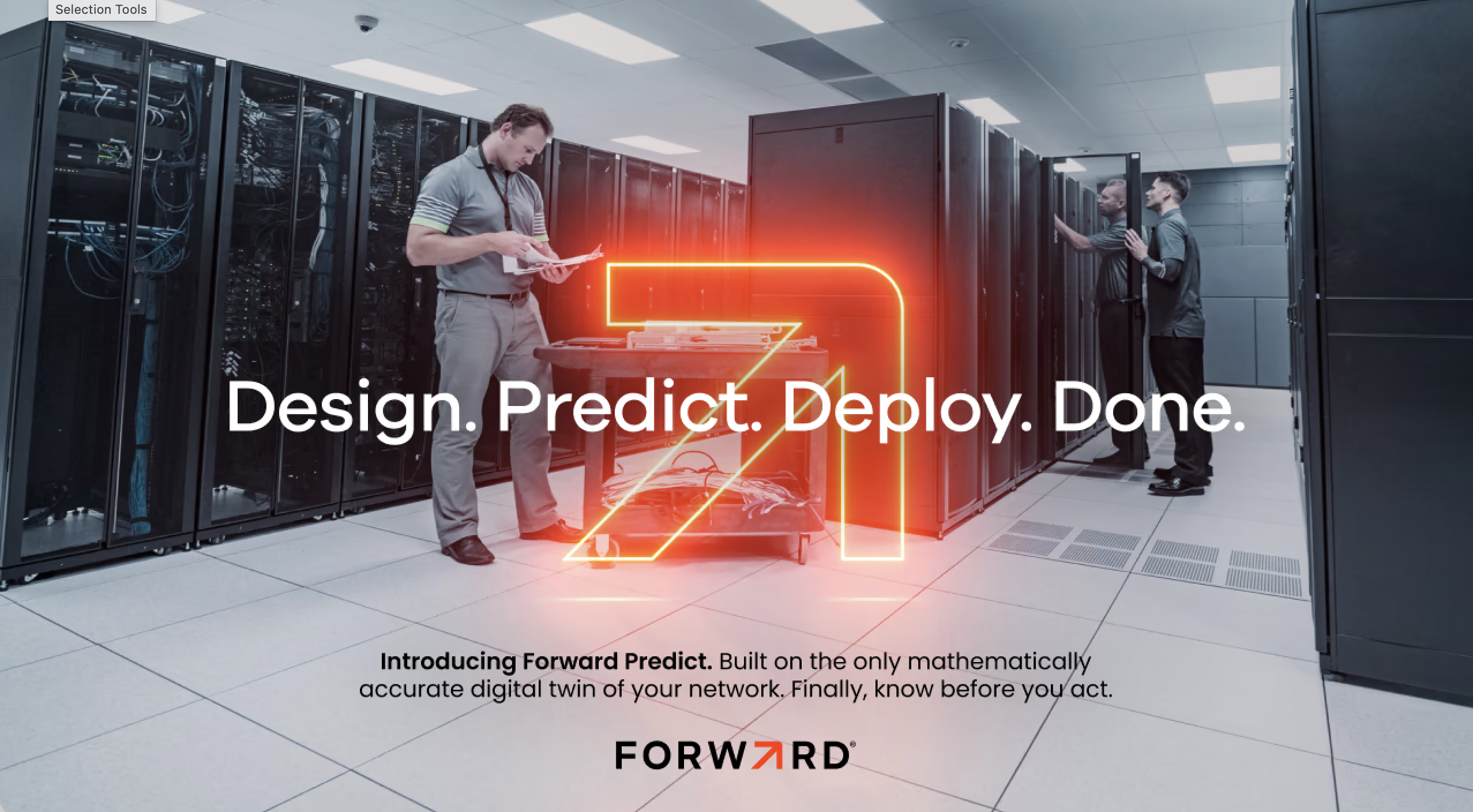
Startup Forward Inc. today rolled out Forward Predict, software that lets customers model the impact of network changes before changes go live. Rather than a routine feature update in a crowded artificial intelligence networking market, the move signals a broader shift in how networks should be designed, operated and trusted as AI becomes central to enterprise information technology.
For decades, networks have quietly served as the connective tissue of enterprise IT. They were critical yet often treated as plumbing. Networks were expected to work, not to drive strategic advantage.
That era is over. Networks are now the platform on which modern digital business runs. Every application, every cloud service and every AI workload ultimately depends on the network. As AI moves from experimentation to production, the network is no longer just a transport layer. Rather, it’s a determinative factor in whether AI initiatives succeed or fail.
AI changes the network equation in three fundamental ways.
First, AI workloads are far more distributed than traditional applications. Training may occur in one environment, inference in another, and data pipelines span on-premises, multiple clouds and edge locations. This creates complex, dynamic traffic patterns that traditional network architectures were never designed to handle.
Second, AI dramatically increases the cost of failure. A network outage in a legacy environment might disrupt email or internal applications. In an AI-driven enterprise, it can halt real-time decision-making systems, customer-facing automation or even safety-critical processes.
Third, AI accelerates the pace of change. Models evolve, data sources shift and infrastructure scales up and down quickly. The network has to keep up, which means more frequent changes, which leads to more opportunities for things to go wrong.
These three variables lead us to one of the most persistent challenges in networking: change management. If you talk to network engineers, particularly those running large enterprise or government environments, you’ll hear a familiar story. Every change follows a similar path: design, limited testing, change review board approval and then deployment to production. Despite best efforts, production often becomes the real test environment.
This process hasn’t fundamentally changed in decades, even as networks have become exponentially more complex. As a result, changes remain the single biggest source of outages and security issues. In fact, my research shows that human error still accounts for over one-third of unplanned downtime.
The industry even has a cultural artifact that reflects this reality: the “war room.” During major change windows, teams of engineers, application owners, and stakeholders gather, often late at night, to monitor for issues and respond in real time. It’s an admission that no one is entirely sure what will happen once a change goes live.
During my tenure in network operations, I spent hours upon hours planning what might go wrong. One of the big differences from my days in engineering to now is that the change windows have shrunk from a weekend to a single day to nothing, so any error now means business downtime.
What makes this especially problematic is not just the visible failures but the invisible ones. Misconfigurations that don’t immediately break anything can quietly introduce security gaps, reduce redundancy or create latent issues that surface weeks or months later under entirely different conditions. In most engineering disciplines, this kind of uncertainty would be unacceptable. Semiconductor design, aerospace engineering and even software development rely heavily on modeling and simulation to predict outcomes before anything reaches production.
Forward, which was Forward Networks until its rebrand today, has spent years building what it calls a “network digital twin,” a mathematically accurate model of an organization’s network spanning devices, vendors, protocols and layers from L2 through L7 across both on-premises and cloud environments. This foundation enables teams to understand the current and historical state of their network with a level of precision that traditional tools can’t match.
The offering shifts the focus from “what is” to “what will be.” Rather than relying on experience, best practices and limited lab testing, engineers can model a proposed change against a complete representation of the production network. The system simulates control- and data-plane behavior, including complex protocol interactions such as BGP and OSPF convergence, to predict the precise impact of the change.
This is where the analogy to software development is particularly relevant. Software has long embraced CI/CD, or continuous integration/continuous delivery, pipelines, in which every code change is automatically tested against defined criteria before deployment. Developers don’t have to guess whether a change will work as they have a framework that validates it. In fact, most organizations will not allow a change to be pushed into production until it has been validated, which is the way network operations should work.
However, networking has never had an equivalent. Forward Predict effectively introduces CI/CD-like validation to network operations, with intent-based testing, regression analysis and deterministic pass/fail outcomes. For engineers, it means a shift from reactive troubleshooting to proactive validation. Instead of asking “What broke?” after a change, they can ask “What will break?” beforehand and fix it before it ever affects production.
For organizations, it means faster change cycles without increased risk. Changes that once required weeks of planning, multiple review cycles and late-night deployments can now be designed, tested and validated much more quickly. For the industry as a whole, it marks a step toward autonomous networking, as networks can’t be fully automated if they can’t be validated first.
Forward is also integrating this capability into AI-driven operations. By combining its digital twin with predictive modeling, the company is creating a feedback loop in which AI can propose network changes, validate them against a simulated environment, and iterate until the desired outcome is achieved.
This addresses one of the biggest challenges in AI for infrastructure: trust. AI can generate configurations or suggest optimizations, but without a way to verify the outcome, organizations are understandably hesitant to let it operate autonomously. By providing a “compiler and testing framework” for network changes, Forward Predict enables validation of AI-driven actions before execution. I’ve asked many network engineers when they might fully trust systems to run their networks, and most have said that, without proof, it would be hard to fully embrace autonomous networking. Forward Predict can give them that.
In practice, that could allow teams to feed a backlog of network changes into an AI system and have those changes designed, tested and validated in parallel, dramatically increasing operational velocity without sacrificing reliability. Of course, no technology is a silver bullet. Networks remain inherently complex, and modeling them with perfect fidelity is a nontrivial challenge. Adoption will also depend on how easily these tools integrate with existing workflows and how much trust organizations are willing to place in automated systems.
As AI takes on a larger role in enterprise IT, tolerance for network uncertainty is shrinking. The focus is shifting toward infrastructure that is not only observable but also predictable, and Forward’s approach is one example of that trend. Rather than just targeting fewer outages or faster change windows, the company is aiming to give engineers a more concrete way to reason about network behavior before changes are rolled out.
For years, the industry has operated on a kind of informed optimism when making network changes. Extensive processes, experienced engineers and careful planning have helped mitigate risk, but they haven’t eliminated it. Forward Predict suggests a future in which that uncertainty is no longer necessary, and network teams can move quickly without breaking things, because they already know what will happen before anything is deployed.
In an era where the network underpins everything from cloud to AI, that shift isn’t just useful. It’s essential.
Zeus Kerravala is a principal analyst at ZK Research, a division of Kerravala Consulting. He wrote this article for SiliconANGLE.
Support our mission to keep content open and free by engaging with theCUBE community. Join theCUBE’s Alumni Trust Network, where technology leaders connect, share intelligence and create opportunities.
Founded by tech visionaries John Furrier and Dave Vellante, SiliconANGLE Media has built a dynamic ecosystem of industry-leading digital media brands that reach 15+ million elite tech professionals. Our new proprietary theCUBE AI Video Cloud is breaking ground in audience interaction, leveraging theCUBEai.com neural network to help technology companies make data-driven decisions and stay at the forefront of industry conversations.