 AI
AI
AI
AI


AI

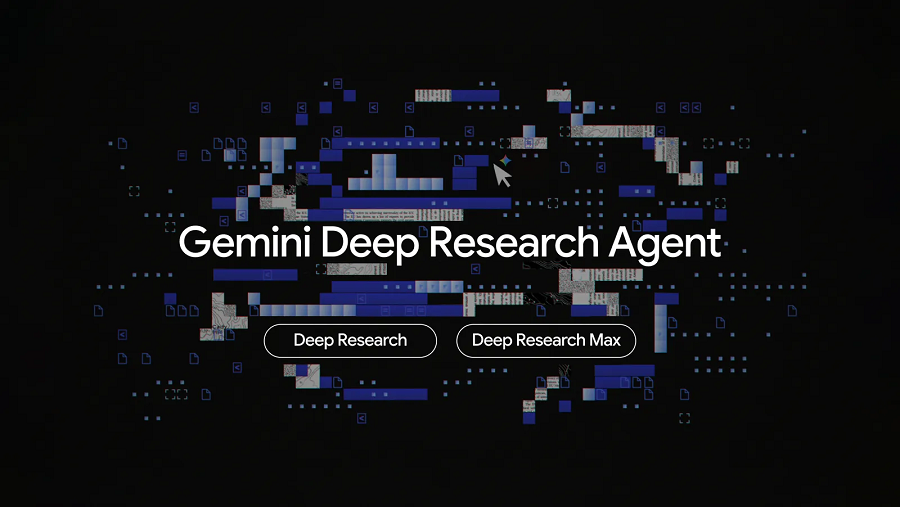
Google LLC has released two artificial intelligence agents that can generate research reports about user-specified topics.
The agents made their debut on Tuesday.
Deep Research and Deep Research Max are the successors to an AI research tool that Google introduced in December. The tool used Gemini 3 Pro, which at the time was the company’s most capable large language model. The company’s two new agents use Gemini 3.1 Pro, a more advanced LLM that made its debut in February.
Google compared the two models using an OpenAI Group PBC benchmark called BrowseComp. It comprises more than 1,000 tasks that measure LLMs’ ability to perform online research. Gemini 3.1 Pro scored 85.9, more than 25 points higher than Gemini 3 Pro.
Deep Research and Deep Research Max can retrieve data from not only the public web but also a company’s internal systems. They connect to those systems via MCP. Workers can round out the datasets that the agents assemble by manually uploading files such as spreadsheets and videos.
According to Google, one of the tasks that its agents can accelerate is healthcare research. A scientist could use them to prepare a report about a new compound that may have therapeutic applications. Financial professionals, meanwhile, can ask the agents to research companies in which they’re considering to invest.
Deep Research and Deep Research Max can optionally visualize the data they retrieve. Those visualizations can be implemented in HTML code or with Google’s Nano Banana image generator. The latter algorithm has a built-in general knowledge database, which helps it accurately interpret the information that it’s asked to visualize.
Before Google’s agents start working on a report, they display an overview of how they plan to go about the task. Users can edit the plan to increase AI output quality. For example, a researcher could list the scientific databases that Gemini 3.1 Pro should prioritize during searches.
Deep Research is the more hardware-efficient of the two agents. According to Google, it costs less than the AI research tool it released in December, provides lower latency and generates higher-quality responses. Developers can use it to power applications that require fast prompt responses.
Google says that Deep Research Max, the second new agent, is optimized for “maximum comprehensiveness.” It increases its output quality by investing more time and hardware resources in generating reports.
“Deep Research’s reports offer value on their own, but also serve as the first step in complex, agentic pipelines which often start with in-depth context gathering,” Google DeepMind program managers Lukas Haas and Srinivas Tadepalli wrote in a blog post.
Deep Research and Deep Research Max are available via the Gemini API in public preview. They will roll out to Google Cloud further down the line. Additionally, the search giant plans to add MCP integrations that will make it easier for the agents to access data from sources such as FactSet and PitchBook.
Support our mission to keep content open and free by engaging with theCUBE community. Join theCUBE’s Alumni Trust Network, where technology leaders connect, share intelligence and create opportunities.
Founded by tech visionaries John Furrier and Dave Vellante, SiliconANGLE Media has built a dynamic ecosystem of industry-leading digital media brands that reach 15+ million elite tech professionals. Our new proprietary theCUBE AI Video Cloud is breaking ground in audience interaction, leveraging theCUBEai.com neural network to help technology companies make data-driven decisions and stay at the forefront of industry conversations.