








 CLOUD
CLOUD
CLOUD
CLOUD
CLOUD

Microsoft Corp. surpassed expectations for its third-quarter financial results today, but its stock moved sideways in the after-hours trading session after it told investors it’s going to bump up its capital expenditures to $190 billion this year.
The company reported earnings before certain costs such as stock compensation of $4.27 per share, easily beating the analyst consensus estimate of $4.06. Revenue for the period increased 18% from the previous year, to $82.89 billion, ahead of Wall Street’s $81.39 billion target. All told, the company reported net income of $31.78 billion, up from $25.82 billion one year earlier.
However, Chief Financial Officer Amy Hood disappointed investors when she called for fourth-quarter revenue of between $86.7 billion and $87.8 billion. The midpoint of that forecast, at $87.25 billion, trailed the Street’s $87.53 billion consensus estimate. The estimate also implies that Microsoft’s operating margin will drop to 44% from 46.3% in the previous quarter, below the Street’s 44.6% target.
Hood blamed the shortfall on rising component costs and the instability in the Middle East, yet she revealed that the company is not letting these developments get in the way of its long-term ambitions in the artificial intelligence industry. She said the company anticipates spending $190 billion on capex this year, up 61% from the year before.
That includes a roughly $25 billion impact from the rising price of memory chips and other components needed to supply its AI data centers, she added. Analysts had estimated that Microsoft would spend $154.6 billion on capex in 2026, so the higher forecast likely caught many investors by surprise.
During the quarter, Microsoft spent $31.9 billion in capex and finance leases, up 49% from the same quarter a year ago, but less than the $34.9 billion expected.
Microsoft is at least taking steps to reduce its costs in other areas, notably by reducing its global workforce. Hood told analysts that the company’s total headcount will shrink year-over-year in calendar 2027. “We continue to evolve how we operate, to increase our pace and agility,” she said in an effort to reassure investors.
The company’s Azure cloud infrastructure business also gave investors something to smile about, with revenue from that segment and other cloud services rising 40% in the quarter, ahead of the Street’s target of 39.3%. The Intelligent Cloud business segment, which includes sales from Azure, server products, GitHub and Nuance, generated $34.68 billion in revenue, coming in above the Street’s consensus estimate of $34.27 billion.
Microsoft’s Productivity and Business Process group, which encompasses the Office productivity suite, LinkedIn and the Dynamics business software platform, delivered $35.01 billion in sales, up 17% from a year earlier and above the Street’s estimate of $34.43 billion.
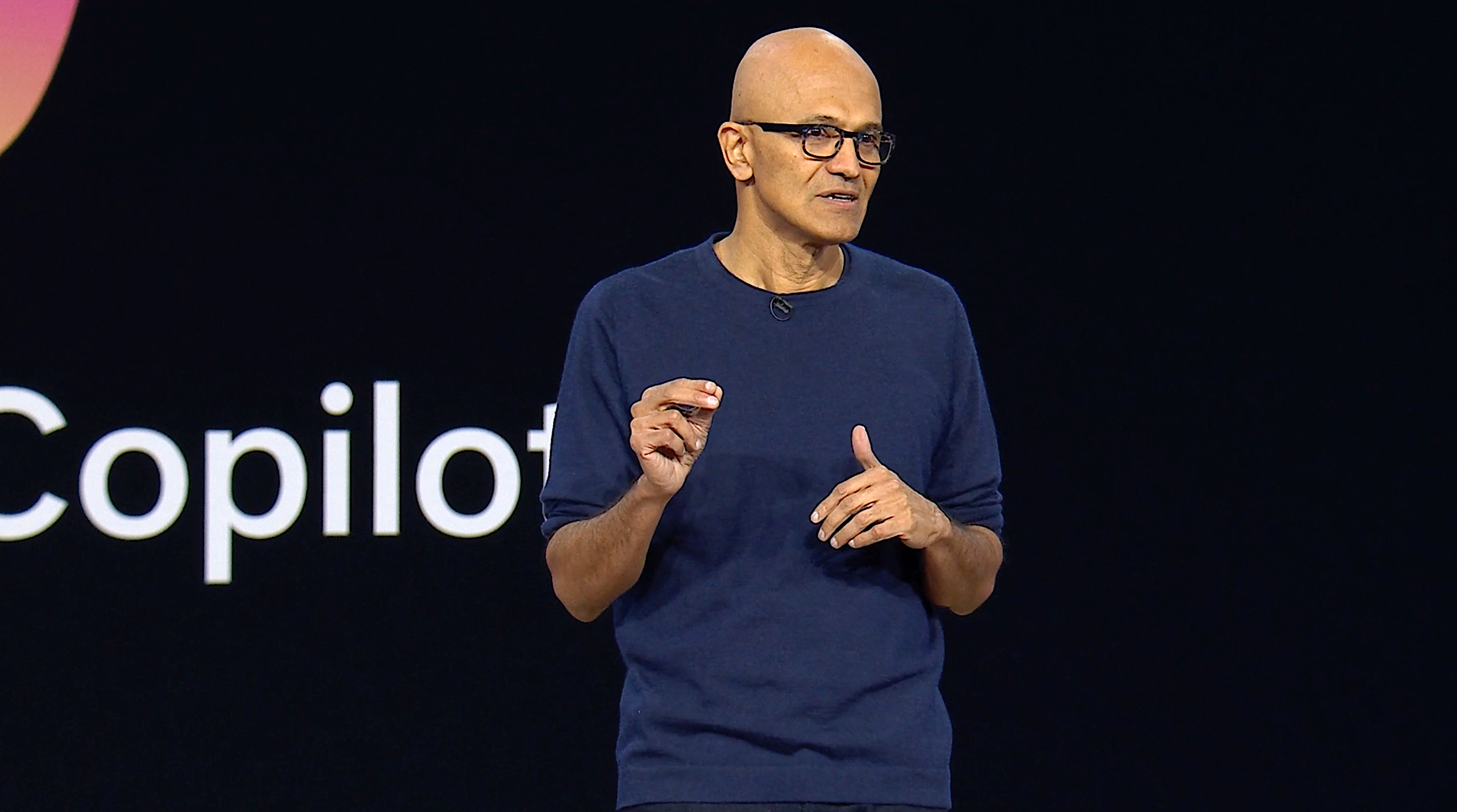
With regard to its AI products, Chief Executive Satya Nadella (pictured) revealed that the company now has more than 20 million seats for its 365 Copilot AI add-on for commercial Office subscriptions, up from 15 million three months ago. He told analysts that he expects a similar increase in the current quarter. “Weekly engagement is now at the same level as Outlook as more and more users make Copilot a habit,” he said.
Annualized revenue from all of the company’s AI services now totals more than $37 billion, up 123% from the same period one year ago. This includes customers running AI services on Azure, revenue from developers building models and AI tools like Copilot.
Microsoft’s More Personal Computing business, which spans windows, Xbox, Bing search advertising and the company’s Surface laptops, added $13.19 billion in sales, down 1% from a year earlier but above the consensus estimate of $12.73 billion. The company said Windows license sales to device makers and its own devices slipped by 2% from a year ago. That happened despite Gartner Inc. recently estimating that shipments of personal computers increased by more than 4% during the quarter.
Hood told analysts that the company now has $627 billion in commercial remaining performance obligations, which refers to unearned revenue and other contracted amounts that will be realized in due course. That’s up $2 billion from the prior quarter.
The muted reaction to Microsoft’s results today means that its stock is still down 12% in the year to date. The decline was the company’s worst quarterly performance since 2008, amid broader headwinds such as the concern that AI may kill swaths of the software industry, and worries that its escalating investments in AI won’t generate the hoped-for returns.
Valoir analyst Rebecca Wettemann told SiliconANGLE that investors were hoping to see a more solid earnings beat than what Microsoft delivered, and were naturally disappointed when that didn’t materialize. “With Google blowing past revenue and earnings expectations and big questions around its spending on AI infrastructure, the market wanted to be wowed to be reassured, and the numbers didn’t do that,” she said.
The analyst believes it’s time for Microsoft to rethink its AI pricing strategy to generate new momentum. She explained that most other AI services vendors have recognized there’s a need to reduce adoption friction amid customer’s fears of messing things up, and said economics are a big part of those fears.
“Microsoft’s Copilot strategy that charges on a per-user basis for the privilege of using an AI agent with a limited scope of value is not helping it when Oracle is offering embedded contextual agents for free and Salesforce and ServiceNow are offering flexible and value-focused pricing options for contextual agents,” she explained.
Microsoft’s subpar performance is all the more concerning considering that technology stocks overall have enjoyed a solid month, with the Nasdaq index gaining 14% in April. Investors have piled back into tech stocks despite the ongoing disruption in the Middle East, which has caused global oil prices to surge and severe disruption to supply chains. Microsoft’s rivals Amazon.com Inc. and Alphabet Inc. also reported results today, and both companies saw their stocks rise after-hours.
Constellation Research analyst Holger Mueller offered a kinder assessment of Microsoft’s performance, saying that it deserved credit for managing to keep growing and become more profitable at a time when its AI spending is reaching epic levels. “Its cash flow remains positive despite the substantial spending on AI infrastructure, but investors will want to see this balance maintained in the coming quarters,” the analyst said. “On another note, it was interesting to see that consumers were the biggest growth engine on the product side, with related revenue up 33%.”
The results come just a couple of days after Microsoft said it has revised the terms of its longstanding partnership with AI leader OpenAI Group PBC. The revised deal ends revenue share payments to the AI firm, and also means that other AI firms can now serve OpenAI’s models, following years of exclusivity on the Azure cloud.
Microsoft still has a license to use OpenAI’s intellectual property for six more years, but that deal is no longer exclusive. “We have a frontier model, royalty-free, with all the IP rights that we will have access to, all the way to 2032, and we fully plan to exploit it,” Nadella told analysts.
Wettemann said OpenAI is likely to benefit from the revised relationship, but Microsoft will have to work much harder. “Although we’re not seeing the downstream results of the most recent negotiation of the OpenAI deal yet, we likely will in future quarters as OpenAI has more flexibility to shop around on infrastructure,” she said. “At the same time, while other competitors built moats around multiple LLMs with enterprise application data strategies, Microsoft took a more narrow lane and more narrow moat.”
Support our mission to keep content open and free by engaging with theCUBE community. Join theCUBE’s Alumni Trust Network, where technology leaders connect, share intelligence and create opportunities.
Founded by tech visionaries John Furrier and Dave Vellante, SiliconANGLE Media has built a dynamic ecosystem of industry-leading digital media brands that reach 15+ million elite tech professionals. Our new proprietary theCUBE AI Video Cloud is breaking ground in audience interaction, leveraging theCUBEai.com neural network to help technology companies make data-driven decisions and stay at the forefront of industry conversations.