 AI
AI
AI
AI




AI

Customer engagement is entering a new phase where execution matters more than experimentation, as enterprises look to turn AI into measurable business outcomes.
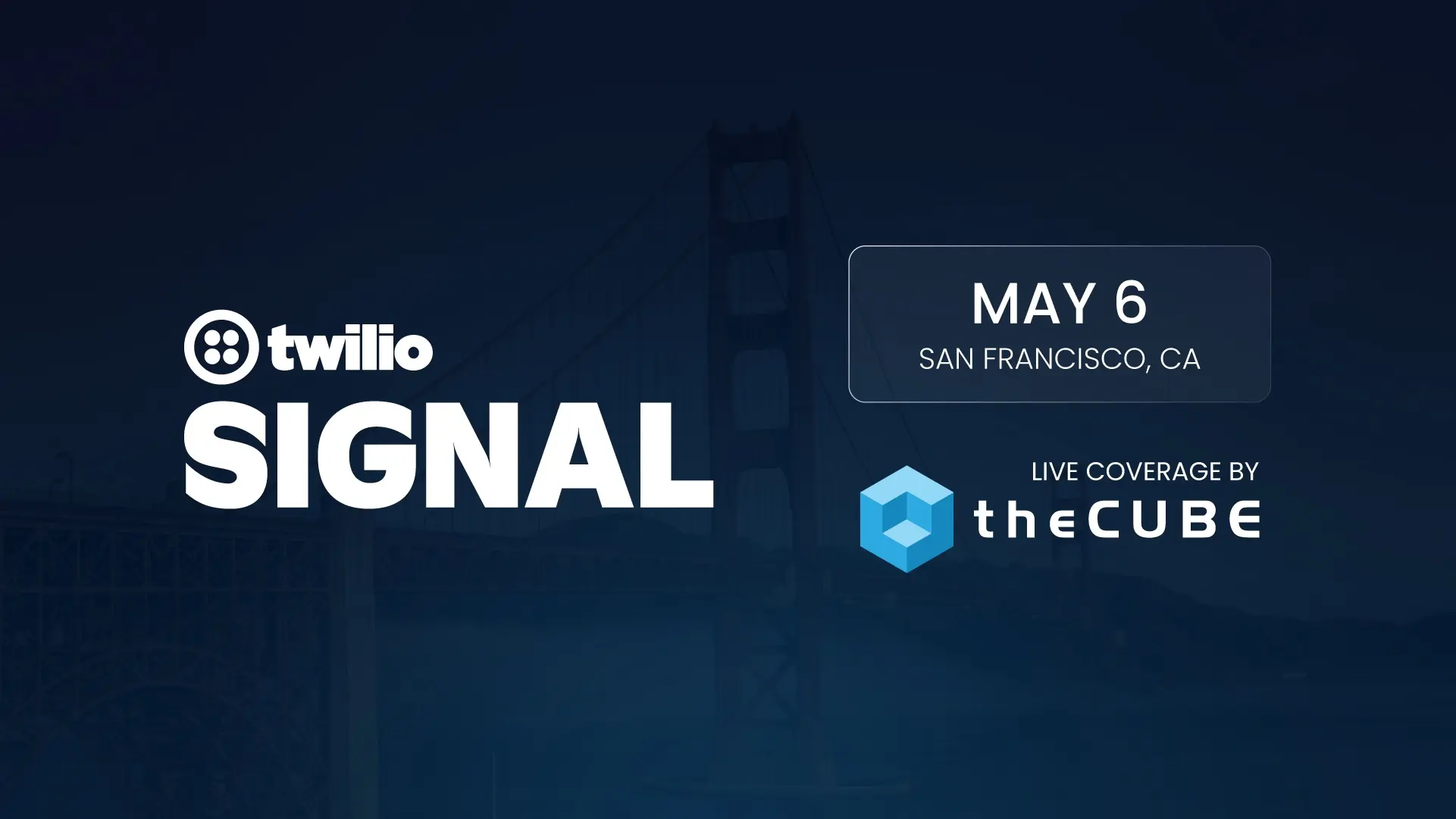
As enterprises push to unify engagement strategies, Twilio Inc. is repositioning its platform as an orchestration layer for AI-driven customer journeys. Rather than treating communications, data and AI as separate systems, organizations are increasingly looking to connect them into a single operating model that can respond in real time. The Signal event arrives at a moment when that shift is accelerating, with companies under pressure to deliver more personalized, responsive experiences at scale.
“Customer engagement has moved past the experimentation phase and into a results-driven reality,” said Paul Nashawaty, principal analyst at theCUBE Research. “At Signal 2026, what we’re seeing is a broader industry shift where AI, data and communications are converging into a single execution layer, one that determines how effectively enterprises can deliver real-time, personalized experiences at scale.”
Join theCUBE, SiliconANGLE Media’s livestreaming studio, on May 6, for exclusive coverage of Twilio’s Signal event. Industry leaders and practitioners will discuss how Twilio is building an AI-driven orchestration layer for real-time customer journeys, connecting data, communications and automation into a single execution model. (* Disclosure below.)
Twilio’s strategy reflects a broader transition in the market, where communications platforms are evolving into systems that can coordinate interactions, data and automation across the customer lifecycle. This shift is less about adding new channels and more about creating a unified layer that can manage conversations dynamically, based on real-time context and intent.
“Twilio has evolved from a communications utility into an orchestration layer that makes conversations work for businesses,” said Khozema Shipchandler, CEO of Twilio.
At the same time, enterprises are running into a familiar barrier: moving AI from pilot projects into production environments that can scale reliably. The challenge is not a lack of ideas, but the infrastructure required to operationalize them across complex, customer-facing systems.
“While there is no shortage of AI experiments, there is a shortage of AI in production,” Shipchandler added. “Most organizations are stuck in pilots, not because of a failure of need or imagination, but because they lack the infrastructure to move from impressive demos to systems that work reliably at scale. The gap is not intelligence — it is infrastructure. Twilio is bridging that gap.”
That disconnect is becoming a critical issue as organizations try to bring together data, communications and AI into a cohesive execution model. Without alignment across these layers, fragmentation can quickly erode both performance and customer trust.
“The stakes for enterprises are rising fast,” Nashawaty said. “This isn’t just about improving engagement; it’s about protecting revenue and long-term customer loyalty. Organizations that fail to unify their data, communications and AI strategies will struggle with fragmentation, and that directly impacts both customer trust and lifetime value.”
As Signal 2026 approaches, a central theme is the move from insight to action, where AI systems are not just informing decisions, but executing them within customer interactions. This shift toward agentic AI is changing how engagement is designed, moving from static workflows to adaptive systems that can respond continuously.
“AI must move beyond insight to action — enterprises should be focused on operationalizing agentic AI, connecting it to clean, real-time data, and measuring success based on business outcomes like speed, efficiency and conversion, not just technical sophistication,” Nashawaty explained.
Twilio is also positioning itself within this transition as a layer that can support automated, AI-driven conversations at scale. As more interactions are handled without human intervention, the need for coordination, trust and control becomes more pronounced.
“As agents begin to execute conversations without human intervention, the world needs a neutral, trusted broker,” Shipchandler said. “We are uniquely positioned to be the agentic control plane for a significant portion of these interactions.”
This evolution reflects a broader inflection point across enterprise technology, where AI is becoming central to how applications are designed and operated, rather than an added feature.
“Q4 2025 marked a decisive inflection point where AI moved from an enhancement to an organizing principle in application development, with agentic systems no longer confined to copilots or narrow workflow automation, making the imperative to operationalize agentic AI more urgent than ever,” Nashawaty added.
Don’t miss theCUBE’s coverage of Twilio’s Signal event on May 6. Plus, you can watch theCUBE’s exclusive content on-demand after the event.
We offer you various ways to watch theCUBE’s coverage of Twilio’s Signal event, including theCUBE’s dedicated website and YouTube channel. You can also get all the coverage from this year’s events on SiliconANGLE.
SiliconANGLE’s “theCUBE Pod” is available on Apple Podcasts, Spotify and YouTube, which you can enjoy while on the go. During each podcast, SiliconANGLE’s John Furrier and Dave Vellante unpack the biggest trends in enterprise tech — from AI and cloud to regulation and workplace culture — with exclusive context and analysis.
SiliconANGLE also produces our weekly “Breaking Analysis” program, where Dave Vellante examines the top stories in enterprise tech, combining insights from theCUBE with spending data from Enterprise Technology Research, available on Apple Podcasts, Spotify and YouTube.
During Twilio’s Signal event, theCUBE analysts will talk with industry executives, ecosystem partners and enterprise practitioners to explore how organizations are operationalizing AI, unifying data and communications, and building real-time customer engagement systems at scale.
(* Disclosure: TheCUBE is a paid media partner for Twilio’s Signal event. Neither Twilio, the sponsor of theCUBE’s event coverage, nor other sponsors have editorial control over content on theCUBE or SiliconANGLE.)
Support our mission to keep content open and free by engaging with theCUBE community. Join theCUBE’s Alumni Trust Network, where technology leaders connect, share intelligence and create opportunities.
Founded by tech visionaries John Furrier and Dave Vellante, SiliconANGLE Media has built a dynamic ecosystem of industry-leading digital media brands that reach 15+ million elite tech professionals. Our new proprietary theCUBE AI Video Cloud is breaking ground in audience interaction, leveraging theCUBEai.com neural network to help technology companies make data-driven decisions and stay at the forefront of industry conversations.