 AI
AI
AI
AI



AI

Whoever controls the agentic control plane controls enterprise AI. Google LLC just showed up to that fight with everything it has.
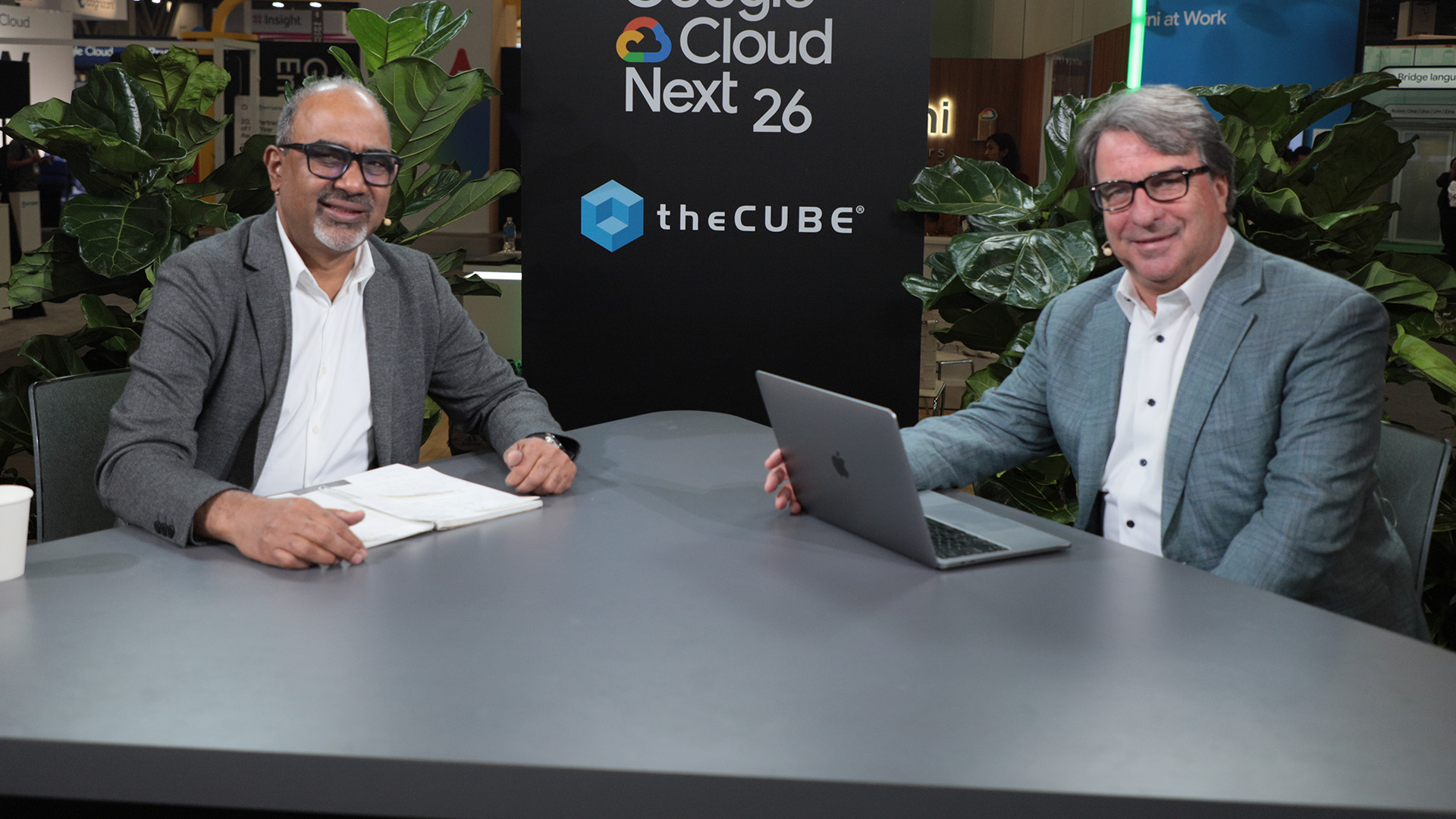
The company claiming it can own the full stack arrived at Google Cloud Next 2026 firing on all cylinders, including unveiling the new Gemini Enterprise Agent Platform — but the deeper story was about how that full stack is converging into a single architectural bet. The company is uniquely positioned as the only hyperscaler with a leading frontier model, sovereign infrastructure and an open, heterogeneous ecosystem all under one roof, according to John Furrier (pictured, right), co-founder and chief executive officer of SiliconANGLE Media Inc. But that positioning comes with real stakes, he warned.
“If you commit to this platform, you’re kind of in,” Furrier said. “Agents are going to talk to agents — that’s a big theme we heard a lot here. It’s a platform and that’s causing all kinds of competitive dynamics, from being competitive to frenemies. The execution risk of going too slow or going too fast is the number one thing I’m taking away.”
Furrier spoke with Sarbjeet Johal (left), founder and chief executive officer of Stackpane Ltd., as part of a day three wrap at the close of Google Cloud Next, during an exclusive broadcast on theCUBE, SiliconANGLE Media’s livestreaming studio. They discussed Google Cloud’s full-stack AI momentum, AI economics and the emerging agentic control plane battle reshaping enterprise architecture. (* Disclosure below.)
The economics case for Google’s vertical integration is one analysts are watching closely. Because Google does not pay the same third-party silicon margins competitors absorb, its custom Tensor Processing Unit stack offers a structural cost advantage at production scale — particularly as enterprises scale workloads across the agentic control plane, Johal noted. The two new TPUs announced at the show — one for training, one for inference — posted 2.7x and 5x price-to-performance improvements respectively.
“At the end of the day, economics matters,” Johal said. “When you put stuff in production, especially if it is at some decent scale, price to performance is the number one criteria for procuring any technology. Because they’re vertically integrated, they have their own TPUs — they don’t have to pay a 70% margin to the likes of Nvidia. They have much better economics of AI, if you will.”
But governance — not economics — is emerging as the defining challenge that will determine which enterprise AI deployments survive contact with production. Just as developer operations made enterprise cloud adoption possible in the prior cycle, agentic governance is what will unlock AI-native apps in the enterprise this time around — and the agent development lifecycle is still in its earliest stages, Johal explained. All three major cloud providers only just announced agent registries in April 2026, underscoring how rudimentary the foundational blocks still are.
“In the hype cycle, governance is on the back burner,” Johal said. “Take any hype cycle — internet, internet 2.0. During that time, security is on the back burner, governance is on the back burner. It’s by design.”
The path forward now lies in the data layer — open lakehouse formats, aggregated data feeds and systems that let AI consume context freely across clouds and SaaS providers, Furrier noted. Separating models from control planes and data layers is what will accelerate enterprise value and insulate organizations from the velocity risk of constant model churn, Johal added.
“If you confront it, most of the time you’ll come out as a winner,” Johal said. “But if you are afraid of change, it will kill you.”
Here’s the complete video interview, part of SiliconANGLE’s and theCUBE’s coverage of Google Cloud Next 2026:
(* Disclosure: TheCUBE is a paid media partner for Google Cloud Next 2026. Sponsors of theCUBE’s event coverage do not have editorial control over content on theCUBE or SiliconANGLE.)
Support our mission to keep content open and free by engaging with theCUBE community. Join theCUBE’s Alumni Trust Network, where technology leaders connect, share intelligence and create opportunities.
Founded by tech visionaries John Furrier and Dave Vellante, SiliconANGLE Media has built a dynamic ecosystem of industry-leading digital media brands that reach 15+ million elite tech professionals. Our new proprietary theCUBE AI Video Cloud is breaking ground in audience interaction, leveraging theCUBEai.com neural network to help technology companies make data-driven decisions and stay at the forefront of industry conversations.