 INFRA
INFRA
INFRA
INFRA


INFRA

Semiconductor giant Advanced Micro Devices Inc. coasted to another solid earnings and revenue beat as it delivered its first-quarter financial results today.
Its guidance for the current quarter came up strong too, thanks to soaring demands for data center chips that power artificial intelligence workloads.
The company reported earnings before certain costs such as stock compensation of $1.37 per share, coming in ahead of Wall Street’s target of $1.29 per share. Revenue for the period soared by an impressive 38% from a year earlier, to $10.25 billion, well ahead of the analysts’ $9.89 billion consensus estimate. That helped the chipmaker improve its bottom line, with net income for the quarter coming to $1.38 billion, up from $709 million one year earlier.
AMD’s AI chip sales fall within its data center segment, and it was predictably the best-performing unit, as sales rose 57% from a year earlier to $5.8 billion. The company said it benefited from strong demand for its EPYC server chips and the continued ramping of its Instinct graphics processing units.
The company’s other segments did OK, too. Client and gaming, which accounts for the sale of central processing units and GPUs for personal computers and consoles, delivered $3.6 billion in revenue, up 23% from a year earlier. Meanwhile the embedded segment, which is focused on smaller chips for specialized, industrial and “always-on” applications, generated $873 million in sales, up 6%. For the current quarter, AMD said it’s looking for sales of around $11.2 billion at the midpoint of its guidance range, well ahead of the Street’s forecast of $10.52 billion.
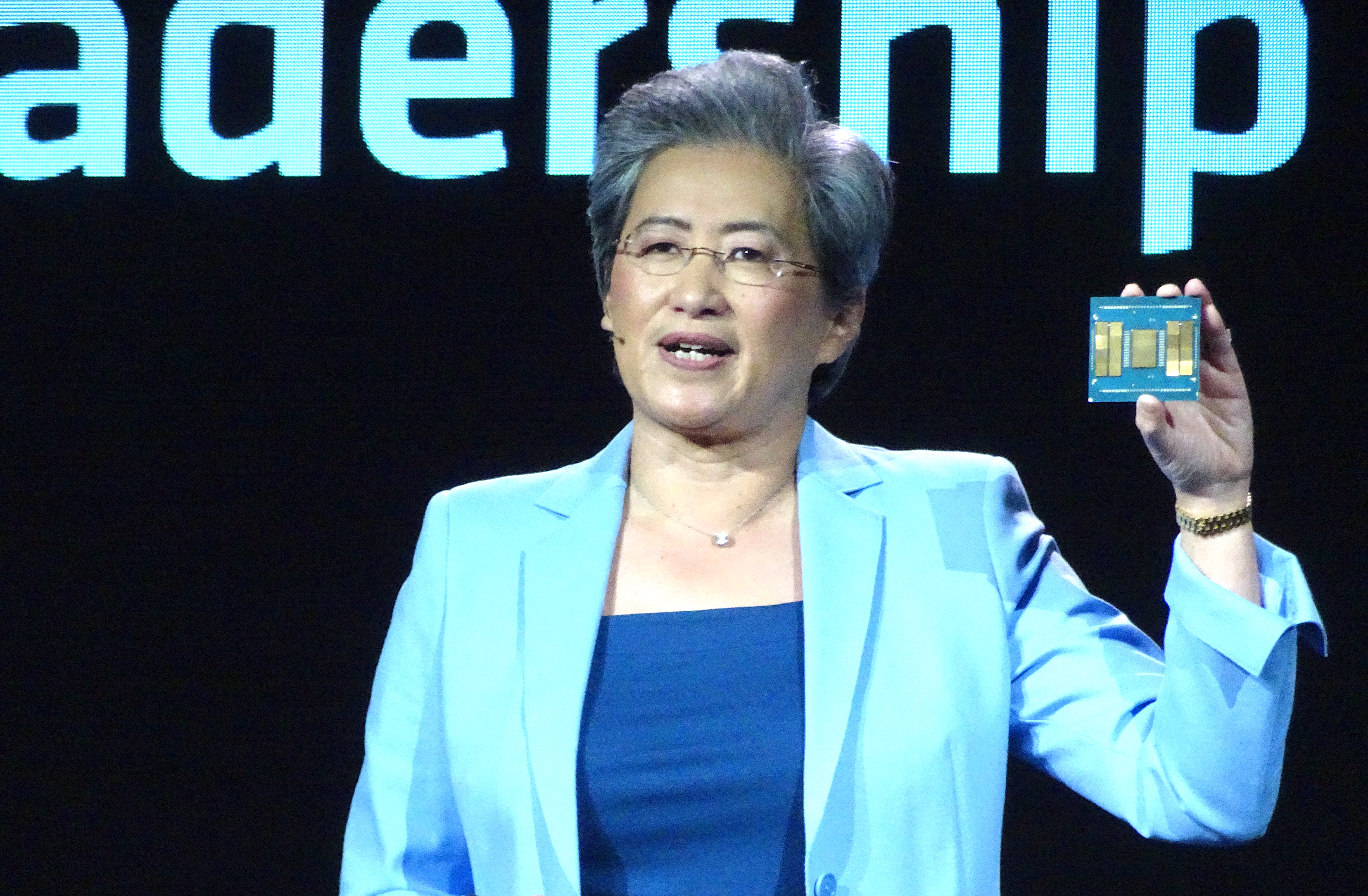
Chief Executive Lisa Su (pictured) said on an earnings call that the company’s data center division is now the “primary driver” of both revenue and earnings growth. “Looking ahead, we expect server growth to accelerate meaningfully as we scale supply to meet demand,” she added.
Earlier, Su told analysts that the company has “strong and increasing confidence” with regards to its ability to generate “tens of billions of dollars” in sales within the data center segment next year. She also hopes to “exceed our long-term growth target of greater than 80% in the coming years.”
Shares of AMD have been on a roll for a long time, and the stock has gained more than 253% over the last 12 months, and is up almost 66% in the year to date. While the company still trails Nvidia Corp. by a long way in terms of revenue, investors have poured money into the company, believing that the AI market is more than big enough to support multiple chipmakers. AMD’s stock gained more than 16% in late trading on the back of today’s results.
The chipmaking industry has been contending with a global shortage of memory components as a result of the insatiable demand from the AI industry, and those problems have been worsened by supply chain challenges due to the war in Iran.
However, these disruptions have been a boon for chipmakers. Intel Corp. just delivered its best-ever month, with its first-quarter results crushing analyst’s forecasts to send its stock up more than 24% in a single day. In the year to date, it has risen by a stunning 194%. Meanwhile, shares of the memory chip maker Micron Technologies Inc. have soared more than 700% in the last year, with Sandisk Corp. showing similar gains. Another chipmaker, GlobalFoundries Inc., delivered its first-quarter results today, comfortably beating expectations on earnings and revenue and providing a bullish forecast too. Its stock gained more than 9%, pushing its gains in the year to date to 112%.
Where AMD differs from Nvidia is that it’s also a key player in the CPU business, and these chips are enjoying a renaissance of sorts amid the rise of “agentic AI” systems that automate work on behalf of humans. GPUs can often be overkill for AI agents, which run far more efficiently on CPUs, and that has benefitted AMD immensely.
Holger Mueller of Constellation Research said AMD is doing well to keep up its stellar growth rate of close to 40%, adding that investors will have been pleased by the strong performance of its PC and gaming segments. “This is proof that innovation in chip design is still the key to accelerating revenue growth, because that’s where Lisa Su and her team keep delivering,” the analyst added. “It’s doing this in a cost-effective way too, as its earnings per share almost doubled compared to the previous quarter. But the pressure is on to keep this up.”
Last week, AMD’s stock jumped on the news that it’s teaming up with its longtime rival Intel Corp. to develop a new instruction set for x86 CPUs. They’re developing a new feature called AI Compute Extensions, and claim it will be able to enhance the performance and energy efficiency of CPUs by increasing compute density by up to 16 times.
On the GPU front, AMD is planning to ship its first-ever rack-scale system for AI data centers, called Helios, later this year. It’s a rival to Nvidia’s Grace Blackwell and Vera Run rack-scale systems for data centers, which sell for upwards of $3 million.
Su told analysts on the call that both OpenAI Group PBC and Meta Platforms Inc. have agreed to buy the Helios systems when they’re available, cementing the company’s status as a viable alternative for AI giants and “hyperscalers” that require more compute power. Meta’s multiyear deal with the company will see it deploy up to 6 gigawatts of GPUs across its global data center network, as well as AI-optimized CPUs.
According to Su, the company expects to start shipping its first chips to Meta and OpenAI in the second half of the year. “Together with our previously announced OpenAI partnership, these engagements position AMD as a core partner to the world’s largest AI infrastructure builders, with deep co-engineering relationships and multiyear visibility into large-scale deployments,” she said.
Support our mission to keep content open and free by engaging with theCUBE community. Join theCUBE’s Alumni Trust Network, where technology leaders connect, share intelligence and create opportunities.
Founded by tech visionaries John Furrier and Dave Vellante, SiliconANGLE Media has built a dynamic ecosystem of industry-leading digital media brands that reach 15+ million elite tech professionals. Our new proprietary theCUBE AI Video Cloud is breaking ground in audience interaction, leveraging theCUBEai.com neural network to help technology companies make data-driven decisions and stay at the forefront of industry conversations.