 INFRA
INFRA
INFRA
INFRA












INFRA

Updated:
Intel Corp. crushed analysts’ expectations as it delivered its first-quarter earnings results today, in a sign that its efforts to turn around its business under Chief Executive Lip-Bu Tan could be finally starting to pay off.
The chipmaker reported solid earnings before certain costs such as stock compensation of 29 cents per share, way ahead of Wall Street’s target of a profit of just a penny a share. Revenue for the period came in at $13.58 billion, also crushing the Street’s expectations, with analysts forecasting sales of just $12.42 billion for the quarter.
Intel’s stock surged more than 20% in late trading on the back of today’s results, adding to strong momentum that has transformed it into one of the hottest stocks on the market this year. Update: Shares ended up rising almost 24% on Friday. With today’s gains, the stock is now up 81% in the year-to-date, after soaring 84% in 2025.
What’s interesting about Intel’s rising stock is that it hasn’t been accompanied by much of a turnaround in its business, which fell far behind rival chipmakers such as Nvidia Corp. and Advanced Micro Devices Inc. at the beginning of the artificial intelligence chip boom. Most of the company’s momentum stems from efforts by the Trump administration to champion the chipmaker, with the U.S. government notably becoming its largest shareholder in a deal made last year to secure additional funding and bring more chip manufacturing stateside. Nvidia has also made a sizable investment in Intel, and so has SoftBank Group Corp.
However, there are signs that the tide is beginning to turn. Intel’s revenue increased by 7% from the same period one year earlier, having previously recorded year-over-year declines in five of the past seven quarters. Moreover, Intel is expecting to see its revenue grow again in the short term. For the current quarter, it’s forecasting sales of between $13.8 billion and $14.8 billion, well ahead of the analyst consensus of $13.07 billion. It’s also forecasting earnings of about 20 cents per share at the midpoint of its guidance range, ahead of the Street’s 9-cent-per-share target.
Intel’s growth is all the more encouraging because, for the most part, it was driven by the company’s data center business, where it’s finally starting to see traction in AI amid surging demand for its central processing units to power inference workloads. Revenue in that business rose 22% from a year earlier to $5.1 billion.
Intel’s CPUs have started getting attention because so-called “agentic AI,” which refers to autonomous software that performs business tasks on behalf of humans with minimal supervision, have different computing needs. Nvidia’s powerful graphics processing units are generally overkill for AI agents, which can run at least partly in a more efficient way on CPUs.
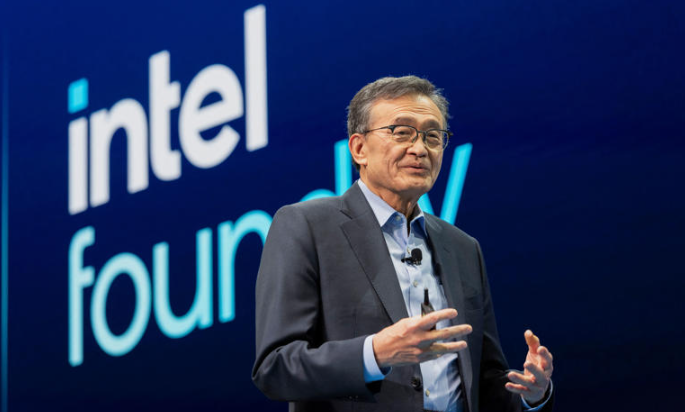
On a conference call with analysts, Tan (pictured) hammered home this point: “The CPU is reinserting itself as the indispensable foundation of the AI era,” he said. “This isn’t just our wishful thinking, it’s what we hear from our customers.”
There’s still plenty of work to be done for Intel, though, as the chipmaker is still unprofitable. Its net loss during the quarter widened to $4.28 billion, rising from a loss of $887 million in the year-ago period.
Intel’s strategy differs from many other chipmakers because it still operates its own chip foundries, which means it not only designs the CPUs but also manufactures them at its own facilities. Most of its rivals outsource the manufacturing process to companies such as Taiwan Semiconductor Manufacturing Co. Intel’s foundry revenue increased 16% to $5.4 billion in the quarter, though much of that revenue stemmed from manufacturing its own chips.
The company has brought some interesting new products onto the market in recent months. Its new Xeon 6+ data center processors went on sale in March, while its Core Ultra Series 3 processors for personal computers and laptops hit the market in January. Also this year, Google LLC committed to buying millions of Intel’s CPUs to power some AI workloads in its own data centers.
Those new chips are made on Intel’s most advanced 18A process node at a massive new chip fab in Arizona, which is technologically similar to TSMC’s two-nanometer process. However, Intel has struggled to secure orders from other chipmakers, despite stating its ambitions to do so and grow its foundry business. The challenge for Intel is that it’s recovering from years of delays on earlier node generations, not to mention teething problems at the new Arizona facility, where some of its 18A wafers have suffered defects, leading to lower production yields compared to its rival.
Holger Mueller of Constellation Research said Intel is finally moving in the right direction, fueled by the shift in focus from AI training to inference. “I think a lot of the gains are due to expectation, because Intel is finally catching a break, growing its revenue and getting more profitable, but its client computing business is still larger than the data center unit,” the analyst said. “Intel is moving in the right direction, and a key objective going forward will be to secure design wins with larger inferences server farms in the coming quarters.”
Intel is currently working on finalizing its newest 14A process node, which is slated to go live in 2028. The company had previously said it would wait until it landed a significant new customer before moving forward with the expense of getting that new process up and running, but Tan appeared to backtrack in January, when he suddenly insisted that the company is “going bigtime” into the new process.
On the call, Tan told analysts that “multiple customers” are currently evaluating the 14A process technology, and that development is accelerating faster than what the company saw with its 18A process. There has been speculation that some of those customers might be Elon Musk’s Tesla Inc. and xAI Corp., though it’s not clear exactly what kind of arrangement is planned. Earlier this month, Intel revealed that it will be collaborating with Tesla on its new Terafab chip complex being built in Austin, Texas, helping to “design, fabricate and package ultra-high performance chips” that will also be used by Musk’s rocket company SpaceX Corp.
During Tesla’s earnings call this week, Musk revealed that the automaker wants to use Intel’s 14A process to manufacture chips at Terafab, and said that by the time the new facility scales up, the process will “probably be fairly mature or ready for prime time.”
Tan elaborated on Musk’s comments today, saying that they both share a strong conviction “global semiconductor supply is not keeping pace with the rapid acceleration in demand,” and that they’re “looking for unconventional ways to improve manufacturing efficiency.”
EMarketer analyst Jacob Bourne told SiliconANGLE that Musk may not be the only customer that’s waiting for Intel’s 14A process to come online. “The domestic manufacturing story continues to pay dividends for Intel, with Tesla’s 14A commitment hinting at more customers in the pipeline as geopolitics pushes AI buyers toward U.S.-based capacity,” he said. “Server CPU demand tied to AI infrastructure buildouts is giving Intel a steadier revenue base that’s less bound to the PC cycle, and so its turnaround is looking less like a hope-fueled blip and more like a steadier, long-term upward trajectory.”
Support our mission to keep content open and free by engaging with theCUBE community. Join theCUBE’s Alumni Trust Network, where technology leaders connect, share intelligence and create opportunities.
Founded by tech visionaries John Furrier and Dave Vellante, SiliconANGLE Media has built a dynamic ecosystem of industry-leading digital media brands that reach 15+ million elite tech professionals. Our new proprietary theCUBE AI Video Cloud is breaking ground in audience interaction, leveraging theCUBEai.com neural network to help technology companies make data-driven decisions and stay at the forefront of industry conversations.