 INFRA
INFRA
INFRA
INFRA







INFRA

Extreme Networks Inc. used its Extreme Connect 2026 user conference this week to make a strong case that artificial intelligence-driven networking has finally arrived.
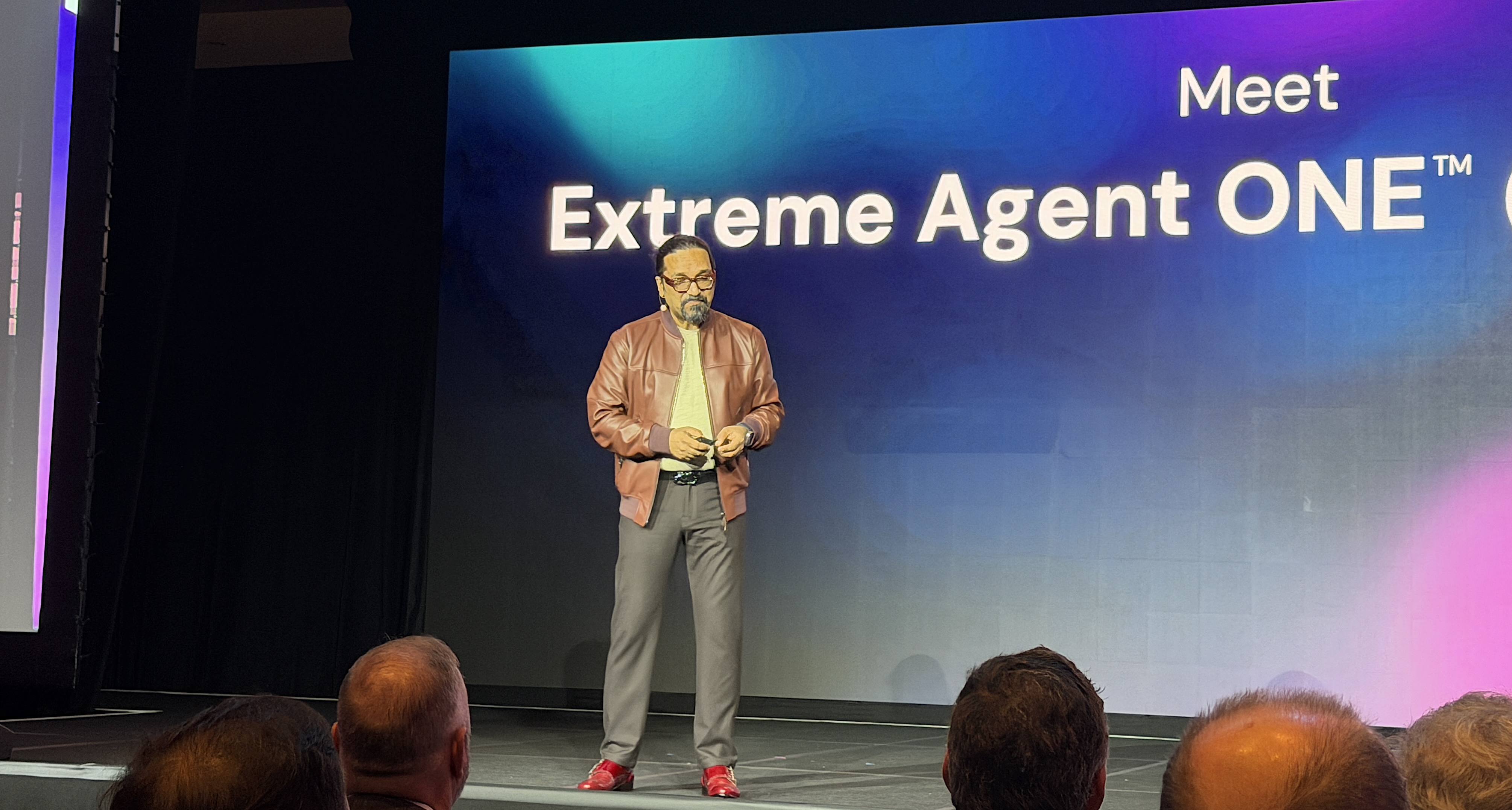
Building on Platform ONE, the company rolled out a full-stack vision spanning new Wi-Fi 7 access points, enhanced fabric-ready switching and a second-generation artificial intelligence layer called Agent ONE, designed to act less like a chatbot and more like an operational co-worker for NetOps teams. Framed by the insistence of Nabil Bukhari (pictured), chief technology officer and president of AI platforms, that Extreme is now an “outcome company” — and backed by several consecutive quarters of double-digit revenue growth — the announcements position Extreme well in the race to bring agentic AI to production networks.
The positioning of Extreme as an outcome company is enabled by Extreme’s “stack,” which starts at the hardware layer and extends up to AI to help customers meet business goals and cut operational costs. The evolution of that stack showed up in three buckets:
Platform ONE, generally available since July 2025, is now the anchoring control plane for wired, Wi-Fi, fabric and software-defined wide-area network, with a strong focus on visualization and unified operations. This includes the following new capabilities:
Scott Calzia, vice president of product management, highlighted that Extreme was out of the gate early with Wi‑Fi 7 and is using Connect 2026 to showcase a broadening of its lineup for both high‑density and cost‑sensitive deployments.
When talking about AI, Bukhari was explicit that Extreme isn’t just “bolting a chatbot onto a frontier model.” He walked through a layered AI architecture:
The first mode, Agent ONE Coworker, is a proactive “warm coworker” that continuously monitors the network, investigates anomalies, and can execute changes on your behalf once you approve a plan. Extreme’s roadmap calls for a second mode, Agent ONE Operator, in Q4 CY26, to run workflows autonomously within guardrails.
I thought Bukhari summed up Extreme’s mission nicely when he stated, “Everything that we have thought of, everything that we have built, everything that we announce, is for one purpose, and that purpose is to make your life easier.” Too often, information technology vendors create new solutions but forget about the practitioner. Network operations have grown increasingly complex, and one of the first orders of business for AI should be to let engineers do what they need to do, but much more easily and quickly.
Extreme sprinkled real-world stories throughout the keynotes to demonstrate the value of Platform ONE and the new hardware. Chet Patel, director of innovation and technology for Caribe Royale Orlando, which hosted Extreme Connect, discussed how Extreme helped reduce Wi-Fi-related complaints. “We had hundreds of tickets before we deployed Extreme, and then after, we now have zero tickets,” he said. “It’s now ‘set it and forget it,’ which is not something we could have ever said about Wi-Fi before.”
In the “drinking your own champagne” portion of the keynote, Extreme’s own Chief Information Officer Anisha Vaswani explained the value of cross-portfolio integration. “We used to have one tool for managing on-prem, we had XIQ for wireless, and we had Ipanema (acquired by Extreme) for SD-WAN,” she said. “Today, we can manage all of that in one platform, and it’s made our lives easier and streamlined operations.”
Another customer, Richard Gingerich, systems engineer for Sight and Sound Theatres, talked about the value of Extreme’s fabric and the desire for an agentic style interface to assist the helpdesk. “I would love for the help desk to interact with the AI agents, he said. “Just ask the bot, ‘Bob has a problem, what’s going on?’ or ‘What VLAN is port 48 on?’ without having to come to the platform UI.”
Those quotes reinforce that Extreme’s AI story isn’t only front-of-house. They’re designing agents to serve as front ends for nonexpert tiers of the organization.
It has been a long journey for Extreme. When Chief Executive Ed Meyercord (pictured below) and Norman Rice joined Extreme, the company’s viability was in question. A number of strategic acquisitions and a few years of engineering work have put the company in a strong position, with a simplified, strong enterprise portfolio.
 Onstage, Chief Marketing Officer Monica Kumar and Bukhari both referred to “feel the momentum,” which is supported by recent numbers. Extreme has quietly put together a multiquarter run of solid growth while shifting the business mix to SaaS. The most recent quarter, the third of fiscal year 2026, saw revenues of $316.9 million, up 11% year-over-year, marking the fifth straight quarter of double-digit growth. Software-as-a-service annual recurring revenue is now $236.4 million, up 29%.
On the market side, Extreme’s stock is trading in the mid-20, up 42% this year and almost 70% in the past 12 months. Extreme Connect hosted several investors, who appear bullish on the company’s outlook.
Though Extreme Connect addresses many audiences, including mine, the most important audience is the network practitioner – the people who work day after day to keep networks up and running, ensuring businesses function. If you’re running a campus, distributed enterprise or OT-heavy environment, there are three practical angles from Extreme Connect that matter:
The Agent ONE design, which includes a knowledge graph, skills and an agentic layer, is an attempt to encode networking domain expertise so AI can do more than summarize PDFs. That shows up in tangible capabilities like real-time five-second packet streaming per client for Wi-Fi troubleshooting in Platform ONE, AI-driven control via conversation, and nudges that surface anomalies before users complain.
Extreme is betting that “one pane of glass” is finally real, not just marketing: wired, Wi-Fi, SD-WAN, fabric, guest, WIPS and even multivendor assets hanging off “edge services” all land in Platform ONE. For practitioners, that means you can reasonably push vendors to show how their AI and observability work across the full topology, not just their own APs or switches.
Bukhari’s talk stressed that AI should optimize joint performance of human and machine,” and that humans must remain in and on the loop. As you evaluate AI-heavy networking offerings, including Extreme’s, the questions to ask are:
Most IT leaders I speak with are bullish on AI as an IT tool, but many engineers remain cautious because you often don’t know what you don’t know until it’s too late. Looking ahead, here are a few pragmatic steps to move forward, while minimizing risk.
The broader story emerging from shows like Extreme Connect is that networking is finally entering the same AI-first transition that has already reshaped software development and security operations. As agentic systems and domain-specific copilots move from demos into everyday workflows, expectations for NetOps will shift. Platforms will be judged less on how many knobs they expose and more on how effectively they translate intent, policy and telemetry into closed-loop, measurable outcomes.
Zeus Kerravala is a principal analyst at ZK Research, a division of Kerravala Consulting. He wrote this article for SiliconANGLE.
Support our mission to keep content open and free by engaging with theCUBE community. Join theCUBE’s Alumni Trust Network, where technology leaders connect, share intelligence and create opportunities.
Founded by tech visionaries John Furrier and Dave Vellante, SiliconANGLE Media has built a dynamic ecosystem of industry-leading digital media brands that reach 15+ million elite tech professionals. Our new proprietary theCUBE AI Video Cloud is breaking ground in audience interaction, leveraging theCUBEai.com neural network to help technology companies make data-driven decisions and stay at the forefront of industry conversations.