 AI
AI
AI
AI


AI

Nvidia Corp.‘s latest results are remarkable even by its own high bar. Revenue set new records, driven by a 90%-plus surge in data center demand and what management described as “parabolic” demand as Blackwell systems ramp across hyperscalers, artificial intelligence clouds, auto and sovereign customers.
But the more important story is how quickly the AI economy is reorganizing around what Chief Executive Jensen Huang calls “AI factories” and “agentic AI.” The stock was down ever so slightly post-close, but it’s up almost 20% year-to-date and over 60% in the last year, which is remarkable for a company with a market cap topping $5 trillion.
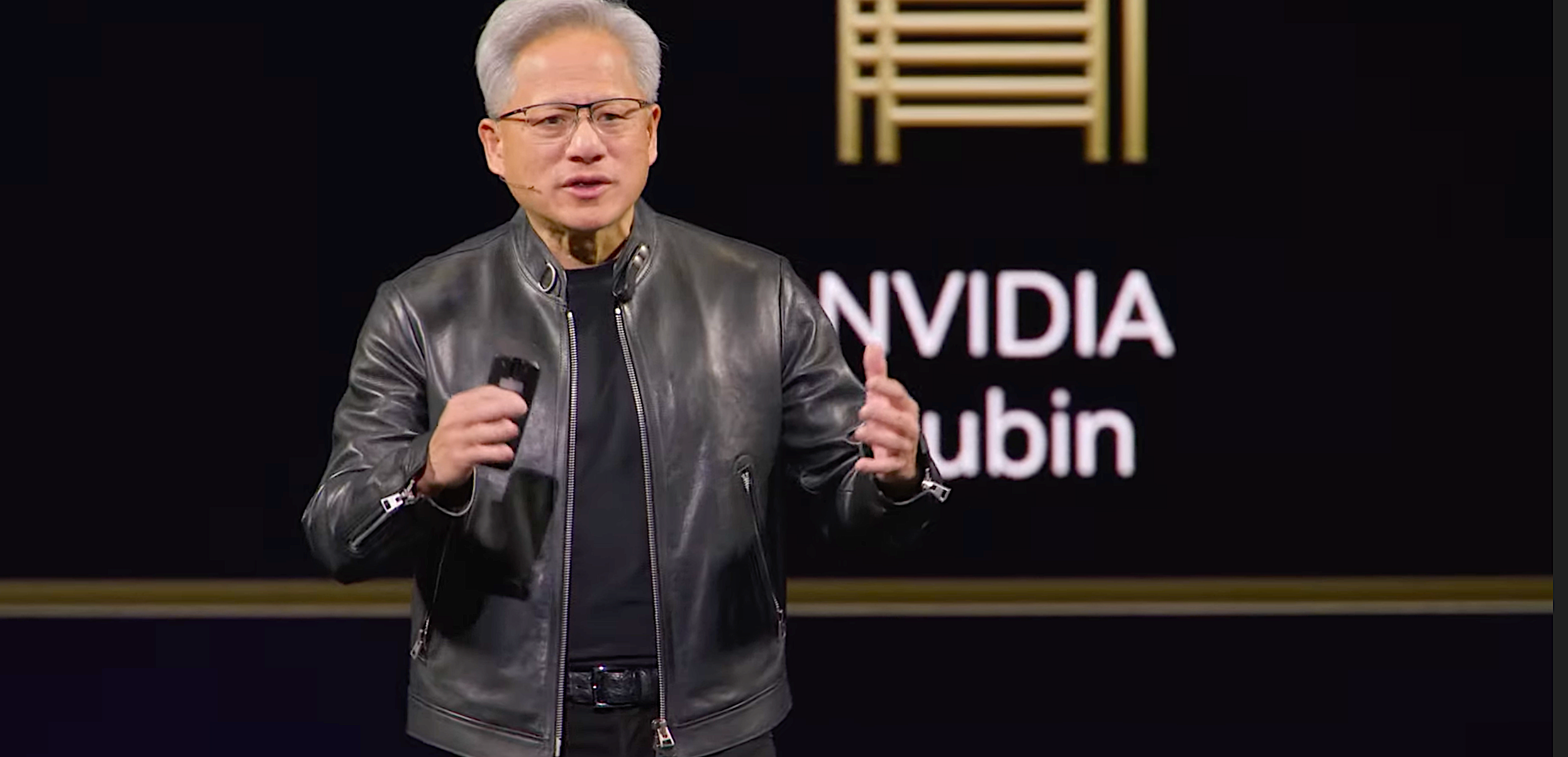
Huang’s talk track was as bullish as the numbers. “This was an extraordinary quarter,” he told investors. “Demand has gone parabolic. The reason is simple. Agentic AI has arrived. AI can now do productive, valuable work. Tokens are now profitable, so model makers are racing to produce more.” That framing has significant implications for cloud providers, chip rivals, enterprises and national strategies.
Nvidia is no longer talking about selling graphics processing units; it is talking about building “revenue-generating AI factories.” Today’s data centers, Huang argued, are constrained by power and capital, forcing operators to optimize for the lifetime cost of producing intelligence rather than the list price of a chip.
“Customers do not buy GPUs,” he said. “They build AI factories, and the right economic metric is not the GPU’s purchase price. It is the lifetime cost of an AI factory producing intelligence, measured in terms of tokens per watt, tokens per dollar, uptime, utilization, time to production, software durability and asset life. Nvidia excels at all of them.”
For the industry, this reframes competition. It’s no longer “my accelerator vs. your accelerator” at the component level. It’s a full stack that includes chips, interconnect, systems, software and an ecosystem, delivering the lowest cost per token and the fastest time to revenue. That favors tightly integrated platforms and hurts vendors trying to compete with point products or semi-custom silicon without a full software and systems story. This is why many industry watchers, including me, believe the moat around Nvidia is almost unbreachable. There are many other silicon providers, but none has as well-rounded a “stack” as Nvidia.
It also explains why AI infrastructure spending can scale to levels that once seemed outlandish. Nvidia cited analyst forecasts that hyperscaler capital expenditures would exceed $1 trillion in 2027 and projected AI infrastructure spending to reach $3 trillion to $4 trillion annually by the end of the decade. If AI factories directly translate into revenue and profit, those numbers start to look less like hype and more like table stakes.
To help investors understand its growth drivers, Nvidia is shifting to a new reporting framework with two main platforms: data center and edge computing. Within the data center, it will break out hyperscale and what it calls ACIE: AI clouds, industrial and enterprise.
Hyperscale, the big public clouds and the largest consumer internet companies made up about half of data center revenue this quarter. The other half, ACIE, includes AI-native clouds, sovereign AI projects, enterprise on-premises deployments and industrial AI factories. That second category is growing faster, from a slightly smaller base, and Nvidia expects it ultimately to be larger.
“The second category is all the AI-native cloud,” Huang said. “Enterprise on-prems, industrial on-prems, and sovereign AI. That segment is growing incredibly fast because everybody needs AI, and we’re going to see AI being adopted by every industry, every country, every company.” He noted that though hyperscale is concentrated in five or six players, the second category spans hundreds of thousands of companies globally. Strategically, this is where competition gets harder.
Serving the hyperscalers means winning a handful of massive, technically sophisticated buyers, which Nvidia is already doing. Serving the ACIE segment requires a vertically integrated platform that “just works,” a broad go-to-market motion and a vast catalog of CUDA-accelerated libraries for every vertical, from computational lithography to molecular dynamics. That’s a high barrier to entry for new entrants and helps explain why, in Huang’s words, “very few companies have exposure into the second category.”
One of the more forward-looking themes this quarter was Nvidia’s emphasis on agentic AI. That is, systems that autonomously orchestrate tools, call sub-agents and drive multistep workflows. This has direct consequences for the CPU side of the house and opens a massive new spigot for Nvidia.
Huang described agents as “harnesses” around large models. Systems such as OpenAI’s Codex or Anthropic’s Claude Code handle I/O, orchestration, memory management and tool use — for example, browsers, compilers and external apps. Those harnesses and tools run on central processing units, while the “thinking,” the actual inference and simulation, runs on GPUs.
“The world has 1 billion users, human users,” he said. “My sense is that the world is going to have billions of agents.” As those agents proliferate and spin off sub-agents that constantly call back into large models, demand for both CPU-based orchestration and GPU-based inference explodes.
Enter Vera, Nvidia’s new CPU “purpose-built for agentic AI.” Built on custom Arm cores and co-designed with Rubin GPUs and NVLink, Vera is designed not around cores per dollar but around tokens per dollar and performance per watt for agentic workloads. Huang said Vera “opens a brand-new $200 billion TAM for Nvidia” in a CPU market the company has never addressed before, and that every major hyperscaler and system maker is lining up to deploy.
The $200 billion CPU opportunity sits on top of, not instead of, the $1 trillion in Blackwell and Rubin platform revenue that Nvidia says it has line of sight to between 2025 and 2027. For cloud providers and enterprises, architecting for agentic AI means rethinking the CPU layer as much as the accelerator layer.
Another important signal from the call is how tightly Nvidia is binding itself to the frontier model ecosystem. Blackwell and, soon, Vera Rubin are not generic accelerators; they are increasingly co-designed with and for leading model makers.
“Our Blackwell architecture is everywhere, adopted and deployed by every major hyperscaler, every cloud provider and every major model maker,” Huang said. He highlighted OpenAI’s GPT-5.5, “co-designed for, trained with and served on Blackwell,” and noted that Nvidia now has deep collaborations with OpenAI, Anthropic, xAI, Meta, Google’s Gemini, Microsoft AI and others.
As a result, Nvidia’s share of frontier AI compute and frontier models is growing. Huang said the company’s coverage of Anthropic was “largely 0 until just recently” and that Nvidia will bring “quite significant, very significant” capacity online for the company across Amazon Web Services, Microsoft Azure, CoreWeave and other partners over the next two years. He added that “every single frontier model company will jump on Vera Rubin from the get-go,” and that this was not the case for Blackwell.
For the AI industry, that concentration has two effects. First, it accelerates innovation at the high end because model makers and infrastructure providers are optimizing together across silicon, systems and software. Second, it raises the bar for any challenger hoping to win meaningful frontier share without similar co-design relationships and full-stack integration.
Though the data center story understandably dominated the call, Nvidia also underscored that “physical AI,” robotics, autonomous vehicles, telco base stations and other edge systems are becoming a material business. Huang spent much of his GTC talk track on physical AI, so it was good to see the dialog continue during the earnings call.
Its edge computing platform generated $6.4 billion in revenue, up 29% year over year, driven by strong demand for Blackwell workstations and growing contributions from robotics and automotive. Over the last 12 months, physical AI generated more than $9 billion in revenue. Nvidia is working with partners like Uber on robotaxis across nearly 30 cities by 2028, as well as a wide range of industrial and surgical robotics projects.
Huang framed this as the third major segment of the company’s business after hyperscale and AI/enterprise data centers. “The next wave is physical AI with billions of autonomous and robotic systems operating in the physical world,” he said. With CUDA now extending to AI-RAN base stations, embedded medical instruments, and factory-floor automation, Nvidia is positioning itself as the default platform wherever AI must act in the real world, not just generate text or images.
For operators, original equipment manufacturers and industrials, that suggests AI capex will increasingly shift from centralized data centers to distributed, real-time systems at the edge. For Nvidia’s competitors, it raises yet another arena where a GPU-plus-software platform has a first-mover advantage.
Huang closed the call by tying these threads together: “The world is rebuilding computing for agentic AI and robotic physical AI,” he said. “Nvidia sits at the center of these transitions.… We built it ahead of this moment so that when agentic AI arrived, Nvidia would be ready. It has arrived.”
Nvidia has been and continues to be the de facto operating system of the AI economy and raises the stakes for everyone else in the ecosystem. The company isn’t just surfing a capex wave; it’s actively defining the blueprint for AI factories, agentic architectures and physical AI at the edge, in ways that reshape how cloud providers invest, how enterprises plan their roadmaps and how chip rivals must respond.
Jensen Huang’s core message – that “customers do not buy GPUs, they build AI factories” and that the metric that matters is tokens per dollar over the life of those factories — will likely inform company leaders on how to approach their AI strategy.
Zeus Kerravala is a principal analyst at ZK Research, a division of Kerravala Consulting. He wrote this article for SiliconANGLE.
Support our mission to keep content open and free by engaging with theCUBE community. Join theCUBE’s Alumni Trust Network, where technology leaders connect, share intelligence and create opportunities.
Founded by tech visionaries John Furrier and Dave Vellante, SiliconANGLE Media has built a dynamic ecosystem of industry-leading digital media brands that reach 15+ million elite tech professionals. Our new proprietary theCUBE AI Video Cloud is breaking ground in audience interaction, leveraging theCUBEai.com neural network to help technology companies make data-driven decisions and stay at the forefront of industry conversations.