 EMERGING TECH
EMERGING TECH
EMERGING TECH











EMERGING TECH

A rocket built by Jeff Bezos’ Blue Origin Enterprises LP exploded late Thursday ahead of a planned launch next week.
The New Glenn heavy-lift vehicle was set to carry 48 of Amazon.com Inc.’s Leo satellites into low-Earth orbit. The retail and cloud giant is building an internet constellation designed to provide connectivity in remote areas. The satellites weren’t on the rocket at the time of the accident.
The explosion occurred during a static test, an exercise in which engineers activate a rocket’s engines at full thrust to check that they work. Ars Technica cited sources as saying that the explosion severely damaged the launch site. It’s believed that a lighting tower and a vehicle used to transport New Glenn to the launchpad are damaged beyond repair.
“It’s too early to know the root cause but we’re already working to find it,” Bezos wrote in a post on X. “Very rough day, but we’ll rebuild whatever needs rebuilding and get back to flying. It’s worth it.”
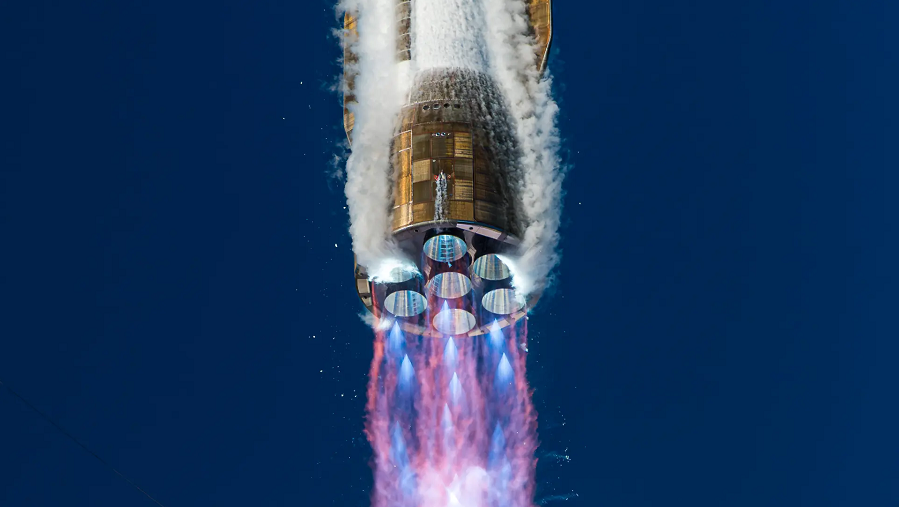
The New Glenn stands 320 feet tall and comprises two segments, or stages. The first stage, which is responsible for taking the rocket to orbit, features seven engines (pictured) fueled by liquid oxygen and methane. The second stage uses two hydrogen-powered engines to navigate the vacuum of space.
According to Ars Technica’s sources, the malfunction that led to the explosion appeared to affect the engine section of the first stage. The New Glenn’s first stage is designed to return to Earth after releasing its payload. That capability, which Blue Origin first demonstrated last November, enables the rocket segment to be reused and thus launch costs. The company’s long-term goal is to reuse each first stage at least 25 times.
One of the payloads that the New Glenn can carry is the Blue Moon Mark 1, a lander designed to deliver cargo to the moon. It has a capacity of three tons. A few days before the accident, Blue Origin won a $188 million NASA contract to launch two moon rovers aboard a Blue Moon Mark 1.
It’s unclear how the Thursday test failure will affect the company’s mission roadmap. The Cape Canaveral launchpad where the explosion occurred is Blue Origin’s sole operational rocket platform. The company recently began building a second launch site nearby, but construction is still in an early stage.
Blue Origin has completed three successful New Glenn flights since the start of 2025. The company was reportedly planning to adopt a monthly launch schedule before the accident. In the longer term, Blue Origin intends to deploy an upgraded version of the New Glenn with significantly more cargo capacity.
Rival SpaceX Corp. performed a test flight of its own next-generation launch vehicle, Starship V3, a few days before the accident. The rocket successfully deployed its payload and its first stage returned to Earth. However, the second stage didn’t land as smoothly as the company had planned, which led the U.S. Federal Aviation Administration to ground Starship temporarily pending a review.
Support our mission to keep content open and free by engaging with theCUBE community. Join theCUBE’s Alumni Trust Network, where technology leaders connect, share intelligence and create opportunities.
Founded by tech visionaries John Furrier and Dave Vellante, SiliconANGLE Media has built a dynamic ecosystem of industry-leading digital media brands that reach 15+ million elite tech professionals. Our new proprietary theCUBE AI Video Cloud is breaking ground in audience interaction, leveraging theCUBEai.com neural network to help technology companies make data-driven decisions and stay at the forefront of industry conversations.