 AI
AI
AI
AI







AI

Useful artificial intelligence has arrived, and if Nvidia Chief Executive Jensen Huang is right, it is about to reshape not only data centers but also the structure of the global economy and the tech labor market.
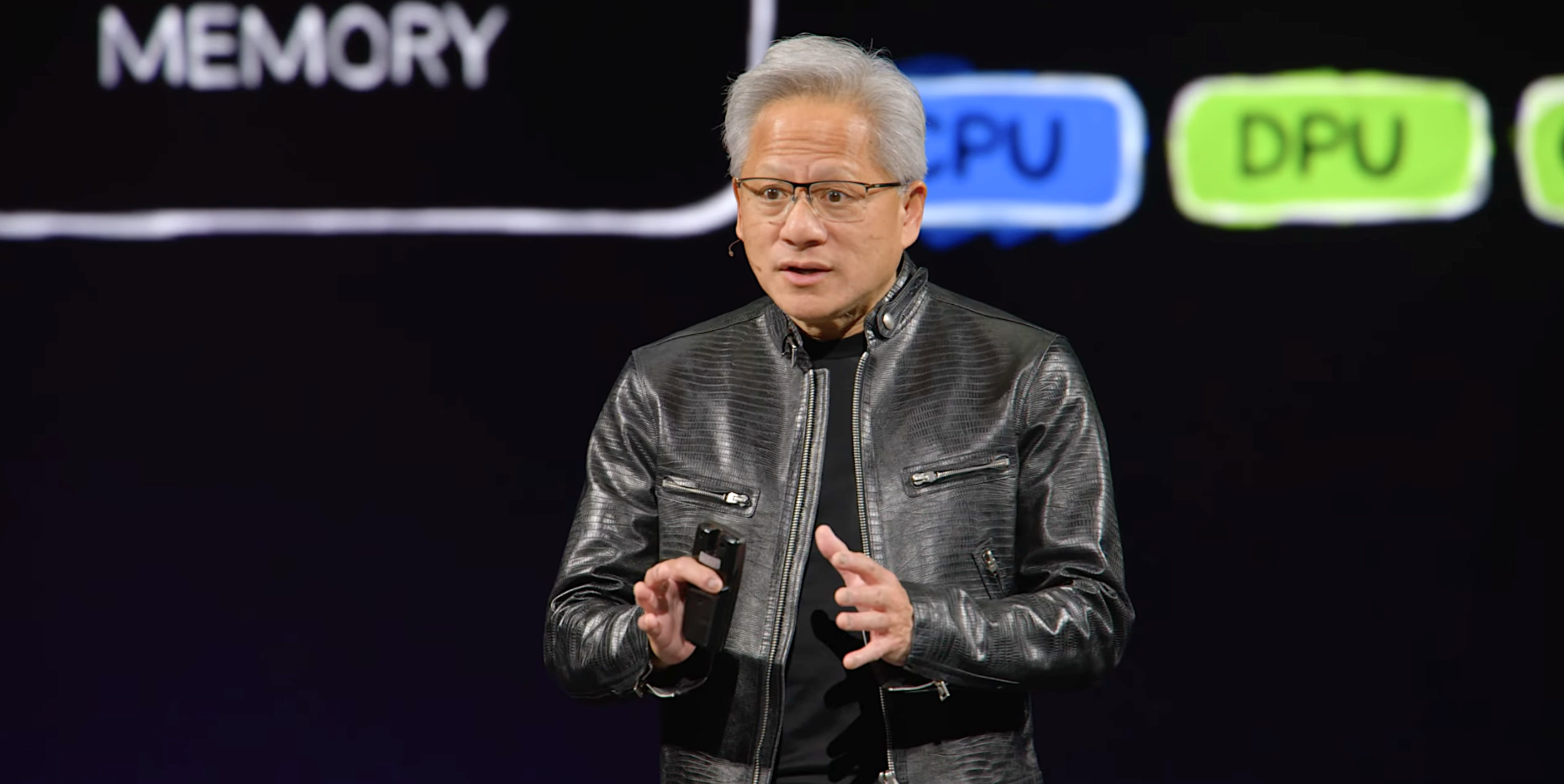
In his GTC Taipei 2026 keynote, Huang laid out his vision for the “age of agents,” agentic AI systems that don’t just answer questions but also observe, reason, plan and act across distributed infrastructure. For enterprise information technology leaders, the key message was that compute is now directly convertible into revenue, and that the architectural choices they make over the next few years will define both competitiveness and cost structure in an AI-saturated world.
Below are five takeaways from Huang’s keynote:
Huang’s first major claim was that the industry has moved beyond experimentation to deliver economic impact. “Today we can say that agentic AI has arrived, that useful AI has arrived,” he told the Taipei audience. He backed that up with GitHub data: Commits have nearly tripled between 2023 and early 2026, even though the number of professional developers has not. In his framing, the roughly 30–40 million software developers are now generating vastly more output thanks to AI copilots.
Crucially, Huang dismissed the idea that AI is a net job destroyer. Pointing to the massive productivity uplift, he argued that the economics are selfreinforcing: if each developer can now generate “$9 trillion worth of productive work” for $3 trillion in salary, enterprises will want more developers, not fewer. “People talk about AI reducing jobs – complete nonsense,” he said. “If you can hire a software engineer and generate $9 trillion worth of productive work, why wouldn’t you want to hire more software engineers?” For chief information officers and chief technology officers, that frames AI not as a headcount-reduction lever but as a force multiplier for already scarce technical talent. Businesses have lived through technical staffing shortages for decades, and AI can help close that gap.
The second major takeaway is that the core economic unit of AI has shifted. In Huang’s words, “tokens are now profitable units of revenues.” Once you assume tokens – the slices of model output that power copilots, agents, and generative services – are directly monetizable, the industry logic shifts: every token generated efficiently is incremental revenue, and every watt wasted is foregone profit.
Huang linked this directly to the current supply-demand imbalance in high-end compute. Because AI services can now be priced and measured in tokens, “AI companies want to build a lot more tokens, generate a lot more tokens, build more AI factories, which is the reason why compute demand here in Taiwan has skyrocketed.” He was explicit that data center design is becoming an exercise in financial engineering: “If you have 1 gigawatt of power, then throughput per watt is revenues, because every token is profitable, every token is revenues.”
For cloud providers and enterprises building their own clusters, the implication is to choose architectures that maximize tokens per watt and minimize time-to-first-token, or risk being permanently behind on unit economics. That may seem overly dramatic but in AI, a little behind will lead to a widening gap over time.
Huang spent a significant portion of the keynote defining what he means by an “agent” and why that matters more than traditional apps. In the old world, you had code running in an application on an operating system. In the new world, “it is an agent, which consists of a large language model or many sitting inside a harness, and that harness orchestrates it to do productive work.”
That harness manages the lifecycle of work. It understands the user’s intent, observes context, reasons, plans, calls tools, and juggles working memory with long-term memory, whether those tools are spreadsheets, compilers, databases, or CUDA-accelerated libraries. Huang likened it to a person in a workshop: “You can think of the model as the brain, the harness as the body, and the tools it uses working in a runtime. Think of it as a workshop.”
This represents a fundamentally disaggregated and distributed computing pattern in which different stages of an agent’s loop activate distinct parts of the data center, such as graphics processing units for thinking, central processing units for tools, data processing units for security, storage for memory, and fabric for orchestration. For enterprises, the shift is not just adopting large language model application programming interfaces but redesigning systems, workflows and even org charts around agents that can own entire business processes end-to-end.
If agentic AI is the new workload, the new unit of infrastructure is the “AI factory.” Huang described AI factories as the largest infrastructure buildout in human history, with single sites heading toward 1 gigawatt and capital costs “at $50 billion to $60 billion, and soon it will be $80 billion to $100 billion per gigawatt.” These facilities must “work the first time, and it must work right away,” because any delay is extremely expensive idle capital.
To address that, Nvidia is pushing DSX, a full-stack blueprint for designing and operating AI factories, spanning simulation in Omniverse (DSX SIM), runtime operations (DSX OS), and power optimization (DSX Max LPS and DSX Flex). The idea is to co-design chips, racks, networking, power, cooling and grid interactions as a single system, then validate it in a digital twin before “a single rack lands.”
Huang was clear that this marks another transformation for Nvidia. “A long time ago, Nvidia used to be a GPU company, but over the years, we’ve evolved to become a systems company,” he said. Now, “Nvidia has really started to transform ourselves yet again” into an AI infrastructure company that helps customers build entire AI factories, not just buy servers. For hyperscalers, telcos, and a growing tier of regional clouds, this positions Nvidia as a strategic partner across the technical and economic architecture of AI.
Finally, Huang introduced Vera Rubin and Vera CPUs as hardware platforms purpose-built for the agentic era. Vera Rubin is not a single GPU; it is a multi-rack, pod-scale system that integrates next-generation GPUs, Vera CPUs, BlueField DPUs, Grok LPUs, NVLink 72, and Spectrum-X into a cable-free rack design to maximize throughput, reliability, and assembly speed. “Vera Rubin is the most ambitious endeavor in the history of our company,” he said, noting that what used to take two hours to assemble in Grace Blackwell racks now takes about five minutes.
On the CPU side, Vera is pitched as “the CPU for agents,” featuring a monolithic 88-core design, high instructions per clock, extreme per-core bandwidth, LPDDR5X memory, and fabric bandwidth built to remove CPU bottlenecks that limit GPU utilization. Historically, CPUs were built “for humans,” rented by the core and measured in seconds; agents, Huang argued, “live in a world that’s in nanoseconds” and are impatient with tool calls and database access. The four design pillars he highlighted were single-thread performance, bandwidth per core, total bandwidth, and energy efficiency – the last being critical to pack more CPU into a fixed power envelope without stealing watts from token generation.
Huang summarized the new division of labor: “The CPU is now the conductor, and the GPU is the orchestra.” For enterprises, that translates into a new optimization problem: design systems in which CPUs, GPUs, DPUs, and storage are co-tuned to agents’ latency and throughput needs, rather than treating CPUs as general-purpose workhorses and GPUs as isolated accelerators.
Jensen Huang’s keynotes have become must-see TV, regardless of the time zone. His message from Taipei is that the AI story has moved beyond proofs of concept and into production. This shift moves the narrative from bits and bytes to a discussion of economics, architecture and operational discipline. Useful AI is here. It is creating more work for more people, and the winners will be those who can translate tokens, watts and racks into durable business advantage. It’s time to recognize that the risks of not hopping on the AI train far outweigh the risks of moving too fast.
Zeus Kerravala is a principal analyst at ZK Research, a division of Kerravala Consulting. He wrote this article for SiliconANGLE.
Support our mission to keep content open and free by engaging with theCUBE community. Join theCUBE’s Alumni Trust Network, where technology leaders connect, share intelligence and create opportunities.
Founded by tech visionaries John Furrier and Dave Vellante, SiliconANGLE Media has built a dynamic ecosystem of industry-leading digital media brands that reach 15+ million elite tech professionals. Our new proprietary theCUBE AI Video Cloud is breaking ground in audience interaction, leveraging theCUBEai.com neural network to help technology companies make data-driven decisions and stay at the forefront of industry conversations.