 INFRA
INFRA
INFRA
INFRA


INFRA

The South Korean government today announced a 900 trillion won, or $584 billion, initiative to grow the country’s chip manufacturing capacity.
Officials also plan to build about $357 billion worth of artificial intelligence data centers.
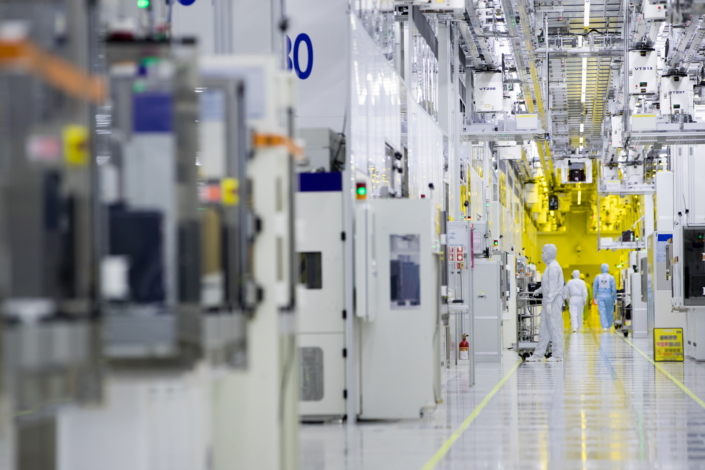
The chip manufacturing initiative will be led by Samsung Electronics Co. and SK hynix Inc., which intend to open two new fabs apiece. Most of South Korea’s semiconductor production infrastructure is located near Seoul. By contrast, the new Samsung and SK hynix facilities are set to be built in South Korea’s southwestern region.
Samsung executives indicated that the company will likely construct its fabs in the southwestern city of Gwangju, which is about a four-hour drive from Seoul. SK hynix, for its part, is still in the process of finding a fab suite. Chey Tae-won, the company’s chair, stated today that building its current flagship manufacturing campus took nine years.
A sizable percentage of the upcoming fabs’ capacity will likely be dedicated to RAM production. Samsung and SK hynix are the world’s two largest memory manufacturers. The former company leads in the DRAM and flash segments, while SK hynix accounts for more than half of global HBM production. HBM is a high-speed memory variety that is widely used in AI chips.
The upcoming fabs will likely use a mix of new and legacy nodes. The reason is that RAM cells, the basic building blocks of a memory chip, contain tiny energy storage devices called capacitors. Memory-grade capacitors can only be made using legacy nodes because shrinking them below 10 nanometers causes technical issues.
An HBM chip contains not only memory cells but also a logic die, a component that helps coordinate the flow of data. It also performs certain related tasks including errors correction. Unlike capacitors, the logic die is usually produced using cutting-edge processes.
SK hynix focuses exclusively on memory production, while Samsung also has a processor manufacturing business. The company debuted its first two-nanometer processor, the Exynos 2600, in December. It’s a mobile system-on-chip that includes a central processing unit, an AI accelerator and a post-quantum cryptography module.
Samsung and SK hynix are committing 800 trillion to South Korea’s chip manufacturing effort. The city of Gwangju, where the former company plans to build its fabs, and South Jeolla Province will contribute up to 20 trillion won. Furthermore, industry players plan to spend 81 trillion won on upgrading the chip packaging infrastructure in central South Korea.
Separately, government officials announced plans to invest more than 1,000 trillion won in AI data centers by 2035. The goal is to add 18.4 gigawatts of computing capacity. The initiative is set to include the participation of SK Group, SK hynix’s parent company.
Support our mission to keep content open and free by engaging with theCUBE community. Join theCUBE’s Alumni Trust Network, where technology leaders connect, share intelligence and create opportunities.
Founded by tech visionaries John Furrier and Dave Vellante, SiliconANGLE Media has built a dynamic ecosystem of industry-leading digital media brands that reach 15+ million elite tech professionals. Our new proprietary theCUBE AI Video Cloud is breaking ground in audience interaction, leveraging theCUBEai.com neural network to help technology companies make data-driven decisions and stay at the forefront of industry conversations.