 APPS
APPS
APPS
APPS


APPS

There remains a common misconception that Zoom is a meeting app. Though Zoom Communications Inc. arguably does meetings better than anyone, it has evolved into a broad work platform. Mount Sinai Health System in New York treats Zoom as core infrastructure.
Zoom recently held a webinar with Mount Sinai to discuss the deployment. What I found interesting is that, despite the rapid growth of cloud communications across most industries, healthcare has remained a holdout thanks to the critical nature of communication in that industry. I recently had a conversation with a U.K. healthcare organization, where the chief information officer told me he needs to ensure clinicians can make calls regardless of any macro issue. The Mount Sinai deployment can serve as a proof point for Zoom and its cloud peers in mission-critical environments.
Over the past two years, Mount Sinai has rearchitected its use of Zoom across telehealth, clinical voice, nursing mobility, education and artificial intelligence-assisted productivity — effectively turning the platform into a collaboration fabric for care delivery and operations.
“We focus on providing exceptional medical care to our communities,” said Rudra Hirlau, head of Workplace Technology at Mount Sinai. “For us, that starts with communication.” On that premise, Zoom evolved from a video client into a core enabler of how the health system delivers care.
Adding to the story is that the design decisions Mount Sinai made under healthcare constraints — Epic integration, HIPAA alignment and clinician workflows — map directly onto the challenges CIOs and chief technology officers are grappling with across industries.
To its credit, the Workplace Technology team at Mount Sinai didn’t approach the project with a feature checklist. Instead, it started with outcomes. “Any project or initiative we embark on, we start by looking at our business objectives and the desired outcomes,” Hirlau explained.
Before any new Zoom initiative moved forward, they anchored it in four objectives: simplify and transform telecommunications, increase “impact velocity” for new capabilities, optimize costs (including staff time), and improve the patient and clinician experience by keeping technology simple and friction-free.
Because the health system was already a long-time Zoom Meetings and Webinar customer, the information technology organization could rely on existing familiarity. “We were already a user of Zoom, and the ease of use with the platform was already there among our colleagues,” Hirlau said. “So, we wanted to leverage that as we tried to simplify and move toward a single platform.”
That discipline translates directly to other sectors. Whether you’re running a global contact center or a distributed factory network, the pattern remains the same: define the business objectives first, then work backward to platform and architecture choices. Collaboration tooling is no longer just about audio and video; it’s about impact velocity and the frontline experience.
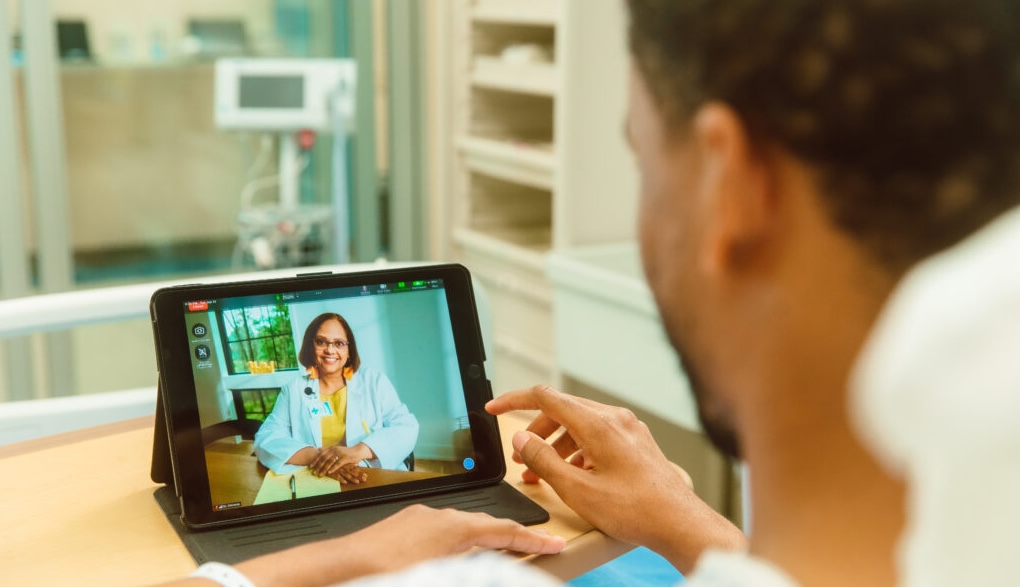
On the clinical side, Mount Sinai integrated Zoom Meetings with Epic to enable telehealth across primary care, ambulatory clinics and urgent care. Epic remains the system of record, but the “front door” experience runs through Zoom, which proved especially important for adoption and completion rates during the health system’s switch to a telehealth platform. Heidi West of Zoom recalled that telehealth completion rates improved to the 80% to 90% range almost immediately.
The bigger story is Zoom Phone. Mount Sinai made a deliberate choice not to treat Zoom Phone as a one-for-one PBX swap. In the Patient Transfer Center or PTC, which coordinates patient movement and access to specialty care across the system, Zoom Phone now supports up to 10 simultaneous calls per user, recording for continuous improvement, and highly customized queues tailored to clinical workflows.
“This was our first major Zoom Phone rollout, and it was by no means simple or easy,” Hirlau said. “But at the end, this was a very successful rollout. We were able to decrease our wait times, reduce abandonment rates, make callers happier and overall improve the time to care.” The PTC’s 50 users now handle around 40,000 calls per month on Zoom Phone, with trouble tickets from the legacy system dramatically reduced.
The “Sinai Phone” initiative goes further. Every nurse receives a mobile device loaded with key clinical applications and the Zoom client, anchored by click-to-dial integration with Epic. “The solution we came up with was a mobile device for each nurse that’s loaded with all the key clinical applications they need on a day-to-day basis, and on top of that include the Zoom application,” Hirlau said. Nurses can tap a number in the EMR to place a call over Zoom Phone and receive calls directly on their mobile devices. Adoption has been strong enough that Mount Sinai plans to double the deployment by year’s end, with nursing leaders publicly calling the change “life-changing” for their workflows.
Strip away the clinical language, and this looks a lot like what banks want in branch operations, what utilities want in field service, and what manufacturers want on the plant floor: programmable voice integrated directly into systems of record and frontline workflows, not a standalone system sitting off to the side.
Mount Sinai is also a Microsoft shop, but it didn’t turn the Zoom-versus-Teams debate into a religious war. Instead, the Workplace Technology team talks about avoiding a “petting zoo” of overlapping applications and about designing ecosystems.
“When I talk about consolidating functionality and applications into a platform, you have to think of it as an ecosystem,” Hirlau said. “We shouldn’t be, when it comes to tools and applications, a petting zoo with one of everything or two of everything. Look at the ecosystems you really want to build.”
The approach:
Most large enterprises already have multiple collaboration platforms in use. The lesson is to stop obsessing over which tool “wins” and instead define roles: which platform owns which ecosystem, how they integrate with systems of record, and where you can safely retire redundancy.
Mount Sinai’s rollout of Zoom’s AI Companion is another example of how healthcare constraints are driving the development of a reusable template. The health system has enabled AI features for every licensed employee — but only after a rigorous pilot with cybersecurity and compliance teams.
“First off, going back to Zoom and ensuring that the Zoom AI component was HIPAA-compliant was obviously very important to us as a health system,” Hirlau noted. “We also conducted a very in-depth analysis with our cybersecurity and compliance teams before we even considered rolling this out to everyone else.”
A key sticking point was ensuring that meeting content didn’t become training data. “We wanted to ensure that it never leaves our tenant or is ever used to train anything from a third-party perspective,” he said. Mount Sinai also chose not to enable features such as automatically starting AI Companion or auto-generated meeting summaries; instead, end users decide when a meeting is appropriate for AI assistance.
Once those conditions were met, the organization shifted its focus to value: reclaiming minutes in the day through summaries, follow-ups and action item extraction. In regulated industries, that arc — pilot, verify data handling, then scale — is becoming the norm for AI-driven collaboration.
One of the most powerful practices Mount Sinai has institutionalized is “rounding” — sending IT, engineering and vendor teams to the clinical floors to observe workflows, speak with clinicians, and see how technology performs in context. Zoom joined these rounds, meeting with nurses, physicians and educators across departments, including labor and delivery and mother-baby units.
“These sessions are so valuable because we collect information, hear feedback from our clinicians, doctors, and nurses, and witness the workflows firsthand,” Hirlau said. “Since that session, there’s been a lot of good work that’s come out of the feedback we collected.”
For enterprises outside healthcare, rounding is a low-tech practice that yields high dividends. Whether you call it branch walks or shop-floor visits, the idea is to stop designing collaboration and communications solely from dashboards and instead co-design with the people who actually use the tools.
Despite multiple successful deployments, Mount Sinai is clear that it’s still on the journey to modernize and migrate off its legacy PBXs. “Even though we finished a lot of these migrations, in our mind it’s a learning process,” Hirlau said. “In the spirit of continuous process improvement, do we need to go back and look at anything?” Each rollout is followed by a cycle of reviewing statistics, tuning queues, adjusting workflows and identifying new use cases — across clinical, educational, and public engagement.
That continuous improvement mindset should be baked into CIOs’ and CTOs’ collaboration and voice strategies. The “go-live” date isn’t the finish line; it’s the start of the optimization loop. Success metrics aren’t just seats migrated — they also include ticket reductions, improvements in key performance indicators such as abandonment rates, and frontline satisfaction.
Zeus Kerravala is a principal analyst at ZK Research, a division of Kerravala Consulting. He wrote this article for SiliconANGLE
Support our mission to keep content open and free by engaging with theCUBE community. Join theCUBE’s Alumni Trust Network, where technology leaders connect, share intelligence and create opportunities.
Founded by tech visionaries John Furrier and Dave Vellante, SiliconANGLE Media has built a dynamic ecosystem of industry-leading digital media brands that reach 15+ million elite tech professionals. Our new proprietary theCUBE AI Video Cloud is breaking ground in audience interaction, leveraging theCUBEai.com neural network to help technology companies make data-driven decisions and stay at the forefront of industry conversations.