 AI
AI
AI
AI





AI

Salesforce Inc. today introduced Slack Code, a new way to interact with coding agents in chat, with the whole team in the loop so everyone can see what’s happening at the conversational level.
Coding agents are slowly changing how developers code; they’re also changing how enterprises build software. Salesforce has been pushing the idea that all work is a “multiplayer sport,” a trend wound deeply into the talking points about Slack, the company’s cloud-based messaging app for getting work done – and that includes software development.
Now that coding agents are quickly becoming part of the team, both developers and non-expert team members interact with them directly to build apps for the enterprise. It’s becoming more important for them to become part of the conversation and for those conversations to remain visible to everyone involved.
“All this individual work is a solo player sport,” Slack Chief Marketing Officer Ryan Gavin told SiliconANGLE in an interview. “The knowledge and the speed at which you’re acting as an individual stays with you as an individual, and you’re not getting an exponential return for the organization.”
With today’s announcement, Salesforce is opening up Slack to become a more collaborative, open space for teams to work directly with coding agents. This includes well-known agents such as Anthropic PBC’s Claude Code, Vercel Inc.’s v0, Cognition AI Inc.’s Devin, OpenAI Group PBC’s ChatGPT and others.
A team could start a discussion in a channel about a new feature they want added to an app or a bug they discovered. Traditionally, this would end with the group breaking apart to their separate terminals and agents, doing their own pieces, submitting code, reviewing it, then throwing it back on the pile and coming back to meet again.
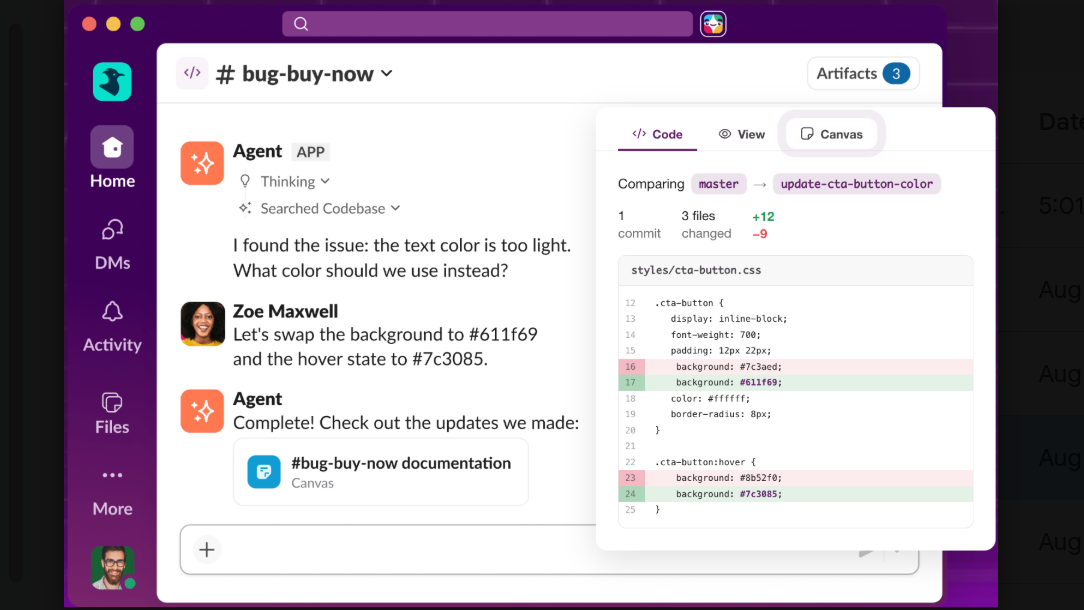
Slack Code is bringing about a different paradigm. Now a team member can tag a coding agent; it opens a Code Channel, spins up an agent space to work on the problem, and displays the code output in a canvas. This includes artifacts such as code changes (diffs of before and after), as well as a working preview for the team to review.
“The question is, how do you compress going from an idea that’s often spurred by a team into code that’s being built by a team – then into code that’s being deployed by a team,” said Gavin.
Ryan described the benefit as “accelerated learning,” where both the team and the AI agents benefit from having more of the work happen in the open instead of individually. Slack Code won’t completely replace the need for engineers to do hard coding work in terminals and IDEs, where the nuts and bolts go together, but it will make sure that the scaffolding comes together with the right amount of feedback at the right time.
In his view, this will reduce lifecycle churn when developers build work and then have to review it and tear it down because it’s discovered the work was done in a direction the team didn’t want to preserve. Ryan noted that agents are already compressing work itself; AI is making coding faster, opening up more time for strategy, creativity, optimization and sharing enhancements.
Ideally, this will also allow developers to bring in interested parties from outside their team early on to provide feedback. For example, when making changes that affect user-facing design, marketing or design team members could be brought in, or others could be pinged for their thoughts to help guide development before a project gets underway.
Conversely, a marketing or business unit could spin up their own coding agent to ideate and begin work on their own app, and get through the early stages of coding. Then, once they are deep enough into the integration phase and think they’re ready for prototyping and deployment, they can tag an engineer to come check the work and fine-tune it enough to make it ready for prime time.
Since all of these conversations live in Slack, they continue to persist even after the conversations are done. The teamwork, the agentic artifacts, the GitHub repo links, the diffs, canvases and all the context generated by the time spent gets archived afterward. This means that the team can go back through their work and see where they came from and where they wanted to go.
“For companies to unlock the full value from AI, it has to move beyond individual productivity gains to operational transformation,” said Valoir Research Chief Executive Rebecca Wettemann. “Slack Code enables AI to move beyond individual copilots to embedded, contextual AI orchestration.”
Salesforce said Slack Code is available starting today, providing access to agents from numerous AI vendors, using any Slack plan. Additional connectors can be built using application programming interfaces to third-party agents and harnesses. Access to the agent of choice is required before it will work.
Support our mission to keep content open and free by engaging with theCUBE community. Join theCUBE’s Alumni Trust Network, where technology leaders connect, share intelligence and create opportunities.
Founded by tech visionaries John Furrier and Dave Vellante, SiliconANGLE Media has built a dynamic ecosystem of industry-leading digital media brands that reach 15+ million elite tech professionals. Our new proprietary theCUBE AI Video Cloud is breaking ground in audience interaction, leveraging theCUBEai.com neural network to help technology companies make data-driven decisions and stay at the forefront of industry conversations.