 BLOCKCHAIN


BLOCKCHAIN

Google LLC’s cloud unit is preparing to launch a service designed to help financial institutions secure clients’ digital assets.
The offering is called Google Multi-Party Compute, Coindesk reported today, confirmed on X by a Google product manager. It’s currently being tested by a group of early adopters described as major financial sector players. Additionally, Google parent Alphabet Inc. is using it to secure its Ethereum and Solana holdings.
Cryptocurrency holders keep their assets in applications called crypto wallets. Every wallet is protected by a unique private key, a snippet of data with a role analogous to a password. Hackers who obtain a wallet’s private key can steal its contents with relative ease.
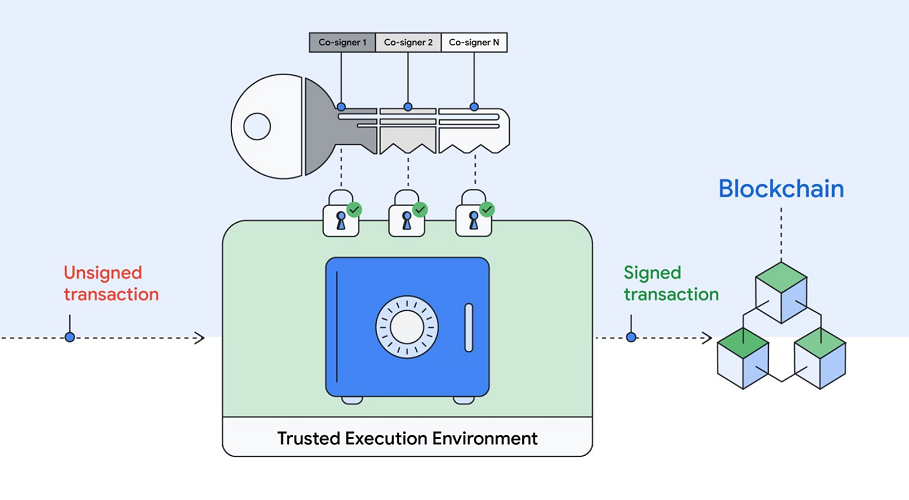
Google’s Multi-Party Compute service improves the security of crypto wallets by making their private keys harder to steal. It achieves that using an approach called multi-party computation, or MPC.
A wallet’s private key is usually stored on a single device. If hackers compromise that device, they can access its private key. MPC mitigates that attack vector by splitting keys into multiple fragments and storing each one on a separate system. The more devices hackers must breach to steal a key, the less feasible it becomes to do so.
Different MPC services split keys in different ways. Some represent each key fragment as a point on a curved line. When a user needs to make a transaction, the key is mathematically reconstructed from the points. Another popular approach, TSS, never reconstructs the key to avoid creating an opening for hackers.
Multi-Party Compute will reportedly enable users to customize how MPC is applied to their crypto wallets. Notably, it will provide the ability to adjust the number of key fragments needed to authorize a transaction. For example, a bank might allow users to approve low-risk payments with three of a key’s five fragments.
The ability to authorize transactions using only a subset of a key’s fragments rather than all of them makes it possible to store away a few fragments in an offline vault. Those offline fragments make it easier to recover the key in the event of a data loss event. Additionally, they simplify certain regulatory compliance tasks.
Multi-Party Compute will also offer other customization options. According to today’s report, the service will enable users to split keys across Google Cloud, rival platforms and on-premises hardware. Additionally, it will verify that each transaction complies with a set of user-defined policies before clearing it. For example, a bank could create a policy that blocks outflows to untrusted wallets.
The code that checks whether transactions comply with user policies will reportedly run in Confidential Spaces. Those are Google Cloud containers powered by a custom, hardened operating system. It encrypts network connections and lacks common operating system features that are sometimes used by hackers to launch cyberattacks.
Multi-Party Compute is currently in private preview. Google plans to make it generally available in early 2027.
Support our mission to keep content open and free by engaging with theCUBE community. Join theCUBE’s Alumni Trust Network, where technology leaders connect, share intelligence and create opportunities.
Founded by tech visionaries John Furrier and Dave Vellante, SiliconANGLE Media has built a dynamic ecosystem of industry-leading digital media brands that reach 15+ million elite tech professionals. Our new proprietary theCUBE AI Video Cloud is breaking ground in audience interaction, leveraging theCUBEai.com neural network to help technology companies make data-driven decisions and stay at the forefront of industry conversations.