 AI
AI


AI

For several years, the conversation about enterprise artificial intelligence has focused on capability: which model is smartest and which GPU is fastest. That made sense when technology was the constraint.
It isn’t anymore. AI can now do far more than most organizations will allow, and the gap is trust.
That’s the core finding of “Permission to Scale: The Critical Role of Trust in Successful AI Adoption,” new research released today at Cisco Systems Inc.’s Cisco Live APJC in Melbourne. Authored by independent researcher Brad Howarth, the study draws on data from 25 Australian organizations.
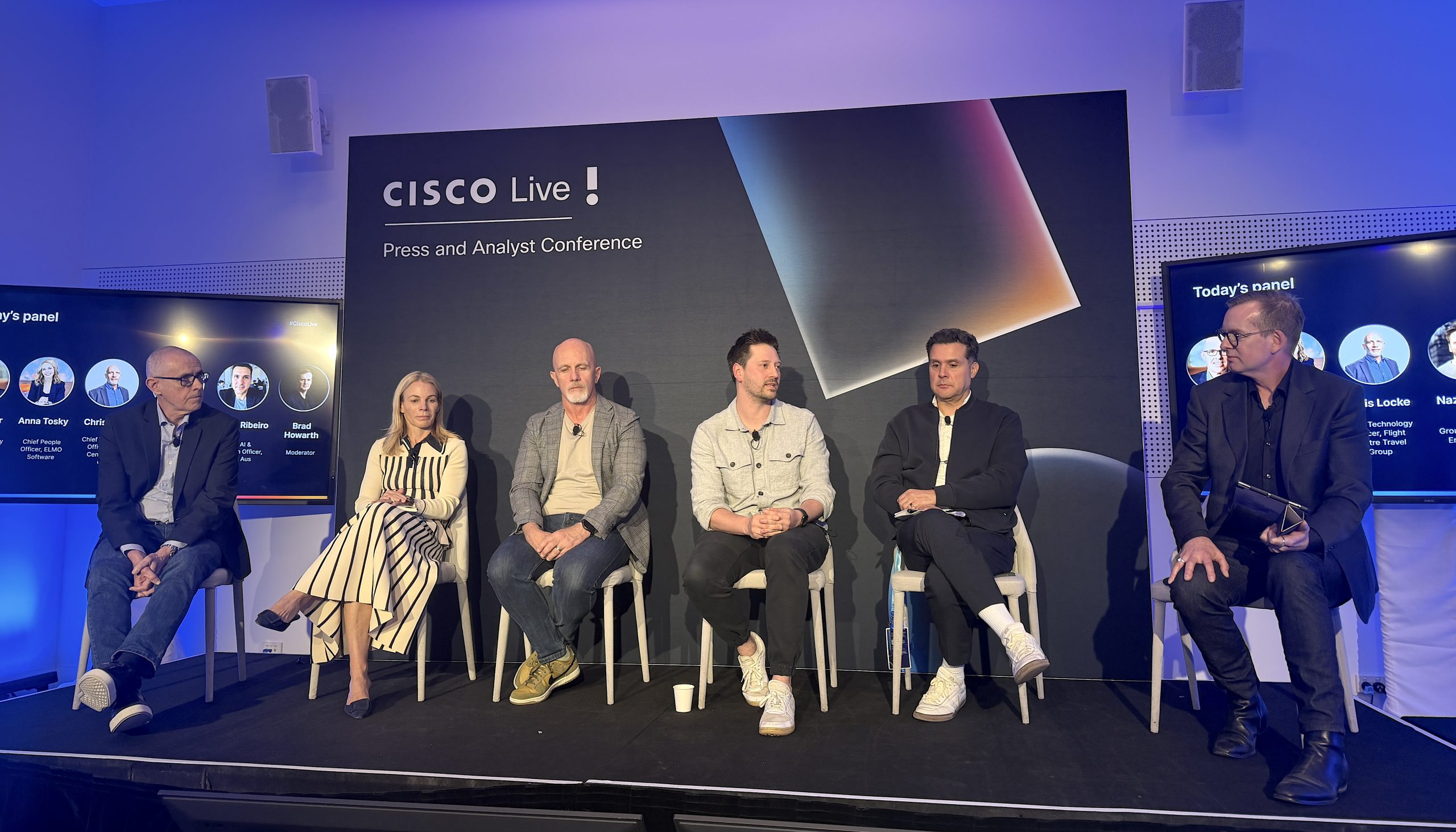
At Cisco Live APJC, Cisco hosted a press panel to discuss the report. The panel, moderated by Howarth, featured a number of corporate leaders from companies that participated in the report, including Carl Solder, chief technology officer of Cisco ANZ (far left); Anna Tosky, chief people officer at Elmo Software (second from left); Chris Locke, CTO at Flight Center Travel Group (third from left); Naz Wilson, group culture and enablement manager at Funlab (third from right); and Lucio Ribeiro, chief AI officer at TBWA Australia (second from right).
Though a sample size of 25 is small, the results align with conversations I’ve had with corporate leadership. I appreciated the panel’s mix of technologies, human resources and cultural leadership. I also valued the mix of roles, as the biggest barrier to scaling AI isn’t technical but people-related.
Australia makes an interesting test case. According to University of Melbourne and KPMG research cited in the report, half of Australians use AI regularly, but only 36% trust it, and just 30% believe its benefits outweigh its risks. That’s the lowest among 47 countries surveyed. If you can build trust in AI in Australia, that work will scale globally. In the press release, Stefan Leitl, vice president and general manager of Cisco Australia and New Zealand, discussed the benefits of winning over this region: “It’s a playbook that travels well beyond Australia.”
Solder noted that among the six pillars in Cisco’s AI Readiness Index, chief information officers and CTOs gravitate toward what they know, namely infrastructure and data, and leave culture for others. He described a customer that invested in infrastructure, governance, data and information technology skills but “didn’t focus on the culture. And they found that there was a big pushback from their employees and customers on using the toolsets they’ve invested in.”
This is something I’ve seen repeatedly: Companies spend millions on AI platforms only to see utilization remain tepid. Howarth discussed an adoption “flywheel” in which successful use creates evidence, evidence builds trust and trust enables broader use. Companies sit around waiting for trust before deploying, and the evidence of trust must be something measurable.
Trust in AI needs to be established with realistic parameters. Many people reject AI after a single mistake, even though in most cases the error rate is much lower than that of people. This mirrors what the automotive industry went through when a Tesla accident would trigger a media storm. The reality is that Tesla’s Autopilot system experiences one crash for about every 7 million miles, compared with human drivers, who average about one crash every 1 million miles.
Perfection isn’t a realistic goal, but being faster and more accurate than others is. Users should understand this going into any kind of trial or proof of concept, as the expectation of perfection can erode trust.
Chris Locke offered a great example of an executive leading by example. The company’s 77-year-old founder, Graham “Skroo” Turner, uses AI every day. “He’s a big Anthropic Claude user,” Locke said. “This is also a guy who once said the internet wouldn’t catch on back in 2000. He may have gotten that one wrong, but he’s betting on AI catching on, so I think he gives us permission to play.”
Ribeiro outlined a more structured approach, describing trust as an equation built on four elements: ownership, competence, consistency and transparency. He was matter-of-fact about why asking a nervous workforce whether it wants AI doesn’t yield an accurate answer. “You never ask a barber if you need a haircut, as the answer is always yes.”
His alternative was honesty. Companies can’t promise to protect every job, but they can promise to make employees “the most prepared, trained, trusted person” if AI disrupts their role.
Funlab, where 79% of the workforce is 21 or younger, relies on peer learning. Its “AI Super Squad” convenes representatives from every department every four weeks. Wilson said early sessions simply clarified which tools were safe, because many employees’ real limitation was “just not knowing whether I am allowed to do certain things or not.”
The report’s central concept is calibrated trust. People need to know when to rely on AI, when to verify its outputs, and when a human must decide. Blindly trusting these systems and their outputs is a significant risk.
During the Q&A, I asked how companies protect against over-trust, especially in high-intensity jobs where people just take the answer and move on. Tosky was candid. “The AI slop. It’s real,” she said. “You ask the employee a question, prompt the AI system and then they send a report without looking at it, and it’s completely wrong. It’s 10 pages you now have to read.”
Elmo keeps a human in the loop on nearly everything, and she argued that the fix starts with redesigning the work. “It’s very unsexy, but start with the process itself, instead of just going, ‘OK, let’s throw a bunch of agents at it.'”
The report recommends that IT leaders adopt a specific practice: Stop treating log-ins as a proxy for trust, and track how often people challenge or override AI outputs. Usage shows people are clicking. Override rates show they’re thinking.
I also raised a contact center concern. AI automates the mundane tasks that served as cognitive breaks for agents, leaving them with nonstop, high-intensity work and higher churn. Tosky called it “AI brain fry” and suggested rethinking metrics and breaks. Wilson added that if AI absorbs routine work, employees lose the repetition that builds context and expertise. That’s a talent pipeline problem few companies are considering.
AI that drafts content is one thing; agents that act are another. Locke said Flight Centre now has agents handling a small subset of airline ticketing that was previously outsourced offshore, with security engaged from day one. He used AI to book his Uber to the event, but a return flight to Europe? “Not yet.”
Fewer than half of respondents are very or extremely confident that their foundations are ready for more autonomous AI, and more than half say their infrastructure needs upgrading. Cisco’s 2026 Relentless Defense report found that only 36% of Australian organizations apply consistent controls to AI agents and nonhuman identities. In the report, Lendi Group CTO Devesh Maheshwari described the target as “bounded autonomy, where the agent can act on your behalf but cannot go beyond the boundaries you have established.”
This is where Cisco can help its enterprise customers. Solder argues that trust must be enforced at the network and security layers. “Built into the network and security underneath, control stops being the brake and becomes the permission to move faster,” he said. Cisco is betting that its networking, security and Splunk portfolio will become the trust layer for agentic AI, and the report provides a business rationale for that bet.
As I stated above, the research is qualitative and aligns with what I hear from CIOs globally. My advice for IT leaders:
The AI winners won’t necessarily have the best models. They’ll have employees, boards and customers who trust the systems enough to let them do more. As Solder put it, “The leaders in our research aren’t scaling AI first. They’re scaling trust.”
Zeus Kerravala is a principal analyst at ZK Research, a division of Kerravala Consulting. He wrote this article for SiliconANGLE.
Support our mission to keep content open and free by engaging with theCUBE community. Join theCUBE’s Alumni Trust Network, where technology leaders connect, share intelligence and create opportunities.
Founded by tech visionaries John Furrier and Dave Vellante, SiliconANGLE Media has built a dynamic ecosystem of industry-leading digital media brands that reach 15+ million elite tech professionals. Our new proprietary theCUBE AI Video Cloud is breaking ground in audience interaction, leveraging theCUBEai.com neural network to help technology companies make data-driven decisions and stay at the forefront of industry conversations.