 INFRA
INFRA
INFRA
INFRA



INFRA

In June 2017, data management solutions company Tintri Inc. went public. By mid-2018, the company was delisted from NASDAQ and filing for bankruptcy. Its future looked bleak. But hope dawned during VMworld 2018, when information storage company DataDirect Networks Inc. made an offer to purchase Tintri and saved the company from almost certain demise.
A year later, the re-branded Tintri by DDN is back at VMworld. Heavy investment by parent DDN is helping Tintri to expand faster than before, and its customers seem to have hardly noticed the switch.
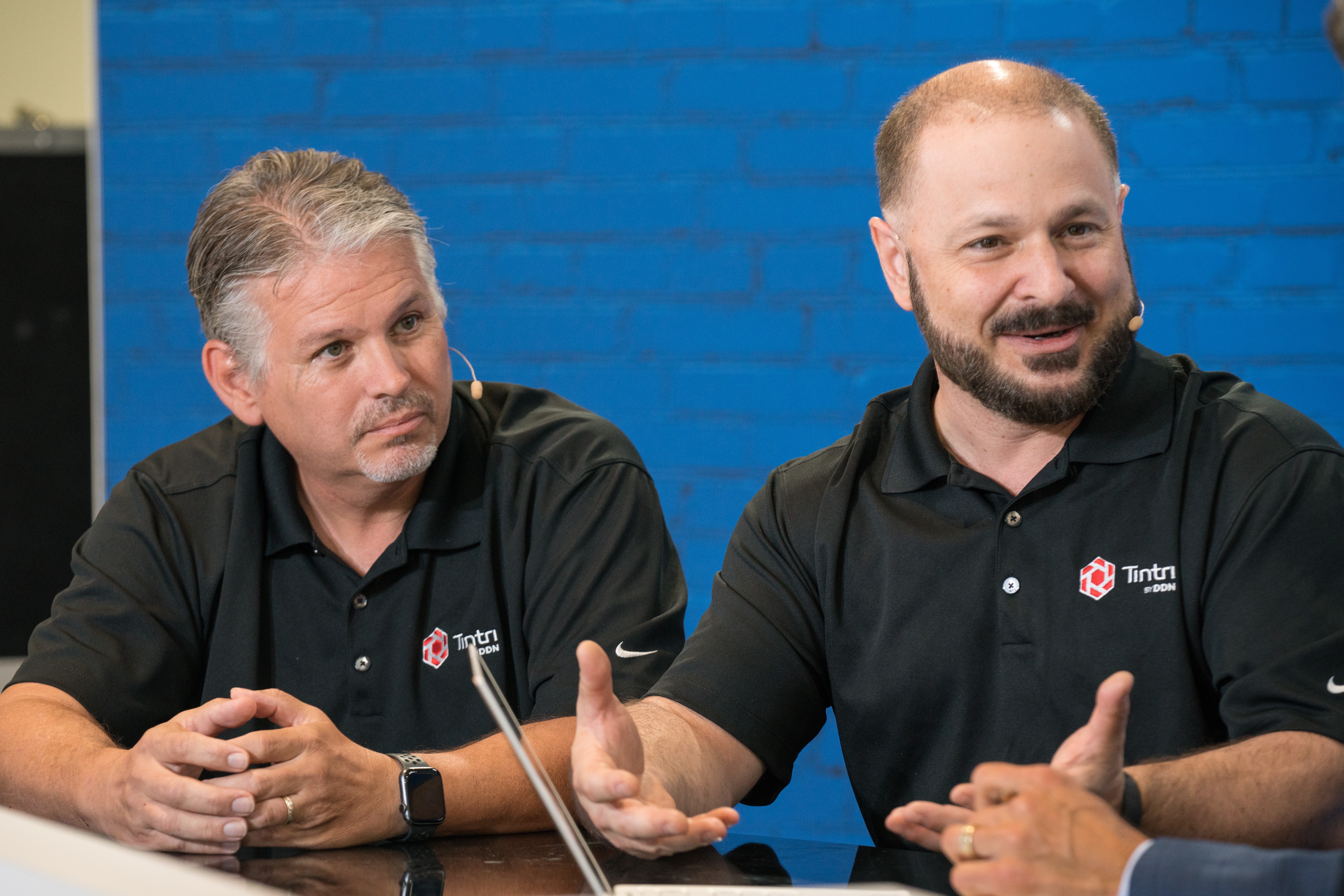
“Retaining existing customers was something that was very successful,” said Mario Blandini (pictured, right), chief marketing officer and chief evangelist of Tintri. “Being owned by the largest private storage company on planet Earth has the advantages of strong sources of supply, great reverse logistics, partnerships with suppliers, as a bigger company to be able to service them long term.”
Blandini and Graham Breeze (pictured, left), senior director of applied technology at Tintri Inc. spoke with Dave Vellante (@dvellante), host of theCUBE, SiliconANGLE Media’s mobile livestreaming studio, during the VMworld event in San Francisco. Joining the conversation, which covered the effects of Tintri’s purchase by DDN, was theCUBE guest host John Troyer (@jtroyer), chief reckoner at TechReckoning (see the full interview with transcript here.) (* Disclosure below.)
[Editor’s note: The following answers have been condensed for clarity.]
Vellante: We’re a year on from your acquisition by DDN. What has it brought to the table?
Breeze: DDN brings so many resources. We transitioned with about 40 people in the company. We’re up to about 200 now, so serious investment. So, we have a big team behind us that are working really hard to make sure that the customer experience is exactly what we want a Tintri [by DDN] experience to be.
Vellante: When you go back to the early CUBE days of VMworld, very complex storage was a major challenge. Tintri was all about simplifying that. Is that original vision still alive? How has it evolved?
Blandini: I’d say that it’s the number one reason why we’re a part of the DDN family of brands. Really, what continues to make us different today is the fact we were designed to learn from the beginning, to understand how virtual machines, end-to-end work with infrastructure, and that’s [still] the foundation of what makes us different today.
Breeze: From the very beginning, we were built to understand the workloads that we service in the data center; and that was virtual machines. We service those on multiple hypervisors today. Understanding that infrastructure network, storage, hypervisor, we can view that end-to-end in terms of a latency graph and give customers an insight into the infrastructure and how it’s performing. We’re actually extending that in some further ways in terms of additional workloads that we’re going to be able to take on later this year.
Troyer: Consistently throughout the years, Tintri user experience has been at the forefront of the company’s success. Can you talk about how and why the Tintri user experience is different from the competition?
Breeze: The value is in what they don’t have to do. So they don’t have to carve up [logical unit number storage], they don’t have to carve up volumes. They deal with everything in their environment from a virtual machine perspective. A virtual machine’s one thing across the infrastructure. They can add those virtual machines seamlessly in seconds; they don’t have to size and add to anything. They basically just place VMs, and we have a very simplistic way to give them a visualization into that because we understand that virtual machine and what it takes to service it. It comes right back to them in terms of time savings.
Blandini: What I was interested to hear [from customers] is that without Tintri, they wouldn’t have the time to do the automation work, the research work, the strategy work, or even the firefighting that’s vital to their everyday operations. It’s hard to quantify that time savings because people say, “Oh, one half of a [full-time equivalent], that’s really not much in the greater scheme of things.” [I’d say that] one half of FTE working on strategic programs is a huge opportunity.
Vellante: What’s your key message to the VMworld customer base?
Breeze: I would say the self-service and the ability to not have to worry about the details. One of our customers put it best today. He said the Tintri box is the best employee he has!
Blandini: We just want to give people an experience that allows them to self-service under the control of the IT department so that they can spend less time on infrastructure. Because at the end of the day, I haven’t met a developer that even likes infrastructure. They love they do not have to deal with it at all. They only do it out of necessity. Even database folks, they love infrastructure only because they had to think about it. They wanted to avoid the pitfalls of bad infrastructure.
Vellante: What’s the number one customer problem that when you guys hear, you say, that’s our wheelhouse; we’re going to crush the competition?
Breeze: So I’d say if they have a virtualized environment, ultimately, we belong in their environment. Somebody said this best earlier again today in the booths: The person who doesn’t have Tintri is the person who doesn’t know about Tintri if they have a virtual environment.
Blandini: Stated simply, if you are using virtualization to abstract infrastructure as a way to accelerate your operations — i.e., you run VMware — if you have a hundred virtual machines, 150 virtual machines, you can really benefit from choosing a different way you do infrastructure. Doing it differently may produce a different outcome. And, hey, different outcomes can be good.
Watch the complete video interview below, and be sure to check out more of SiliconANGLE’s and theCUBE’s coverage of the VMworld event. (* Disclosure: Tintri Inc. sponsored this segment of theCUBE. Neither Tintri nor other sponsors have editorial control over content on theCUBE or SiliconANGLE.)
Support our mission to keep content open and free by engaging with theCUBE community. Join theCUBE’s Alumni Trust Network, where technology leaders connect, share intelligence and create opportunities.
Founded by tech visionaries John Furrier and Dave Vellante, SiliconANGLE Media has built a dynamic ecosystem of industry-leading digital media brands that reach 15+ million elite tech professionals. Our new proprietary theCUBE AI Video Cloud is breaking ground in audience interaction, leveraging theCUBEai.com neural network to help technology companies make data-driven decisions and stay at the forefront of industry conversations.