 EMERGING TECH
EMERGING TECH
EMERGING TECH


EMERGING TECH

Startup Inertia Enterprises Inc. today announced that it has raised $450 million in funding to build a laser-powered fusion reactor.
Bessemer Venture Partners led the round. It was joined by Alphabet Inc.’s GV fund, Modern Capital, Threshold Ventures and others.
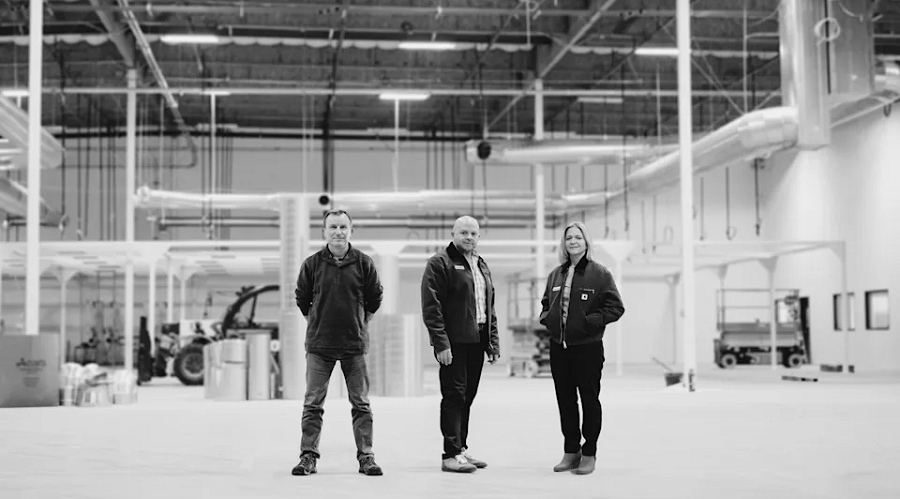
Inertia was launched last year by former Twilio Inc. Chief Executive Jeff Lawson (pictured, center). The company’s other co-founders, Annie Kritcher and Mike Dunne, are two of the world’s most prominent fusion power researchers. Kritcher led the development of the first fusion reactor that produced more power than it used. Dunne, in turn, is the former head of Stanford University’s LCLS X-ray research facility.
“In just three years, we’ve gone from the first experiment to ever produce more fusion energy than was delivered to the target, to repeating that result many times and pushing the target gain higher,” Kritcher said. “We’re now focused on translating physics we know works into a pathway toward commercial-scale fusion energy.”
Fusion reactors generate power by combining light atomic nuclei into heavier ones. The mass of the heavier nuclei is slightly smaller than the combined mass of the particles from which they were created. This mass differential turns into electricity.
Inertia is named after a reactor design called inertial confinement fusion, or ICF, that underpins its technology. It uses tiny pellets filled with hydrogen isotopes as fuel. A powerful laser emitter shines light onto the pellets multiple times per second, which produces both heat and pressure inside the reactor. The resulting sun-like conditions allow fusion to take place.
The laser that powers Inertia’s reactor is 50 times more powerful than earlier systems. The company plans to make it from diodes, tiny semiconductors that generate light when a current runs through them. Inertia picked diodes over flash lamps, devices that are also used to power large-scale lasers, because they’re about 10 times more efficient.
The semiconductor industry currently doesn’t make enough laser diodes to support the company’s requirements. To resolve that bottleneck, Inertia’s engineers will work with partners to boost the available supply by about 100 times.
The company also plans to mass produce the tiny hydrogen isotope pellets that its reactor uses as fuel. According to Inertia, the plan is to create production lines that can make the pellets for under $1 apiece. The reactor will turn the pellets into energy inside reactor chambers that the company plans to make from lead. The metal is less expensive than the exotic materials historically used for the task.
Besides cost-efficiency improvements, large-scale fusion power generation will also require several other advances. At the top of the list are reactors that can produce significantly more power than what they use. Currently, the power output of the Lawrence Livermore National Laboratory’s best design is four times higher than its input power.
Inertia says its diode-powered laser emitter will enable its reactors to generate 18 times more power than what they will use. That’s enough to build a prototype power plant capable of supplying a limited amount of electricity to the grid. According to the company, large-scale energy production will require increasing the ratio between input and output power to more than 30.
Inertia’s website states that its long-term goal is to build a power plant with a capacity of 1.5 gigawatts. That corresponds to the energy usage of about about 1 million homes.
Support our mission to keep content open and free by engaging with theCUBE community. Join theCUBE’s Alumni Trust Network, where technology leaders connect, share intelligence and create opportunities.
Founded by tech visionaries John Furrier and Dave Vellante, SiliconANGLE Media has built a dynamic ecosystem of industry-leading digital media brands that reach 15+ million elite tech professionals. Our new proprietary theCUBE AI Video Cloud is breaking ground in audience interaction, leveraging theCUBEai.com neural network to help technology companies make data-driven decisions and stay at the forefront of industry conversations.