 AI
AI
AI
AI







AI

The agentic journey is entering a new phase — one focused on proving value at scale.
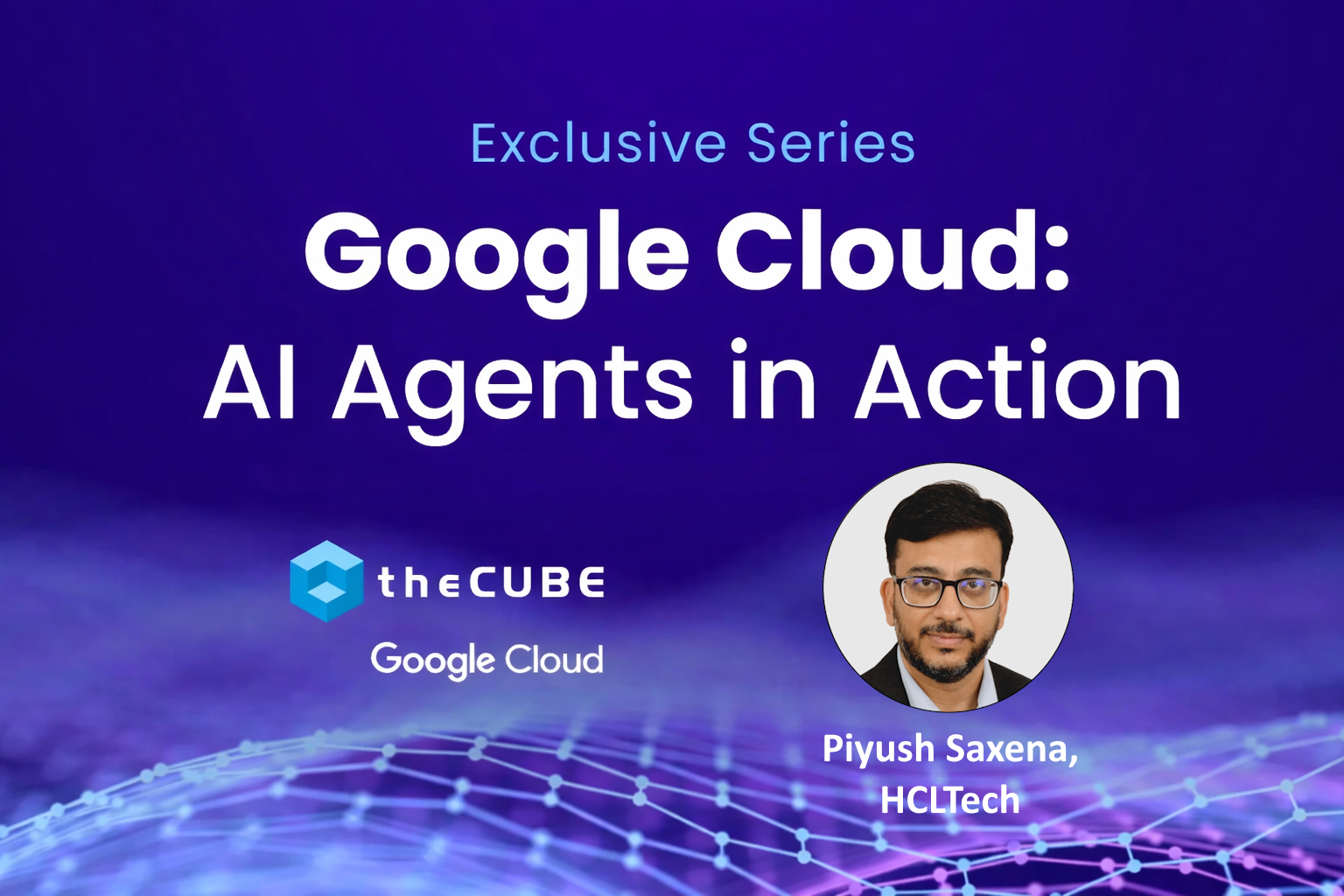
Enterprises are shifting away from AI experiments that showcase potential without financial accountability. The focus now is stack maturity, integration depth and measurable business return. HCLTech, working alongside Google Cloud, is aligning its strategy around that reality — emphasizing full-stack capability and outcomes rather than isolated deployments. Companies are demanding structure, governance and clarity before expanding agent deployments across the enterprise, according to Piyush Saxena (pictured), senior vice president and global head of the Google Ecosystem Business Unit at HCLTech.
“A lot of these customers are looking at HCLTech and Google Cloud as a partner in this journey,” Saxena said. “There are essentially three things they’re focusing on. They’re looking for a partner who brings a very mature AI stack, where you have the AI model, which is what they’re betting on to keep pace with the ever-changing market dynamics. The second area they’re looking for is full stack competencies and solution capabilities and also how these models can extend to the partner ecosystem. I think the third critical area is they’re looking for technology that enables measurable outcomes and delivers a very clear return on investment. In summary, AI maturity, comprehensiveness of the solution, and outcomes and return on investment is what customers are expecting.”
Saxena spoke with theCUBE’s John Furrier for the Google Cloud AI Agents in Action Series on theCUBE, SiliconANGLE Media’s livestreaming studio. They discussed how HCLTech and Google Cloud are operationalizing AI agents to deliver measurable industry outcomes. (* Disclosure below.)
As organizations deploy more agents, complexity surfaces quickly. Discovery, access control and coordinated execution become immediate concerns. Without centralized oversight, deployments fragment and governance gaps widen, particularly in regulated industries where compliance cannot lag experimentation, according to Saxena.
“Let me start with Gemini Enterprise, which is the front door for agents … it’s an agent consumption platform,” he said. “As organizations start adopting agents at scale, they will face the challenges of things like agent discovery or agent access controls or ability to leverage agents from a single platform. These are key things when we are working with the customers. These are the use cases which are coming.”
Beyond centralized access, orchestration defines maturity. Multi-agent use cases require structured workflows that connect models, runtime environments and enterprise data systems. That coordination layer determines whether agents remain isolated tools or become embedded operational assets, Saxena explained.
“Solutions like Agent Development Kit for agent orchestration, which is extremely critical if we have to deliver an industry use case, which is multi-agentic in nature … becomes very core to that solution,” he said. “All these agentic capabilities built on top of Google Cloud data capabilities, ranging from products like BigQuery, Bigtable or AlloyDB, provide seamless integration into the Vertex AI platform and agent runtime environment. This creates a very comprehensive solution to deliver industry outcomes to our customers.”
The agentic journey proves itself in real-world deployments where efficiency and cost control are measurable. In manufacturing settings, engineers often lack fast access to actionable insight from machine data. Embedding conversational intelligence into daily workflows speeds diagnosis and helps less-experienced staff make informed decisions more quickly, Saxena noted.
“We developed an interactive conversational AI assistant. We have named it AskHub, for the factory floor engineers, and this is powered by Gemini Enterprise,” he said. “What this does is give easy access to the factory floor engineers to ask questions like: Are the torque fluctuations indicative of gearbox failure? Or are the temperature readings in the factory environment suggestive of future breakdown in the critical machines? Without AskHub, it is very difficult for these engineers to get answers to these questions. They have to make multiple calls, and it takes a lot of time and reduces their efficiency.”
The shift is measurable rather than theoretical. Reduced downtime and faster root-cause analysis translate directly into cost savings. When agents close skill gaps and increase engineer productivity, financial impact compounds across facilities.
“AskHub powered by Gemini Enterprise has helped us address the skill gap where the engineers are now more empowered,” Saxena added. “This has also helped us reduce the machine downtime because they can take quick actions, do faster root cause analysis and increase engineer efficiency. They’re more productive now and, therefore, reduce the overall factory operations cost for the customer.”
Distribution mechanics are increasingly shaping how quickly the agentic journey scales. Publishing ready-to-use agents in a centralized marketplace reduces procurement friction and broadens access beyond deeply technical teams. It also embeds purchasing into existing cloud consumption models, according to Saxena.
“We have released 300 agents on Google Cloud Marketplace, focused on a combination of industry and horizontal use cases,” he said. “The customers have been able to get easy access to these ready-to-use agents through Marketplace. This has also made this purchasing very convenient for the customers through their Google Cloud accounts. A lot of non-technical users have no-code, low-code access, and they can create and deploy these agents in their environment just by going and reviewing these agents on the Marketplace.”
Trust and economics drive adoption. Enterprises want verified, compliant deployments, and partners want shorter sales cycles and expanded market coverage. The marketplace model addresses both dynamics at once, Saxena pointed out.
“Marketplace is a very secure, compliant and controlled environment,” he said. “Our customers are very comfortable downloading and deploying any agents which are pre-verified, pre-validated by the Google Cloud team, along with partners like HCLTech. What Marketplace enables and offers us is the accelerated sales cycle and easier procurement for our customers. The more agents we publish, the more market share we are able to get through the Google Cloud Marketplace, which is a big differentiator. It effectively reduces our cost of sales.”
Here’s the complete video interview, part of SiliconANGLE’s and theCUBE’s coverage of the Google Cloud AI Agents in Action Series:
(* Disclosure: TheCUBE is a paid media partner for the Google Cloud AI Agents in Action Series. Neither Google Cloud, the sponsor of theCUBE’s event coverage, nor other sponsors have editorial control over content on theCUBE or SiliconANGLE.)
Support our mission to keep content open and free by engaging with theCUBE community. Join theCUBE’s Alumni Trust Network, where technology leaders connect, share intelligence and create opportunities.
Founded by tech visionaries John Furrier and Dave Vellante, SiliconANGLE Media has built a dynamic ecosystem of industry-leading digital media brands that reach 15+ million elite tech professionals. Our new proprietary theCUBE AI Video Cloud is breaking ground in audience interaction, leveraging theCUBEai.com neural network to help technology companies make data-driven decisions and stay at the forefront of industry conversations.