 INFRA
INFRA
INFRA
INFRA





INFRA

Kubernetes Ingress networking is entering a transition moment that is bigger than a routine tooling refresh.
Internal research cited by Kubernetes security leadership suggests that roughly half of cloud-native environments currently rely on NGINX Ingress Controllers. As that part of the ecosystem approaches a major shift, platform teams must reevaluate how they manage traffic, security and observability across increasingly heterogeneous environments.
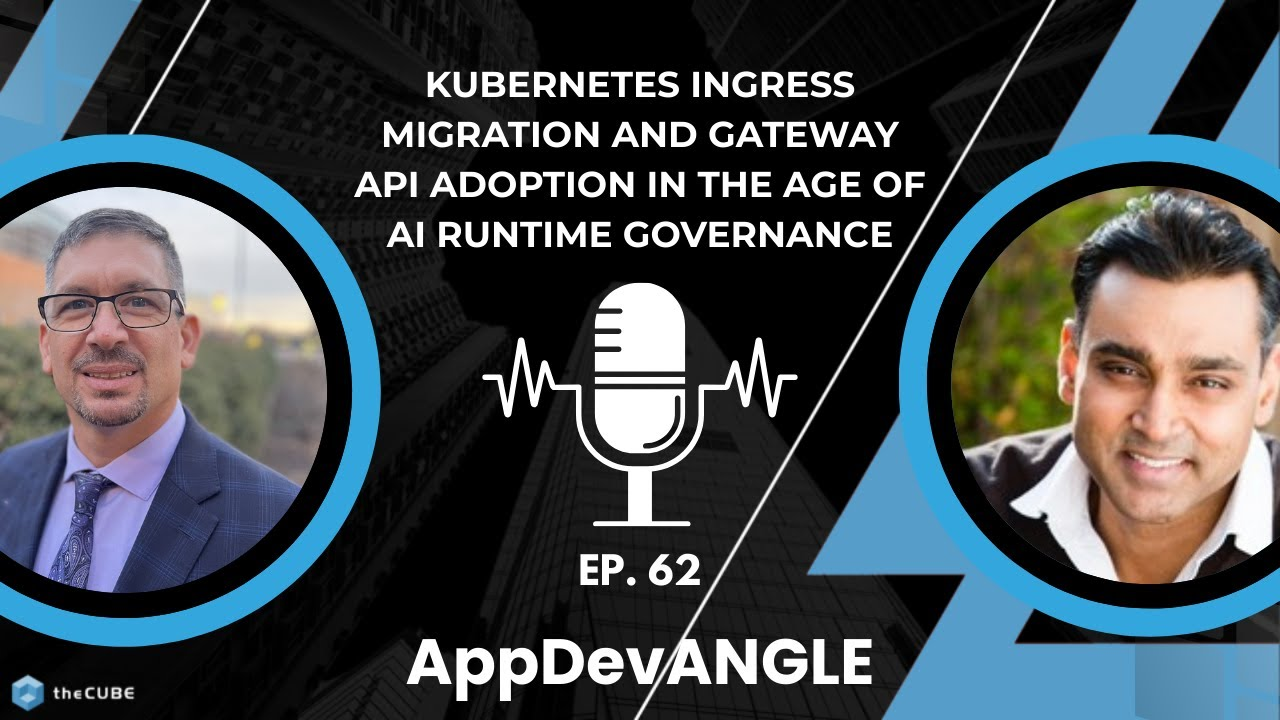
In the latest episode of theCUBE Research’s AppDevANGLE podcast, Paul Nashawaty spoke with Sudeep Goswami, chief executive officer of Traefik Labs, about what this migration moment means for Kubernetes operators and why ingress architecture is becoming a broader platform design question.
“This is a big change,” Goswami said. “Many people were not expecting this to happen this soon.”
At first glance, the issue may seem narrow: If one ingress layer changes, teams only need another controller. But the reality is more complicated.
Enterprises have spent years layering annotations, policies and custom configurations into their ingress environments. For some, that means the migration path is no longer just a product swap. It is an architectural decision that touches operations, modernization roadmaps and future AI deployment models.
Goswami described two broad paths now emerging. Simpler deployments may be able to refactor directly into a new architecture. More complex enterprise environments, however, often need a lower-risk transition that preserves existing configurations before moving toward a more future-oriented model built around Kubernetes Gateway API.
“What Traefik offers is a two-step approach,” Goswami said. “Install Traefik as a drop-in replacement … and while you are doing that, then think about what is going to be the future-proofed architecture, which is really dependent on or driven by Gateway API.”
That distinction matters because the Gateway API is becoming a key part of the next-generation Kubernetes networking stack. Still, it does not provide one-for-one support for the sprawling annotation models many enterprises use today.
The bigger takeaway from the conversation is that ingress is no longer an isolated networking layer.
For enterprises operating in hybrid environments, application traffic increasingly spans virtual machines, containers, APIs and now AI runtimes. As a result, ingress is evolving into a broader control point for policy enforcement, routing consistency and runtime observability.
Goswami framed this through three overlapping enterprise arcs: migration, modernization and transformation.
Migration includes replatforming workloads, moving across infrastructure environments and now dealing with ingress controller change. Modernization involves supporting coexistence between virtual machines and containerized applications while decomposing monoliths into services. Transformation adds AI and agentic workflows into that mix.
“Ingress NGINX is just one piece of the overall pie,” Goswami commented. “The move that you make with the ingress NGINX replacement — is it in alignment with the rest of the architecture?”
That is the right question. Point solutions may solve the immediate migration problem, but platform teams increasingly need architectures that can survive broader changes in workload location, application design and traffic governance requirements.
One of the most important issues for platform teams is consistency across environments.
Organizations are no longer running purely containerized estates. Many are balancing workloads across Kubernetes clusters, VMs, private infrastructure, public cloud, edge locations and, in some cases, disconnected or sovereign deployments.
Goswami described Traefik’s role as a “front door” for applications regardless of where they run or what substrate they use.
“By having this front door to your applications, you get a lot of benefits around unified routing, unified security, but then also unified observability,” he explained.
That consistency matters operationally. If policy models differ across VMs, containers and AI services, teams end up multiplying complexity rather than reducing it. In environments already constrained by skills shortages and operational sprawl, another silo is the last thing most enterprises need.
The ingress conversation also becomes more consequential when AI enters production systems.
AI workloads introduce new runtime endpoints, inference APIs, model-routing requirements and data-governance concerns. In agentic systems, the problem becomes even more complex because the runtime interaction patterns are no longer just app-to-app traffic.
Goswami outlined three distinct conversations that require governance in an agentic workflow: The interaction between the agent and the large language model, the interaction between the agent and Model Context Protocol servers or resources and the interaction between the agent and downstream APIs.
“What you need at an architectural level, rather than point products, is an agent that can be governed to the LLMs, to the MCP and to the APIs,” he said.
That requirement implies a broader runtime policy architecture — one that spans ingress, API gateways and AI-specific traffic controls under a more unified governance model.
For platform teams, this is a warning against treating AI runtime governance as something separate from cloud-native traffic management. The same architectural fragmentation that created complexity in microservices can become even more costly when applied to AI.
So, what should enterprises prioritize as they evaluate their next ingress model?
The answer from Goswami centered less on feature checklists and more on operating leverage. Teams need architectures that remain location-agnostic, workload-agnostic and consistent across heterogeneous environments. Policies should follow workloads as they move across clouds, private infrastructure and edge environments. Security and observability should remain coherent even as traffic patterns become more dynamic.
“They should have full freedom on where it runs,” Goswami said. “They should also have full freedom on what kind of workload it is.”
That kind of portability is increasingly important as distributed hybrid infrastructure becomes the norm. Enterprises are not just standardizing on Kubernetes; they are standardizing on mixed estates, where containers, VMs and AI services must coexist.
The Kubernetes ingress migration may look tactical, but it exposes a deeper issue: Application networking can no longer be managed as a narrow infrastructure function.
As platform teams rethink ingress, they must also confront larger questions about policy consistency, modernization, hybrid operations and AI runtime governance. The organizations that treat this as a strategic architecture decision rather than a controller replacement will be better positioned for what comes next.
Here’s the complete conversation with theCUBE Research’s Paul Nashawaty and Sudeep Goswami, part of the AppDevANGLE podcast series:
Support our mission to keep content open and free by engaging with theCUBE community. Join theCUBE’s Alumni Trust Network, where technology leaders connect, share intelligence and create opportunities.
Founded by tech visionaries John Furrier and Dave Vellante, SiliconANGLE Media has built a dynamic ecosystem of industry-leading digital media brands that reach 15+ million elite tech professionals. Our new proprietary theCUBE AI Video Cloud is breaking ground in audience interaction, leveraging theCUBEai.com neural network to help technology companies make data-driven decisions and stay at the forefront of industry conversations.