 AI
AI
AI
AI








AI

Sports and entertainment organizations are no longer just selling tickets. They are building continuous digital relationships.
Nearly 70% of fans now seek additional statistics and digital insights during live events, according to theCUBE Research, signaling a broader shift in expectations. Fans want more than a moment in time. They want an ongoing, personalized experience that spans before, during and after the event.
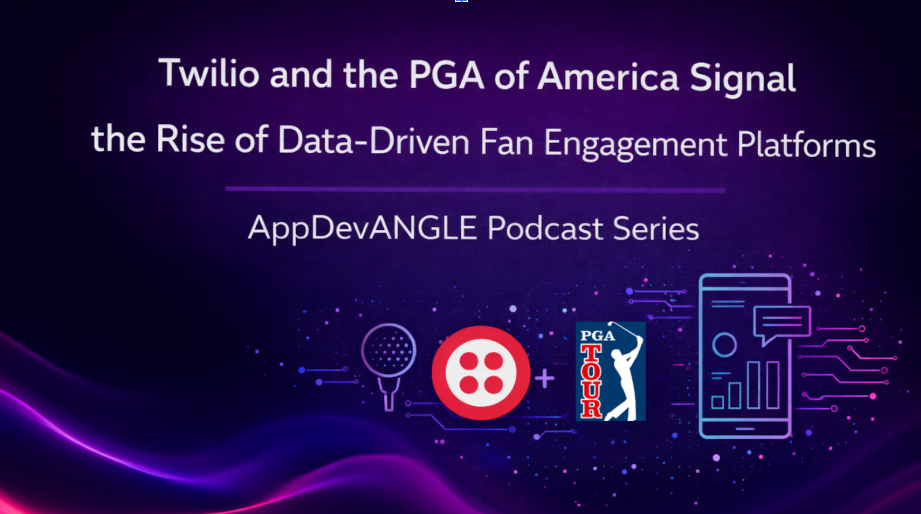
In the latest episode of theCUBE Research’s AppDevANGLE podcast, Paul Nashawaty spoke with Chris Koehler, chief marketing officer of Twilio Inc., about the company’s expanding partnership with the PGA of America and what it reveals about the evolution of customer engagement platforms.
“We’re trying to create the experience layer of the internet,” Koehler said.
For decades, sports organizations operated around discrete events: Sell tickets, fill venues and deliver a compelling in-person experience. That model is evolving into something more continuous and data-driven.
The PGA of America partnership reflects that transition. While marquee tournaments remain important, the broader opportunity lies in engaging golfers and fans across everyday interactions, from booking tee times to receiving personalized coaching insights.
“You move from a moment in time around the event itself to the full experience before they arrive … and post as well,” Koehler explained.
This mirrors patterns already seen in retail, travel and hospitality, where organizations design around the full customer lifecycle rather than isolated transactions.
At the center of this shift is first-party data. Sports organizations are increasingly prioritizing direct relationships with fans rather than relying on intermediaries. That data enables real-time personalization across channels, such as SMS, email, mobile apps and voice interactions.
For developers and platform teams, this introduces new architectural requirements:
The goal is to transform systems of record into systems of engagement that operate continuously, not just during events.
“Everyone wants to be felt and understood,” Koehler said. “That use case can span across any industry.”
The shift is not just about data. It is about orchestration.
Fans expect engagement across multiple touchpoints: messaging, email, mobile apps, call centers and in-person experiences. Delivering that requires platforms capable of coordinating interactions across channels while maintaining context.
In the PGA use case, engagement may include:
That complexity turns engagement into a platform problem rather than a marketing function. “How do you create that ongoing conversation across channels?” Koehler said. “That’s critically important.”
Sports organizations operate at massive scale, with millions of fans interacting across global audiences and multiple events. That creates both an opportunity and a challenge.
Platforms must support:
The PGA partnership, along with Twilio’s work with organizations such as AEG and Chelsea Football Club, reflects a broader strategy: using marquee customers as proof points for scalable engagement platforms.
“If we can show that the PGA of America can do that … we think we can help drive customer engagement globally across any industry,” Koehler said.
One of the more important shifts highlighted in the conversation is how organizations adopt these capabilities. Most do not start with a full platform. Instead, they begin with a single use case, such as messaging or email, and expand over time.
“We see people start with messaging … then they progress over time,” Koehler said.
This “crawl, walk, run” model reflects a broader trend: the move from disconnected communication tools to unified customer engagement platforms.
Over time, organizations integrate:
The end state is a system capable of managing the entire customer journey.
Artificial intelligence is increasingly part of that journey, particularly in areas such as conversational interfaces and customer support.
Koehler noted that many organizations are starting with voice-based AI agents, often to augment or replace call center workflows. Over time, those capabilities expand into broader conversational AI experiences across channels.
At the same time, AI is helping address one of the biggest barriers to adoption: the skills gap. “It’s easier than ever to figure out how to deploy new technology,” Koehler said, pointing to the growing role of AI-assisted development.
Still, the fundamentals remain unchanged. AI can accelerate engagement, but it depends on strong data foundations and integrated platforms to deliver value.
The Twilio–PGA of America partnership reflects a broader shift across industries: Engagement is no longer episodic. It is continuous, data-driven and increasingly platform-centric.
For developers and platform teams, that means rethinking how applications are designed, how data is activated and how communication flows are orchestrated at scale.
The organizations that succeed will be those that move beyond isolated interactions and build systems capable of sustaining ongoing, personalized relationships with their users.
Here’s the complete conversation with theCUBE Research’s Paul Nashawaty and Twilio’s Chris Koehler, part of the AppDevANGLE podcast series:
Support our mission to keep content open and free by engaging with theCUBE community. Join theCUBE’s Alumni Trust Network, where technology leaders connect, share intelligence and create opportunities.
Founded by tech visionaries John Furrier and Dave Vellante, SiliconANGLE Media has built a dynamic ecosystem of industry-leading digital media brands that reach 15+ million elite tech professionals. Our new proprietary theCUBE AI Video Cloud is breaking ground in audience interaction, leveraging theCUBEai.com neural network to help technology companies make data-driven decisions and stay at the forefront of industry conversations.