 AI
AI
AI
AI


AI

Customer relationship management vendor HubSpot Inc. today introduced a set of product updates aimed at helping sales and marketing teams adapt to a shift in how buyers research and engage with vendors, with a particular focus on visibility inside artificial intelligence-driven search tools.
The announcements, part of the company’s Spring 2026 Spotlight, center on what HubSpot executives describe as the growing importance of “context,” or the combination of customer data, behavioral signals and operational history, in making AI systems more effective in marketing, sales and support workflows. The company said AI systems produce more relevant and actionable outputs when they are tightly integrated with customer data and business processes.
The updates span marketing, sales and customer support. HubSpot said they reflect a broader industry transition from traditional search and manual workflows to AI-assisted discovery and automation.
The most prominent addition is HubSpot Answer Engine Optimization, a new category of tool designed to help companies understand how they appear in AI-generated responses from large language models.
The product provides visibility into brand mentions, competitive positioning and citation sources across AI-generated answers, along with recommendations for improving presence. It is available as part of HubSpot’s Marketing Hub or as a standalone offering priced at $50 per month.
HubSpot said organic web traffic to its customers has declined 27% year over year, while traffic from AI-driven sources is increasing and converting at higher rates. “We’re seeing in our own data that about 42% of customers are essentially using AI search in their evaluation process,” said Beeri Amiel, director of product development at HubSpot.
The AEO tool is designed to help marketers understand and influence how AI systems represent their brands by testing prompts across multiple AI platforms and analyzing both responses and citations.
“We send those prompts across the answer engines and we allow them to really dive into why answer engines like ChatGPT, Perplexity and Gemini talk about their brand and why not,” Amiel said.
Unlike traditional search engine optimization, which focuses on keyword rankings, AEO emphasizes broader signals such as brand presence, third-party content, reviews and social media activity.
“In AEO, your website is only part of the story,” Amiel said. “You have to think about it across multiple channels and not just your website.”
Because AI systems compress multiple research steps into a single interaction, prospects arrive later in the buying cycle with more information. “We’re doing way more of the evaluation process through an answer engine than we ever did on Google,” he said. “By the time they’re getting to your website, they’re already much further down the funnel. All the selling was done by the answer engine.”
Despite the rapid growth of AEO, HubSpot isn’t advising its customers to de-emphasize SEO. “It seems like the pie is getting bigger rather than there being a crossover point” where AI traffic exceeds search, Amiel said.
HubSpot said early data from beta users suggests that companies adopting AEO strategies are seeing measurable gains, with customers experiencing roughly 20% higher AI referral traffic than those that didn’t optimize for AI, and leads converting at three times the rate of traditional search traffic.
HubSpot is also expanding its Breeze Assistant, a conversational companion integrated into its platform, to support what it calls “Loop Marketing,” or a framework that uses customer data to guide campaign development. The assistant can generate optimal customer profiles, brand guidelines and campaign plans based on data already stored in HubSpot.
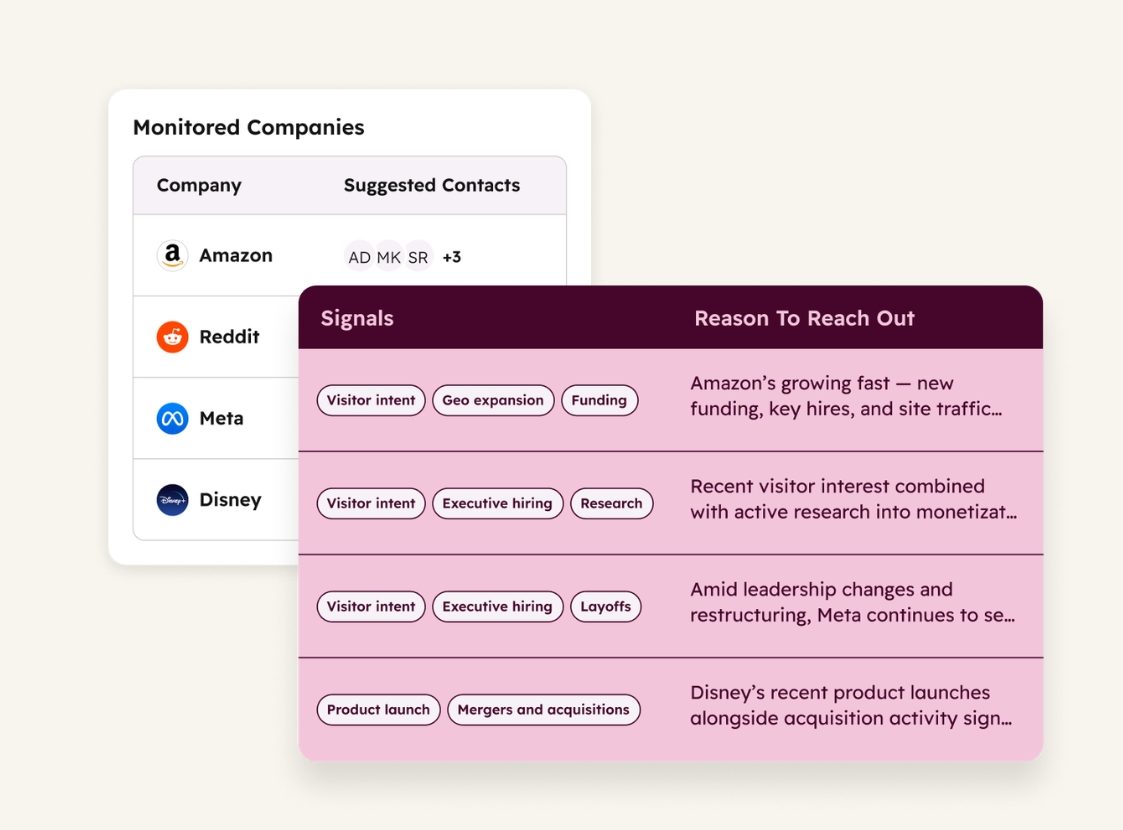
In sales, the company introduced updates to its Prospecting Agent and a new feature called Smart Deal Progression (pictured), both aimed at reducing administrative overhead.
The Prospecting Agent monitors signals such as funding announcements, hiring activity and technology adoption to identify potential buyers, assemble contact lists and generate outreach messages. Sales representatives review and approve communications before they are sent.
HubSpot said early users of the tool have seen outreach response rates reach twice the industry benchmark, with one customer reporting a 28% increase in meetings booked after using the system for unengaged marketing leads.
Smart Deal Progression analyzes meeting transcripts and historical CRM data to recommend updates to deal records, suggest next steps and draft follow-up emails. Context is preserved across interactions to reduce manual data entry.
HubSpot said it’s taken pains to ensure that agents don’t over-automate the prospecting process. “The agent monitors signals, sources contacts and drafts outreach, but nothing goes to a prospect until a rep reviews and approves it,” said George Davis, director of product. “With Smart Deal Progression, the agent analyzes the transcript and suggests CRM updates, but the rep confirms before anything changes.”
In customer support, HubSpot enhanced its Customer Agent to handle email interactions in addition to other channels. The agent can be deployed selectively, such as handling a percentage of incoming tickets or during specific hours and can route conversations to human agents when needed.
The system draws on customer history across the platform to generate responses and provide context when escalation is needed.
HubSpot said customers using the agent are seeing higher resolution rates and faster response times, with the tool resolving an average of 65% of support conversations.
The company reported $3.13 billion in revenue for 2025, up 19% year over year, and said it now serves more than 288,000 customers globally.
Support our mission to keep content open and free by engaging with theCUBE community. Join theCUBE’s Alumni Trust Network, where technology leaders connect, share intelligence and create opportunities.
Founded by tech visionaries John Furrier and Dave Vellante, SiliconANGLE Media has built a dynamic ecosystem of industry-leading digital media brands that reach 15+ million elite tech professionals. Our new proprietary theCUBE AI Video Cloud is breaking ground in audience interaction, leveraging theCUBEai.com neural network to help technology companies make data-driven decisions and stay at the forefront of industry conversations.