 INFRA
INFRA
INFRA
INFRA





INFRA

Agentic infrastructure is quickly becoming the foundation for how enterprises build and run AI at scale. What’s emerging is a shift from piecemeal tools to integrated systems where data, models and operations are tightly connected, making AI a production capability rather than an experiment.
Nutanix Inc. is positioning itself within this transition by aligning cloud-native architectures, Kubernetes and hybrid environments into a unified approach that reflects how enterprises actually deploy and manage AI workloads today. This sets up the broader discussion around control, governance and scalability, according to John Furrier, executive analyst at theCUBE Research, in a keynote analysis segment at Nutanix .NEXT event in Chicago.
“This keynote wasn’t about features; it was about the company declaring a position in the AI infrastructure stack,” Furrier said. “Nutanix is moving from a cloud platform vendor to an AI operating model company. The CEO [Rajiv Ramaswami] said, ‘We are the operating model for AI factories.’ That is a systems game.”
Furrier was joined by fellow analyst Paul Nashawaty and host Alison Kosik at Nutanix .NEXT, during an exclusive broadcast on theCUBE, SiliconANGLE Media’s livestreaming studio. They explored how agentic infrastructure, hybrid platforms and data-centric systems are reshaping enterprise AI operations at scale. (* Disclosure below.)
Watch theCUBE’s complete video analysis of the event keynote:
Here are three key insights you may have missed from Nutanix .NEXT:
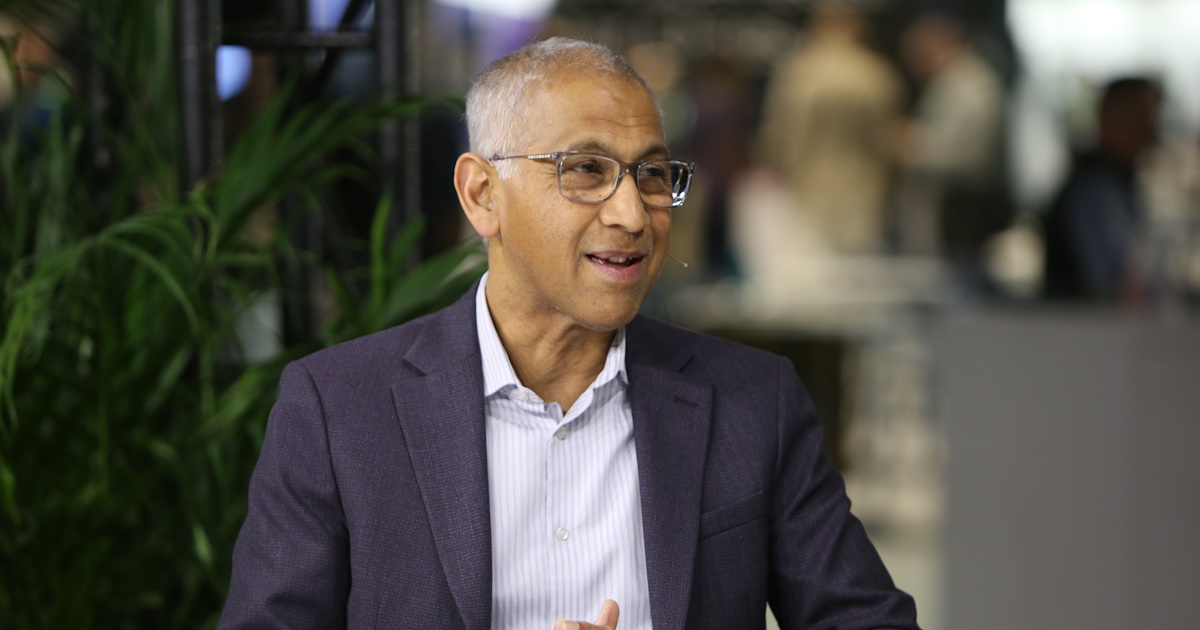
Agentic infrastructure is emerging as a unifying layer where cloud-native foundations and AI-driven systems converge to support autonomous applications and workflows. Nutanix is evolving beyond its hyperconverged infrastructure roots into a platform designed to help enterprises operationalize AI, combining containers, Kubernetes and ecosystem integration into a single, extensible architecture, explained Rajiv Ramaswami (pictured), president and chief executive officer of Nutanix.
“It’s all about AI influencing agentic AI where you now move from simple inferencing to being able to really have agents delegate stuff to agents and have more autonomy and enable more autonomy in the enterprise,” he said. “That world is our future as well, because we are now moving to this new world of providing a complete platform to enable organizations, companies to be able to go build and run these agentic AI applications in a very easy turnkey way and also focused on building an ecosystem to support all of that.”
The rise of agentic infrastructure is also reinforcing the importance of ecosystem-driven platforms, where partnerships and co-engineering define how value is delivered. As enterprises scale AI deployments, integrated stacks across compute, data and applications are becoming essential to move from experimentation to production, noted Todd Lieb, vice president of cloud partnerships at Dell Technologies Inc.
“I think if you were to take both [the cloud and the data center,] we’re innovating like crazy around the compute layers,” he said in an interview with theCUBE. “There’s an evolution from HCI into more of a disaggregated infrastructure strategy. On the AI side, we’re constantly trying to keep up with Nvidia and their release of new chips and GPUs. But the big story … is the data. Good data means good AI. Bringing AI to the data is really the strategy.”
At the same time, enterprise demand is shifting toward platforms that simplify deployment while maintaining control over data, infrastructure and governance. This is driving a new emphasis on operational readiness, where organizations need environments that can support AI workloads without requiring full replatforming, according to Thomas Cornely, executive VP of product management at Nutanix.
“There’s all the tech stuff around AI and everything, and we get big announcements around enabling that,” he said. “The macro is, take care of your data, sovereign, have control. Nobody has time anymore; this is moving so fast. I need help to actually set up environments and make them run and keep them secure. This is where we’ve been able to come in.”
Here’s the complete video interview with Rajiv Ramaswami:
Ecosystem collaboration is becoming the delivery mechanism for modern end-user computing, especially as hybrid environments introduce complexity across cloud and on-prem systems. The shift toward consistent user experiences and backend abstraction allows organizations to modernize infrastructure without disrupting workflows, turning infrastructure decisions into invisible operational choices rather than user-facing changes, pointed out Saud Al-Mishari, principal group product manager at Microsoft Corp.
“We released Windows365 in this concept of cloud PC for humans,” he told theCUBE. “Now, we’re taking it forward and we’re actually looking at cloud PCs for agents. Why? So we can free up the human to step away from that legacy app UI and let an agent interact with that so that the human can go do more valuable decision-making work than interacting with a UI. That’s where we see things going long term.”
Migration is no longer just a technical decision — it’s becoming a strategic reset point for infrastructure. Early movers such as Dartmouth College used timing and necessity to rethink their entire stack, ultimately simplifying operations while improving flexibility. The result highlights how replatforming can reduce complexity while enabling teams to operate more cohesively across environments, explained Ty Peavey, director of infrastructure services at Dartmouth College.
“We were in a really unique situation where both our contracts with VMware and with our hardware vendors were coming to term at the same time,” he said. “We had a really good opportunity to think about what we wanted to deploy as our next-generation hypervisor. We already knew we wanted to go into hyperconverged. We made some assumptions that we would just stick with VMware. It was prior to the Broadcom acquisition. We weren’t 100% happy with VMware — heavy costs, not great support, not a great partner at the time. We wanted to be very open-minded.”
As AI adoption accelerates, the database layer is evolving into a central control point for enterprise architecture. Organizations are prioritizing unified data platforms that simplify access, reduce fragmentation and support AI-native applications, while enabling scalability, flexibility and consistent operations across hybrid, cloud and on-prem environments, noted Olivier Zieleniecki, global VP of partners at MongoDB Inc.
“We truly transitioned from just a document database model to really unified data platform,” he said. “[Databases] have moved, have changed from just being a passive system of records to being an active memory layer for AI-native applications.”
Here’s the complete video interview with Saud Al-Mishari; Scott Manchester, chief product and technology officer at Nerdio Inc.; and Tarkan Maner, president and chief commercial officer of Nutanix:
Enterprises are increasingly designing infrastructure that disappears into the background while still supporting highly demanding, real-time operations. Hybrid environments are becoming the practical model, balancing cloud scalability with on-premises control for security, latency and reliability. In high-stakes environments, even minor disruptions translate directly into user friction, according to Dan Regalado, chief information officer of Wynn Resorts Ltd.
“We’re a hybrid infrastructure,” he said. “We have workloads on the cloud and we have workloads on our own data center. I want technology to be invisible to our guests. If technology is visible to our guests, sometimes that means that we failed because there’s some friction. It’s a hybrid infrastructure. We’re intelligent in a way that we’re not purist in thinking that everything should be in the cloud, everything should be on-prem. What needs the scalability and the velocity of provisioning will be on the cloud. What needs to be secure and stable can be on-premise.”
Storage and data infrastructure are no longer passive layers — they are becoming active enablers of AI, security and operational resilience. As enterprises modernize, the ability to unify, protect and operationalize data across environments is emerging as a foundational requirement, pointed out Sandeep Singh, SVP and general manager of enterprise storage at NetApp Inc.
“From a storage angle, when you think about what’s happening in the marketplace with AI, with cyber resilience, ultimately, data is at the core of each one of those priorities, including for even just infrastructure modernization,” he said in an interview with theCUBE. “When you think about storage, it very quickly elevates from not only just storing data, but being able to analyze it, protect it and secure it, and then, enable AI to have access to it.”
At the same time, infrastructure itself is evolving to handle AI and traditional workloads as a unified system. The distinction between “AI applications” and everything else is beginning to fade, replaced by intelligent platforms that dynamically allocate resources based on workload needs.
“We think there’s use cases for both,” added Dan Ciruli, VP and GM of cloud-native at Nutanix. “It’s often better to run in a hypervisor for Kubernetes. That is going to become the layer; here’s the thing that I think that you think about applications — AI applications and regular applications. I think that in two years or three years, we don’t make that distinction anymore. We just call these applications, and we will expect there to be infrastructure that is smart enough to know, ‘Ah, I can see this workload requires a GPU.'”
Here’s the complete video interview with Dan Regalado:
For more of theCUBE’s coverage of Nutanix .NEXT, check out these exclusive segments:
To watch more of theCUBE’s coverage of Nutanix .NEXT, here’s our complete event video playlist:
(* Disclosure: TheCUBE is a paid media partner for Nutanix .NEXT. Neither Nutanix, the sponsor of theCUBE’s event coverage, nor other sponsors have editorial control over content on theCUBE or SiliconANGLE.)
Support our mission to keep content open and free by engaging with theCUBE community. Join theCUBE’s Alumni Trust Network, where technology leaders connect, share intelligence and create opportunities.
Founded by tech visionaries John Furrier and Dave Vellante, SiliconANGLE Media has built a dynamic ecosystem of industry-leading digital media brands that reach 15+ million elite tech professionals. Our new proprietary theCUBE AI Video Cloud is breaking ground in audience interaction, leveraging theCUBEai.com neural network to help technology companies make data-driven decisions and stay at the forefront of industry conversations.