 AI
AI
AI
AI





AI

Following a multiyear journey to advance its artificial intelligence agenda, Dell Technologies Inc. is arriving at a moment it has long been preparing for: the AI factory as the next model for enterprise infrastructure.
Dell has been building toward this moment based on a belief that artificial intelligence would lead to a fundamental shift in how work gets done and how businesses would operate. So far, the numbers show that Dell has not been wrong. The company has deployed AI factory systems to over 4,000 customers and its AI server sales have climbed from $10 billion in early 2025 to $25 billion, with predictions for $50 billion this year.
As the tech giant prepares for its annual Dell Technologies World gathering in Las Vegas, industry observers will be looking for signals around what the AI factory will mean for the future of IT infrastructure and what return on investment is being realized as AI adoption grows.
“At Dell Technologies World 2026, we’re going to hear a lot about AI Factories as the new infrastructure model,” said theCUBE Research’s Dave Vellante. “These are integrated systems that can manufacture intelligence at scale. Compute has shifted to accelerated architectures, storage is becoming a real-time data engine and networking is now part of the compute fabric itself. In our view, Dell is one of the premier companies positioned to bring these elements together into a cohesive AI factory — spanning servers, storage, networking and ecosystem integration. The challenge now is execution at scale and maintaining openness, but the opportunity is significant as enterprises look for trusted partners to operationalize AI beyond pilots and into production.”
TheCUBE, SiliconANGLE Media’s livestreaming studio, will be covering the latest news and announcements at Dell Technologies World in Las Vegas, from May 18-20. Tune in for on-site reporting and exclusive interviews as theCUBE’s analysts talk with industry leaders from Dell, its partners and customers. Coverage will explore how Dell is evolving into a full-stack AI platform player, working with key partners and generating rack-scale AI factories and high-performance storage to power hybrid architectures built for real-world enterprise workloads. (* Disclosure below.)
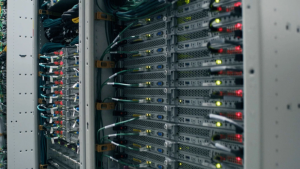
In the year since the last Dell Technologies World gathering, the company has made a series of enhancements to its AI Factory offering through key industry partnerships, such as those with Nvidia Corp., Advanced Micro Devices Inc. and Microsoft Corp.
Last fall, Dell unveiled the newest editions of its PowerEdge XE servers, with the ability to scale up to eight PCIe-based GPUs per machine, including the high-powered new Nvidia RTX Pro 6000 Blackwell Server Edition. This configuration offered enterprise customers the ability to support everything from generative and agentic AI to digital twins and industrial robotics.
Not long after, Dell implemented a public preview of PowerScale on Microsoft Azure, showcasing the machine’s capability to build next-gen applications for AI, machine learning workloads and advanced analytics. This month, Dell and AMD enhanced their on-premises AI infrastructure offering with support for AMD Instinct MI350P PCIe GPUs in Dell PowerEdge servers.
Dell’s vision of the factory as the new IT infrastructure for meeting the specific demands of AI is evolving into a full operational paradigm, according to Paul Nashawaty, principal analyst with theCUBE Research.
“From theCUBE Research perspective, Dell’s AI Factory represents a meaningful shift by positioning AI as a full operating model rather than a collection of point solutions,” Nashawaty said. “By combining infrastructure, data services, orchestration, and professional services into a cohesive platform, Dell is directly addressing the friction that has kept enterprises stuck in perpetual experimentation rather than operational AI deployment.”
As Dell’s game plan for the AI Factory becomes clearer, the focus is now shifting to the role of AI agents in the infrastructure, a topic that is expected to receive a great deal of attention at the conference this month.
In March, the company introduced new packaged AI software components, including knowledge assistants and an agentic AI platform that it built with several partners. Dell’s approach to agents meshes with its expectations of the AI Factory. Growing adoption of agents will power the need to operationalize AI for token management, and the infrastructure will have to follow.
Dell is also finding that autonomous actions of AI agents are becoming a workforce multiplier for its customers. This has been seen in the company’s data rates for adoption, according to Mindy Cancila, vice president of corporate strategy at Dell.
“We’re seeing 68% of organizations already think they’re mature and agentic,” Cancila told theCUBE. “It’s gone from buzzword to media implementation. Not only that, 76% of those organizations expect to move their agentic workflows from POC into production this year. The aggregate of that and what it means for businesses across the board, [is] every organization is really focused on the right set of use cases that are going to move from ROI into generating revenue.”
Moving from ROI into revenue generation has emerged as a central concern for many organizations as they adopt AI. Dell’s own surveys have shown cost, budget and ROI to be the second most critical challenge for AI implementation.
The company has placed its confidence in a return on AI investment through deployment of agents internally. Dell’s chief financial officer has started to deploy agents in his organization to perform tasks such as reconciliations and accounting journal entries. The company has also been charting hours per week freed up for its sales force through the use of an internal sales chat CRM model.
Dell identified four primary areas of its business where AI could be applied to achieve maximum impact. These were supply chain, global services, engineering and global sales. Dell and its customers are beginning to see tangible, impactful returns from AI investments, according to John Roese, global chief technology officer and chief AI officer of Dell.
“They’re transforming their cost of sales, they’re transforming their supply chain, they’re changing the way they develop products, and that’s really the magic,” Roese told theCUBE. “It took a little while to get everybody aligned [so] that you connect the dots between a value proposition of impactful ROI to your business and your investment in AI, and that has largely started to fall into place over the last year in the enterprise.”
Don’t miss theCUBE’s coverage of Dell Technologies World, from May 18–20. Plus, you can watch theCUBE’s exclusive content on-demand after the event.
We offer you various ways to watch theCUBE’s coverage of Dell Technologies World, including theCUBE’s dedicated website and YouTube channel. You can also get all the coverage from this year’s events on SiliconANGLE.
SiliconANGLE’s “theCUBE Pod” is available on Apple Podcasts, Spotify and YouTube, which you can enjoy while on the go. During each podcast, SiliconANGLE’s John Furrier and Dave Vellante unpack the biggest trends in enterprise tech — from AI and cloud to regulation and workplace culture — with exclusive context and analysis.
SiliconANGLE also produces our weekly “Breaking Analysis” program, where Dave Vellante examines the top stories in enterprise tech, combining insights from theCUBE with spending data from Enterprise Technology Research, available on Apple Podcasts, Spotify and YouTube.
During theCUBE’s coverage of Dell Technologies World, don’t miss insights from company executives and industry experts who will explore how agentic AI is moving from experiment to enterprise standard — and how Dell is positioning itself at the center of that shift. Tune in for exclusive insights and analysis as theCUBE examines how Dell is evolving into a full-stack AI platform player.
(* Disclosure: TheCUBE is a paid media partner for Dell Technologies World 2026. Sponsors of theCUBE’s event coverage do not have editorial control over content on theCUBE or SiliconANGLE.)
Support our mission to keep content open and free by engaging with theCUBE community. Join theCUBE’s Alumni Trust Network, where technology leaders connect, share intelligence and create opportunities.
Founded by tech visionaries John Furrier and Dave Vellante, SiliconANGLE Media has built a dynamic ecosystem of industry-leading digital media brands that reach 15+ million elite tech professionals. Our new proprietary theCUBE AI Video Cloud is breaking ground in audience interaction, leveraging theCUBEai.com neural network to help technology companies make data-driven decisions and stay at the forefront of industry conversations.