 AI
AI
AI
AI






AI

IBM Think saw Big Blue grab its place in the artificial intelligence spotlight.
In a week full of notable, and surprising, AI news, IBM Think saw CEO Arvind Krishna emphasize AI as the operating model of the future while positioning IBM’s platform as a control plane for AI and quantum infrastructure.
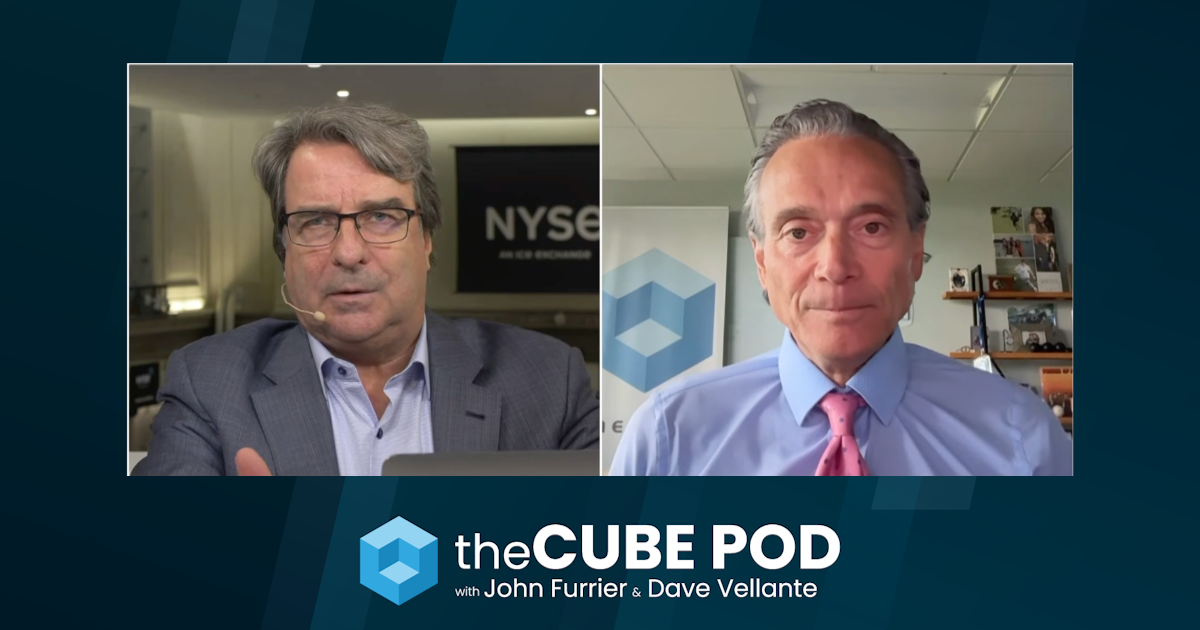
The rise of the AI operating model has led to a new persona: the AI builder, an employee with perhaps a business or analytics background who can prompt AI models to accomplish certain business tasks. The new state of enterprise is comparable to a teenager driving their first car, according to John Furrier (pictured left), executive analyst at theCUBE Research.
“Everyone’s getting their driver’s license at 16 years old and getting keys to their parents’ cars, and they’re driving around town with their AI,” Furrier said. “What we’re seeing today in this market is 16-year-olds driving the car, and they’re drinking. There’s a lot of immaturity. Screw the rules; blow the stop sign. Driving around town is great, but you get on the freeway, you don’t know what you’re doing.”
On the latest episode of theCUBE Pod, Furrier and Dave Vellante (right), chief analyst at theCUBE Research, discussed insights from IBM Think. They delved into IBM’s future with quantum, as well as recent deals in the enterprise space.
Recently, IBM has undergone a transformation from a services-based company back to a products-based company. IBM Think was supposed to present a picture of IBM’s future, but critics feel that perhaps Krishna undersold the company’s potential.
“Arvind is a technical CEO,” Furrier explained. “He’s got the [Nvidia Corp. CEO Jensen Huang] level chops. And if you look at the market, Jensen’s running away with everything. I would have advised Arvind to go in and flex hard on why Red Hat was a good bet and use that as a stepping stone to point to what they’re doing today. That would have given a lot more confidence to the already enthusiastic market.”
The question remains whether IBM’s Red Hat ecosystem will challenge the AI giants of the modern enterprise landscape, but the platform is moving in a positive direction, according to Furrier and Vellante. Although IBM Think did not emphasize what Huang terms “extreme co-design,” an engineering approach that develops an AI stack or “AI factory” from scratch, it may be in the company’s future, employees suggested.
“Red Hat is a viable platform, but I think it’s more of a loosely integrated platform,” Vellante said. “It hooks into Red Hat from the ecosystem of which IBM is a part of. And, of course, they own Red Hat, so they can do deeper integration. But maybe they don’t feel comfortable leading with that integrated stack story like Oracle does, like clearly Nvidia does, like Google did.”
Krishna also focused on the future of infrastructure — and that involves quantum. With experts predicting a “ChatGPT moment” for quantum, IBM could dominate that market if they play their cards right, theCUBE Research predicts.
“There’s only one product where IBM is the clear number one and that’s mainframes,” Vellante said. “Oracle’s number one in database, and Dell’s number one in storage … and on and on and on. Quantum can be the redo of IBM’s glory with the mainframes, where IBM can be the number one in that product category.”
One of the biggest headlines this week was SpaceX’s surprise deal with Anthropic, which saw Elon Musk’s company giving the AI powerhouse all of its compute capacity — which is no longer being used for Grok. The deal aligns with theCUBE Research’s analysis that compute capacity will be the biggest constraint on the AI era.
“If you can manufacture something that is a CPU, a high bandwidth memory, a NAND chip or a GPU, you’re going to sell it if it works,” Vellante said. “And power is the constraint. If you’re power constrained, performance per watt is the most important metric. I’ve been contending for quite some time now that Nvidia is going to have the best perf per watt.”
Intel’s shares recently jumped 5% after its reported deal with Apple Inc., although Vellante and Furrier are more intrigued by the implications of Intel’s deal with Nvidia. They predict that Nvidia’s strategy of supporting the neocloud market will pay major dividends in the long run.
“Whoever can manage the capital — capital allocation, capital deployment — will win the CapEx game,” Furrier said. “That’s going to be key. The role of neoclouds will be significant in this, because they’re adding more hyperscaler capabilities … at the behest of AWS, Azure and Google Cloud. Nvidia is playing the cards beautifully, in my opinion, by enabling these neoclouds because they’re creating more buyers to negotiate.”
Brian J. Baumann, founder of NYSE Wired and director of capital markets, technology at NYSE
Michael Harris, vice chair and global head of capital markets at NYSE
Lynn Martin, president at NYSE Group
Arvind Krishna, chairman and CEO at IBM
Jay Gambetta, director of IBM Research and IBM fellow
Jensen Huang, president, co-founder and CEO at Nvidia
Rob Thomas, senior vice president, software and chief commercial officer at IBM
Nick Otto, global head of strategic partners at IBM
Jim Kavanaugh, SVP and chief financial officer at IBM
Mohamad Ali, SVP and head of IBM Consulting
Ginni Rometty, Aspen economic strategy group member and former CEO at IBM
Sam Palmisano, president and CEO of HealthLink, former CEO of IBM
Brad Gerstner, founder and CEO at Altimeter Capital Management
Warren Buffet, chairperson of Berkshire Hathaway
Ric Lewis, SVP of infrastructure at IBM
Elon Musk, CEO of Tesla
Vera Rubin, American astronomer
Simon Chan, founder of FirsthandVC and AI Agent Conference
Gemma Allen, theCUBE host
Here’s the full episode of this week’s theCUBE Pod:
You can also listen to us on Apple Podcasts or on Spotify. And for those who prefer to watch, check out our YouTube playlist. Tune in now, and be part of the ongoing conversation.
Support our mission to keep content open and free by engaging with theCUBE community. Join theCUBE’s Alumni Trust Network, where technology leaders connect, share intelligence and create opportunities.
Founded by tech visionaries John Furrier and Dave Vellante, SiliconANGLE Media has built a dynamic ecosystem of industry-leading digital media brands that reach 15+ million elite tech professionals. Our new proprietary theCUBE AI Video Cloud is breaking ground in audience interaction, leveraging theCUBEai.com neural network to help technology companies make data-driven decisions and stay at the forefront of industry conversations.