 INFRA
INFRA
INFRA
INFRA











INFRA

Updated with opening stock price:
Cerebras Systems Inc. today opened trading as a public company at $350 a share, 89% above its offering price, as it kicked off what looks like a huge year for initial public offerings.
The enthusiastic reception among investors follows on Wednesday’s pricing of its stock at $185 per share ahead of the most anticipated IPO of the year so far, well above its expected range of between $150 and $160 per share. It was valued at more than $100 billion early in the day, but the price eased back to close at $311.07 a share, still up 68% on the day for a $67 billion valuation.
The artificial intelligence chipmaker raised at least $5.5 billion from the sale Wednesday, which comes at a red-hot moment for the semiconductor industry. In the last month, chipmakers such as Intel Corp., Advanced Micro Devices Inc. and Micron Technology Inc. have all seen their shares rise more than 80%, while growing by even more looking back at the past 12 months.
The chip sector is growing fast because investors are becoming increasingly enthusiastic about the potential for other types of silicon chips besides Nvidia Corp.’s graphics processing units to power the AI boom. Cerebras’ public debut makes it one of the largest IPOs to hit the technology sector in years.
The last time a company raised more was back in 2019 when Uber Technologies Inc. hit the market, raising around $8 billion. Since then, the biggest IPO was Snowflake Inc.’s 2020 offering, which reeled in around $3.8 billion. Including the automotive sector, Rivian Inc. raised $12 billion via its 2021 IPO.
The IPO price suggests that Cerebras has a market capitalization of $56.4 billion on a fully diluted basis. Chief Executive Andrew Feldman holds a stake in the company worth about $1.9 billion.
Cerebras, which will trade under the ticker symbol “CBRS,” was founded 10 years ago in 2016 and is based in Silicon Valley. But it took time to gain traction, and its route to the public markets was a difficult journey. The chipmaker revealed plans to hold an IPO in September 2024, only to withdraw those plans about a year later amid heavy scrutiny over its prospectus, which revealed that it was extremely reliant on a single customer – the United Arab Emirates-based AI company G42, which accounted for 80% of its chip sales that year.
The deal was further complicated when the U.S. Committee on Foreign Investment in the United States announced it was conducting a security review over Cerebras’ partnership with G42, although the companies were later cleared of any wrongdoing.
Since then, Cerebras has looked to diversify its business, and has shifted its focus from selling only hardware systems in favor of cloud-hosted services. It launched a public cloud service based on its chips, which are ideally suited for AI inference workloads – or running trained AI models in production. That means Cerebras is competing not only with Nvidia, but also heavy hitters such as Google Cloud, Amazon Web Services Inc., Microsoft, Oracle Corp. and CoreWeave Inc.
In its refreshed prospectus, Cerebras revealed that G42 accounted for just 24% of its revenue in 2025, though most of its new sales went to another UAE-based customer – the Mohamed bin Zayed University of Artificial Intelligence, which accounted for 62% of its revenue that year.
Still, investors are betting that the company’s revenue mix is going to change. In January, Cerebras announced it had struck a $20 billion deal with OpenAI Group PBC to provide it with 750 megawatts of compute capacity over the next three years. Then in March, the company revealed that AWS is set to offer customers access to its chips via the cloud-based AWS Bedrock service.
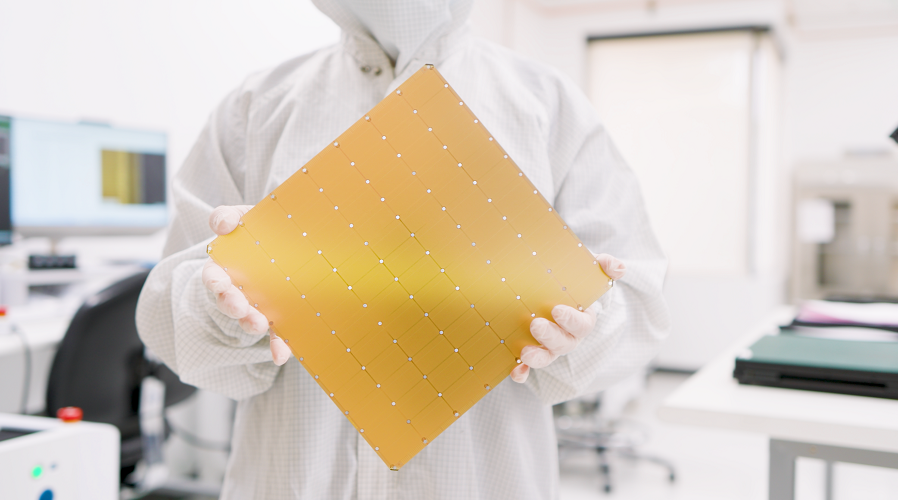
The company’s flagship product is a dinner plate-sized chip called the WSE-3, which is several times larger than Nvidia’s Blackwell B200 GPU. One of its main selling points is its 44-gigabyte pool of SRAM. SRAM is a memory variety that features significantly more transistors per square millimeter than standard server DRAM. As a result, it’s considerably faster and several orders of magnitude more expensive.
The processor also integrates a quartz crystal that moves millions of times per second in response to an electric current. Each movement corresponds to a clock cycle, the basic unit of time in chips. Cerebras says WSE-3’s 900,000 cores can access the onboard SRAM pool with latency of one clock cycle, which is significantly faster than what a standard graphics card offers. The result is much faster inference than GPUs.
It was only a matter of time before AI fueled a return to record IPO numbers, and Cerebras’s strong debut is a promising sign for the broader industry, said Holger Mueller of Constellation Research. “Cerebras provides a viable alternative to Nvidia for inference, and the market is keen to help fund it,” the analyst said. “Strong competitors will help to reduce the cost of AI for enterprises, and so this will help to keep the flywheel spinning in terms of innovation.”
Elon Musk’s SpaceX, OpenAI and Anthropic PBC are all expected to go public later this year in even bigger potential IPOs.
The signs are good. The IPO price is significantly higher than first advertised. When Cerebras officially filed its paperwork on May 4, it said it was looking to sell 28 million shares at between $115 and $125 per share. A week later, it boosted the offering to 30 million shares at a price range of $150 to $160.
Cerebras’ biggest shareholders include the venture capital firm Fidelity, which owns a stake valued at about $3.8 billion, followed by Benchmark, which owns about $3.3 billion worth of stock. OpenAI President Greg Brockman is reported to hold shares valued at $14.4 million, while the ChatGPT maker’s CEO Sam Altman holds stock that would now be worth about $16.5 million.
With reporting from Robert Hof
Support our mission to keep content open and free by engaging with theCUBE community. Join theCUBE’s Alumni Trust Network, where technology leaders connect, share intelligence and create opportunities.
Founded by tech visionaries John Furrier and Dave Vellante, SiliconANGLE Media has built a dynamic ecosystem of industry-leading digital media brands that reach 15+ million elite tech professionals. Our new proprietary theCUBE AI Video Cloud is breaking ground in audience interaction, leveraging theCUBEai.com neural network to help technology companies make data-driven decisions and stay at the forefront of industry conversations.