 AI
AI
AI
AI












AI

Unconventional AI Inc. has developed an artificial intelligence architecture that could improve the power efficiency of image generation models.
The technology is the basis of a new neural network series, Un-1, that the company released on Thursday.
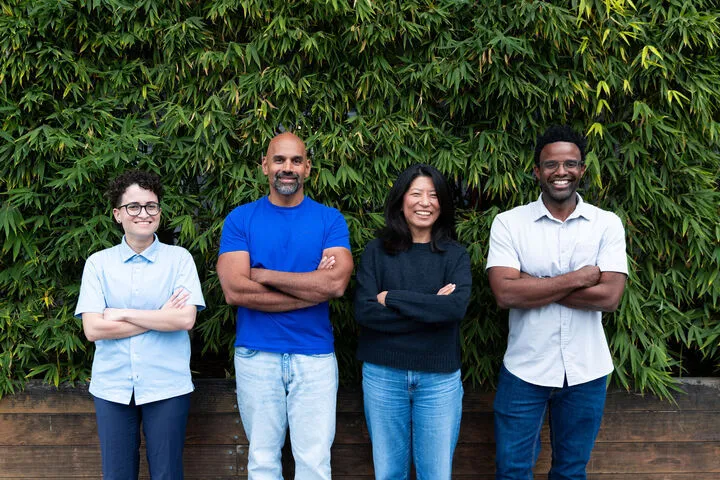
Unconventional AI is led by Chief Executive Naveen Rao (pictured, second from the left), the former corporate vice president of Intel’s AI platforms group. In December, the company raised $475 million from a consortium that included Amazon.com Inc. founder Jeff Bezos. It’s developing chips that can run AI models using significantly less power than today’s graphics cards.
Not all processors are based on standard silicon transistors. Multiple startups are developing so-called in-memory computing devices that use a mix of transistors and capacitors, tiny energy storage devices. Quantum processors, meanwhile, often substitute silicon with materials such as sapphire.
The Un-0 model series is part of an effort by Unconventional AI to develop more efficient AI chip architectures. According to the company, Un-0 is optimized to run not on standard transistor-based circuits but rather oscillators. An oscillator is a device that emits a signal such an electrical pulse at regular time intervals.
Unconventional AI says that a large number of miniature oscillators could be assembled into a machine learning accelerator. The semiconductor industry already mass produces such components because they’re used in chips such as central processing units. In particular, CPUs rely on oscillators to set the pace at which their other circuits perform calculations.
Un-0 doesn’t run on a physical oscillator chip. Instead, it generates images using several thousand simulated oscillators. The oscillators are linked together, which means that the signals produced by one virtual device affect the output of the others and vice versa.
There are six Un-0 models that vary in size and output quality. The smallest comprises 1,024 virtual oscillators while the largest features 16,384. Unconventional AI trained the models using two open-source datasets, CIFAR-10 and ImageNet-64, that contain thousands of images optimized for machine learning projects.
The training process unfolded differently than in a standard AI project. Usually, developers go about the task by optimizing AI model components such as weights. By contrast, Unconventional calibrated the manner in which Un-0’s simulated oscillators affect one another and the frequency at which they generate signals.
The workflow through which a standard AI model generates media files starts with an image that contains random noise. Un-0 kicks off the process the same way, but the subsequent steps differ.
First, a small group of oscillators generates an instruction that informs the model what type of image it should create. The instruction prompts Un-0’s other oscillators to interact with one another. According to Unconventional AI, the interactions produce a series of numbers that can be assembled into an image.
The company ran a series of benchmark tests to evaluate Un-0’s output quality. It determined that the model can match “the quality of leading conventional image generation methods when they were first published.” As a result, Unconventional AI believes that future advances may make it possible to improve the power efficiency of AI applications significantly.
Support our mission to keep content open and free by engaging with theCUBE community. Join theCUBE’s Alumni Trust Network, where technology leaders connect, share intelligence and create opportunities.
Founded by tech visionaries John Furrier and Dave Vellante, SiliconANGLE Media has built a dynamic ecosystem of industry-leading digital media brands that reach 15+ million elite tech professionals. Our new proprietary theCUBE AI Video Cloud is breaking ground in audience interaction, leveraging theCUBEai.com neural network to help technology companies make data-driven decisions and stay at the forefront of industry conversations.