 INFRA
INFRA
INFRA
INFRA



INFRA

The growth of AI workloads is changing how organizations approach data management, and hybrid storage is emerging as a key resource.
While the cloud originally promised simplicity, the reality is that infrastructure has become more complex. Most organizations now operate across a combination of on-premises infrastructure, cloud services and edge environments. Enterprises are turning toward hybrid storage-as-a-service models to combine cloud flexibility with on-premises control, enabling them to manage local and cloud data through a unified consumption model.
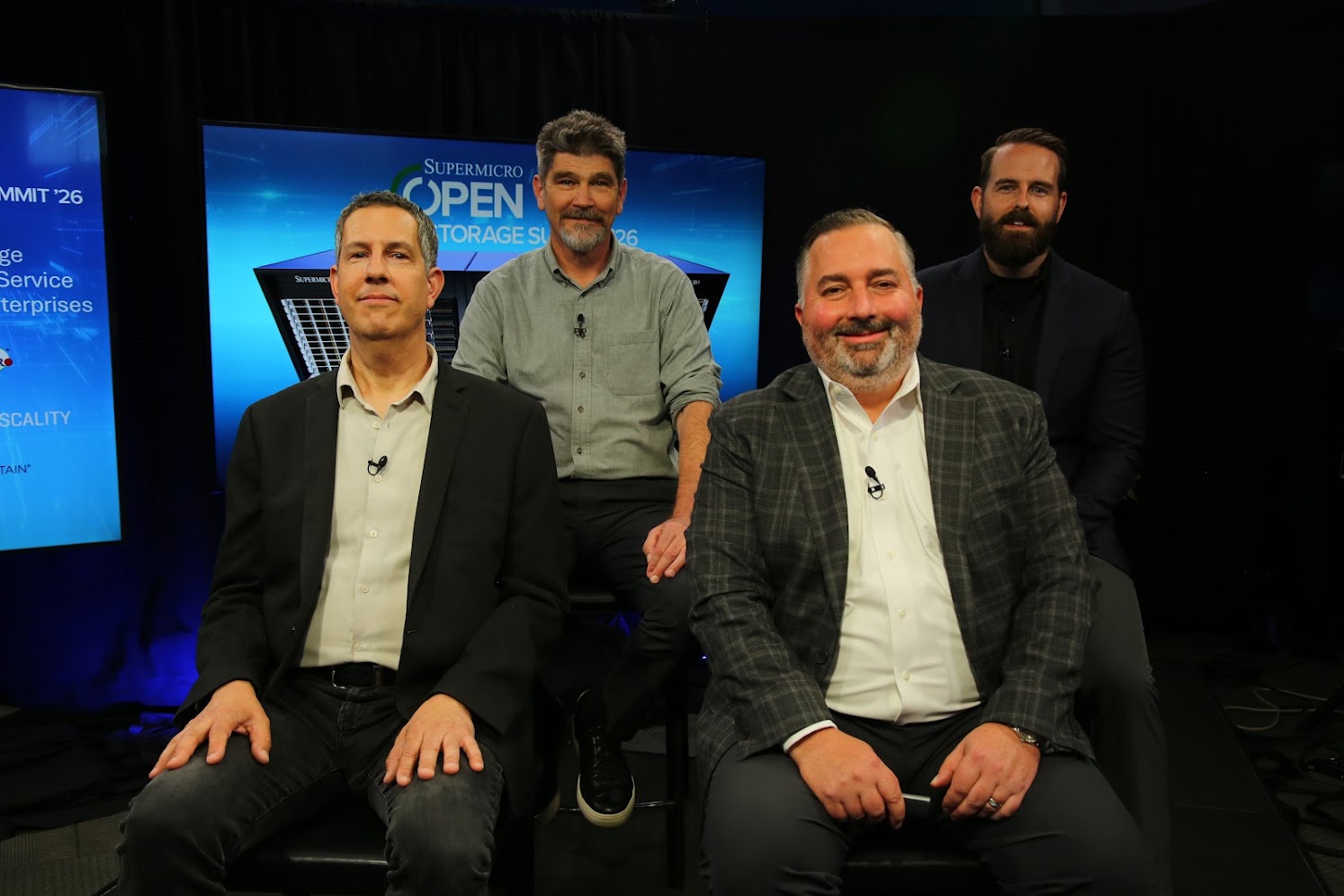
“There’s a big change and shift in the industry right now, where people are using hybrid storage architecture and their infrastructure lives at the edge as well as in the cloud,” said Gary Brown (pictured, bottom left), senior product marketing PM, Xeon products at Intel Corp. “There are many different requirements coming into play. What we want to offer the end customer, whether the organization is looking to deploy AI or other applications, databases or analytics … the flexibility to be building out their storage so that it gets a consistent experience from the edge and on-premises to the cloud. And integration is very important.”
Brown spoke with Rob Strechay for the Supermicro Open Storage Summit interview series, during an exclusive broadcast on theCUBE, SiliconANGLE Media’s livestreaming studio. He was joined by Paul McLeod (top left), product director of storage at Super Micro Computer Inc.; Greg DiFraia (bottom, right), senior vice president of AI and alliance partnerships at Scality Inc.; and Cliff Madru (top, right), vice president of Iron Cloud and Data Services at Iron Mountain Inc. They discussed how hybrid storage architectures are evolving, what service providers are learning from customer deployments and how organizations can balance agility with operational control. (* Disclosure below.)
The evolution of storage architecture is being driven by the need for hybrid solutions designed to meet AI requirements. Exponential data growth has elevated the role of storage in the enterprise well beyond that of a simple repository, according to Madru.
“Storage-as-a-service, though, is so far removed from what your typical S3 compatible object storage would normally be in this type of design, because now you’re bringing in on-premises architecture,” Madru told theCUBE. “Having the flexibility of how we can deploy in support of our specific customer needs becomes a critical component of how we offer storage-as-a-service and effectively deliver that from cloud to edge. Understand that storage isn’t about the storage; it’s about how it impacts your business.”
Madru’s point about storage’s impact underscores how key storage providers such as Scality have retooled their portfolios to support AI workloads across multiple business environments. Earlier this year, Scality unveiled enhancements that encompass a wide range of compute platforms.
“We have Artesca at the edge, we have Scality Ring at the core and we just launched Scality ADI, which is purpose-built architecture for AI workloads,” said DiFraia. “This portfolio works in concert with each other to go across edge, core and cloud architectures, from high performance all the way down to cold storage in a common framework.”
Interoperability across hybrid environments also depends heavily on open standards, an approach embraced by Supermicro. Supermicro employs Redfish as a standard API for managing modern and hybrid infrastructure. Its systems also use a Baseboard Management Controller, or BMC, to provide out-of-band remote management capabilities for servers.
“I think open standards again become one of the key factors here from building hardware and hardware solutions and working with multi-partner solutions,” McLeod said. “Open standards are really how we can talk to each other and find those weaknesses and correct those weaknesses. With our BCM and Redfish protocols, we’re able to integrate with the management interfaces that Scality is working on for the management of edge devices.”
Storage providers are developing solutions that enable customers to balance compute agility with operational control. That requires designing hardware that can meet system needs across multiple environments, according to Intel’s Brown.
“We can’t predict how customers will need to partition their applications for the on-premises servers and in the cloud,” Brown explained. “So, our silicon has to be very capable with capacity and bandwidth from an I/O and storage point of view, as well as the compute CPU core performance. What they run on the edge, what they run in the cloud, we can never tell. We have to have very dedicated silicon that offers great performance no matter where.”
Stay tuned for the complete video interview, part of SiliconANGLE’s and theCUBE’s coverage of the Supermicro Open Storage Summit interview series.
(* Disclosure: TheCUBE is a paid media partner for the Supermicro Open Storage Summit interview series. Neither Supermicro, the sponsor of theCUBE’s event coverage, nor other sponsors have editorial control over content on theCUBE or SiliconANGLE.)
Support our mission to keep content open and free by engaging with theCUBE community. Join theCUBE’s Alumni Trust Network, where technology leaders connect, share intelligence and create opportunities.
Founded by tech visionaries John Furrier and Dave Vellante, SiliconANGLE Media has built a dynamic ecosystem of industry-leading digital media brands that reach 15+ million elite tech professionals. Our new proprietary theCUBE AI Video Cloud is breaking ground in audience interaction, leveraging theCUBEai.com neural network to help technology companies make data-driven decisions and stay at the forefront of industry conversations.