 AI
AI
AI
AI






AI

Cisco Systems Inc. today detailed a broad expansion of its Webex collaboration portfolio that brings artificial intelligence agents into team conversations, connects office technology with workplace management and enables customer-service agents to continue working after an interaction ends.
Introduced at WebexOne in Austin, Texas, the updates extend Cisco’s strategy of integrating people, AI agents and enterprise information. The company is positioning such shared context as the foundation for software that can coordinate tasks across applications and carry decisions beyond meetings.
“Agents are entering the workforce at an unprecedented pace, both to help you and operating by themselves,” said Snorre Kjesbu, Cisco’s senior vice president and general manager of collaboration. “Connected intelligence goes from people to people but also people to AI and AI to AI.”
The announcements span Webex software, meeting-room hardware, and customer experience, with most new features and products planned for early 2027.
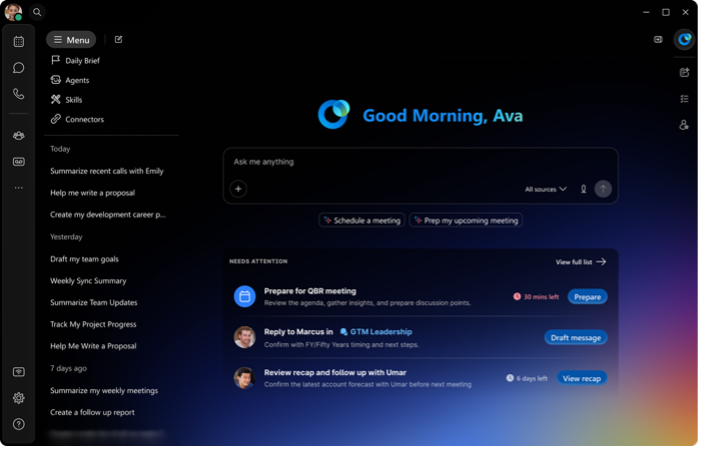
The redesigned Webex (pictured) provides a personalized view of upcoming meetings, calls and priorities, drawing on calendars, messages and ongoing workflows. Agents can participate in spaces, meetings and calls and help teams schedule conversations, take notes, translate and complete tasks.
Cisco also announced plans to bring Anthropic PBC’s Claude into Webex through Claude Managed Agents. The integration is intended to support analysis, content generation and coordinated actions using context derived from team interactions. Separately, a Model Context Protocol integration will bring Webex information into OpenAI Group PBC’s Dots agents, with plans to make Dots available inside Webex as a personal agent.
“People and agents working together is how collaboration is going to be done going forward,” said Amit Barave, vice president and general manager for Cisco’s Webex Suite and AI.
New personal agents can answer when users are busy, assess a caller’s request and urgency, then help schedule a follow-up or send a message. An AI coach, initially appearing in Webex’s Vidcast video recorder, will provide feedback on recorded presentations, including pacing, tone and unnecessary verbiage.
Cisco is also introducing Dialog, a software layer beneath its Webex AI Agent platform that connects customer history with enterprise systems, knowledge and policies. The aim is to replace disconnected service interactions with agents that maintain an understanding of a customer over time.
Dialog supports extended task execution, allowing an agent to coordinate with employees, other agents and backend systems until a customer’s request is resolved. It retains context across channels and learns from customer outcomes and employee judgment within enterprise policies. Cisco anticipates beta availability in the first quarter of 2027.
“We are moving away from a world where we build agents to where we train and onboard agents like digital co-workers,” said Vinod Muthukrishnan, a Cisco executive who leads Webex customer experience operations.
Rather than requiring organizations to construct individual conversation flows, Cisco says Dialog can onboard agents using existing conversations, policies and operating procedures. It is designed to support both Cisco and third-party agents.
Cisco executives said that broader scope also expands the need for oversight. “We are talking about securing, observing and governing an entire execution chain that starts with the conversation and goes well into the enterprise,” Muthukrishnan said.
Cisco is expanding its AI Agent 360 control plane and management platform with observability based on its Splunk technology to connect agent behavior with operational data, including escalation patterns and business impact. General availability is planned for December. Cisco AI Defense provides security capabilities, while additional integrations connect customer-service agents with Google LLC, Nvidia Corp. and Amazon Web Services Inc. technologies.
Cisco is also extending AI to customers that retain on-premises communications systems. Webex AI Agent is generally available for Cisco’s Unified Contact Center Enterprise, with voice support for Contact Center Express planned this month. A separate integration layer, expected in early 2027, will let organizations host third-party AI models locally to meet data sovereignty and compliance requirements.
For physical offices, Cisco’s Workplace Designer expands planning from individual meeting rooms to floors, buildings and campuses. Organizations can import floor plans and receive recommendations for room configurations, wireless infrastructure and collaboration devices.
Cisco’s Cloud Control unified operations management platform will bring together networking, collaboration and security management. Workplace data can help IT and facilities teams understand utilization, investigate service problems and decide whether existing space meets their needs. Cisco’s AI Canvas combines workspace and device intelligence with network insights to support investigations across systems.
RoomOS 27, scheduled for November availability, adds AI capabilities and native Google Meet support alongside existing meeting-platform options. Its director agent coordinates cameras, microphones and speakers, using Nvidia acceleration for contextual noise removal. Smart Room Assurance helps teams calibrate equipment and monitor room performance.
The new Cisco Ceiling Speaker Pro completes the company’s integrated audio architecture. It works with ceiling microphones and cameras to locate speakers and distribute their voices around a room. A single Ethernet connection carries power, audio and control, while automatic configuration reduces setup work. Cisco expects to make the speaker available for order later this quarter.
“With spatially aware voice lift, we know where the voice is coming from, and we intelligently distribute it where it’s needed in the room,” said Espen Løberg, vice president and general manager of Cisco’s collaboration devices business. “We’re not just making the room louder. We’re making the conversation more natural.”
Support our mission to keep content open and free by engaging with theCUBE community. Join theCUBE’s Alumni Trust Network, where technology leaders connect, share intelligence and create opportunities.
Founded by tech visionaries John Furrier and Dave Vellante, SiliconANGLE Media has built a dynamic ecosystem of industry-leading digital media brands that reach 15+ million elite tech professionals. Our new proprietary theCUBE AI Video Cloud is breaking ground in audience interaction, leveraging theCUBEai.com neural network to help technology companies make data-driven decisions and stay at the forefront of industry conversations.