 AI
AI
AI
AI


AI

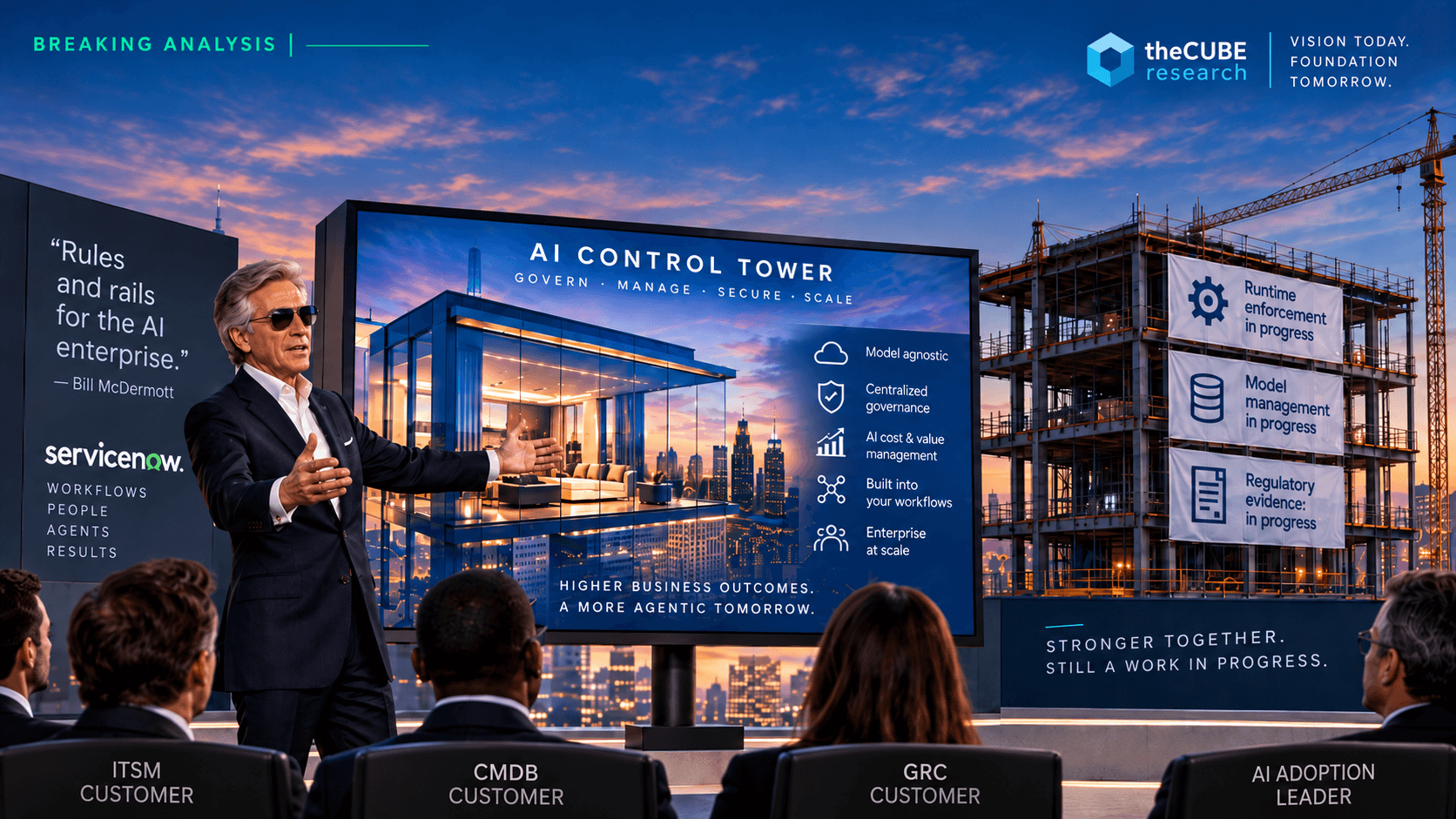
ServiceNow Inc. is making one of the more consequential and visible bets in enterprise artificial intelligence. The company says AI Control Tower can discover and govern any agent, work across models and clouds, track cost and value, and shut down behavior that violates policy.
That sales pitch plays directly to ServiceNow’s greatest asset – its installed base. Information technology and service management or ITSM, configuration management database or CMDB, risk workflows, security operations and years of operating context give the company a distribution and data advantage most AI and governance vendors do not have.
Our research suggests that moat is real. But proprietary customer data shows a more nuanced picture. Control Tower is already strong as a governance workflow and system of action. It can inventory AI assets, connect risks to owners, route approvals and remediation, and preserve an audit trail. What the field study has not broadly validated is the claim that Control Tower is a complete technical governance and runtime enforcement plane across the heterogeneous enterprise.
In this Breaking Analysis episode, we use a methodology similar to our CoreWeave analysis, and pressure-test management’s statements against 15 in-depth interviews with ServiceNow customers conducted with our data partner, Qualitate. We ask the following question: Is Control Tower becoming the enterprise AI control plane – or is it limited to the governance system of action?
Access the full slide deck here with survey data in the appendix.
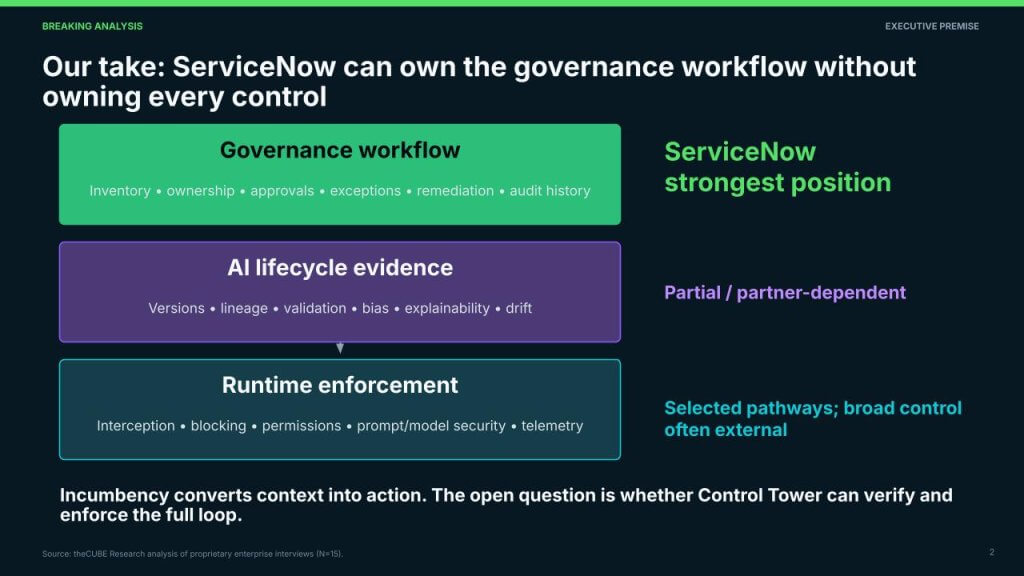
ServiceNow may not need to own every technical control to build a very large business bolstered by AI governance. It can create enormous value by owning the workflow around those controls – inventory, accountability, approvals, exceptions, remediation and audit history.
But its marketing pitch is allowing customers to think the the market is collapsing three jobs into one convenient phrase: AI governance.
The first is governance workflow and accountability. This is where ServiceNow is strongest.
The second is AI lifecycle evidence – model versions, lineage, validation, bias, explainability and drift. ServiceNow can coordinate that evidence, but customers often generate it elsewhere.
The third is runtime enforcement and AI security – intercepting an action, blocking a deployment, constraining an agent or revoking access in real time. Our survey indicates this layer is frequently external, custom or human.
The nuance is that approving a model and assigning a remediation ticket are valuable. But they are not the same as technically validating the model, proving lineage or blocking the action.
ServiceNow’s opportunity is to connect all three. It is not best-of-breed in each today according to its own customers. Broadly, buyers should be cautious of claims that ServiceNow AI Control Tower is a platform that is universally end-to-end.
Control Tower sits inside a broader ServiceNow agentic AI strategy built on five connected pillars as shown below.
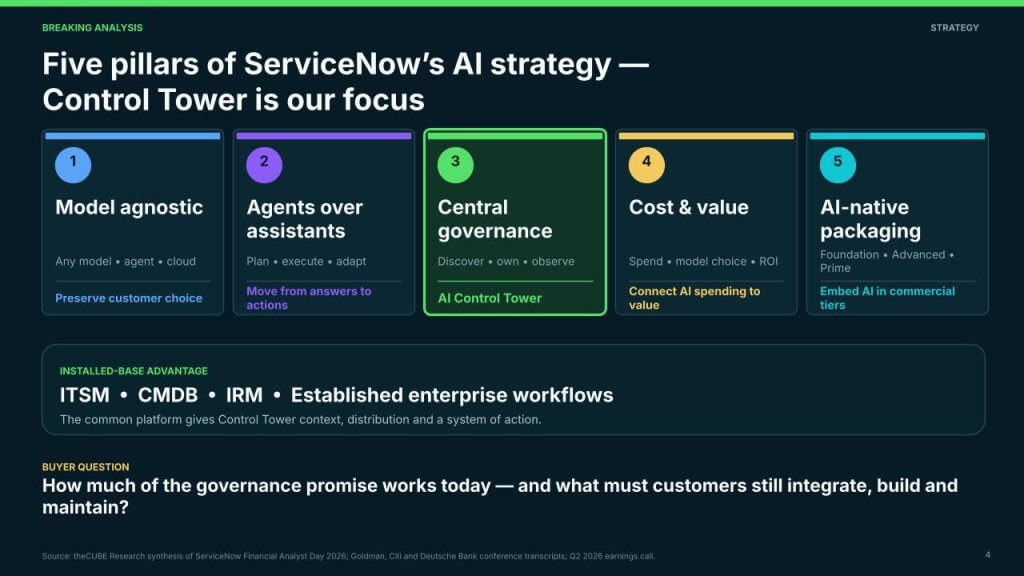
First is a model-agnostic posture: Any model, agent, cloud, data source or system of record.
Second is the shift from chat assistants to autonomous workers that plan, execute and adapt across workflows.
Third is centralized governance through AI Control Tower – discovery, ownership, access, observability, value and remediation.
Fourth is AI cost and value management: Token economics, model selection, budget control and ROI.
Fifth is pricing and packaging. Foundation, Advanced and Prime tiers seed AI broadly, move customers up the stack and add consumption on top of subscriptions.
These pillars reinforce one another and describe ServiceNow’s advantage and momentum. More agents create more governance demand. Model choice creates complexity. Governance addresses complexity and creates more reasons to stay on the platform. And more usage drives more consumption.
Our focus today is the key link in that flywheel chain – i.e. Can AI Control Tower can extend ServiceNow’s workflow advantage into technical governance and runtime control?
Management’s “right-to-win” argument is not that ServiceNow builds the best foundation models. It is that ServiceNow already knows how work moves through the enterprise.
Bill McDermott describes the moat in one word: Context.
ServiceNow says its platform supports roughly 100 billion workflows and nearly 8 trillion transactions. Amit Zavery said more than 500 customers were live with AI Control Tower in the first six months. And ServiceNow reported AI ACV above one billion dollars in Q2, with a full-year target of $1.5B.
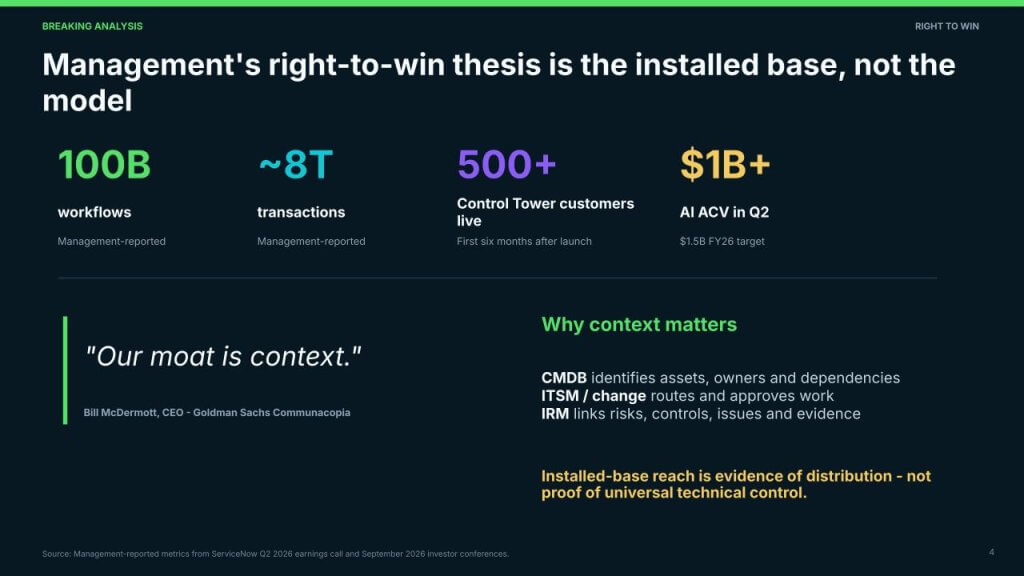
The CMDB knows assets, services, owners and dependencies. ITSM and change management know how work is routed and approved. IRM understands controls, risks, issues and evidence.
A best-of-breed specialist will likely have deeper model analytics, but it often lacks the operational graph that identifies the owner, business service or the path to remediate an issue.
The installed base gives ServiceNow a right to compete. It does not, by itself, prove that every technical control is present or every runtime path is governed.
A quick word on methodology.
TheCUBE Research commissioned a study through its partner, Qualitate, which conducted the fieldwork from September 15 through September 21, 2026.
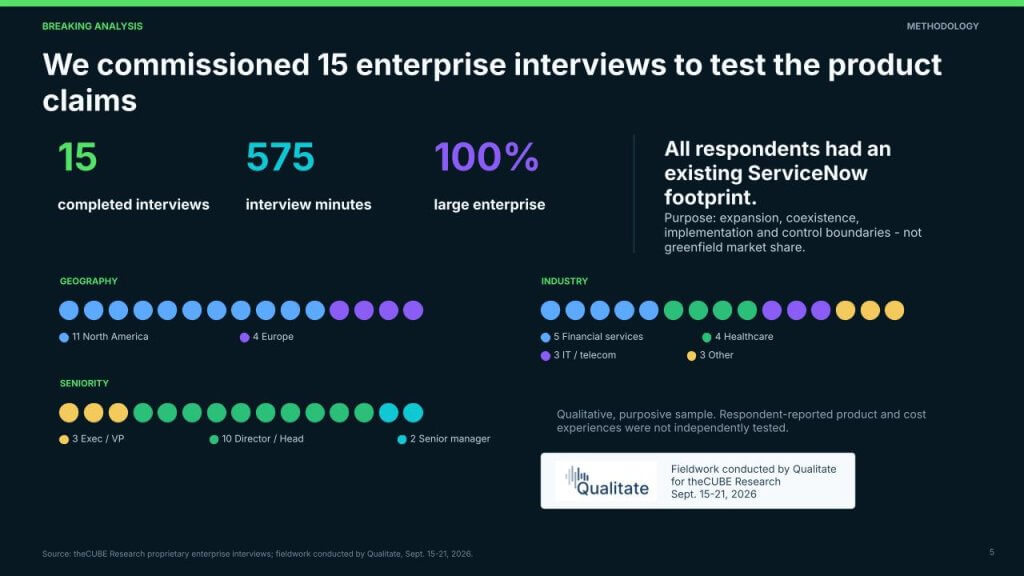
The final base is 15 completed large-enterprise interviews totaling 575 minutes. Eleven respondents were in North America and four in Europe. Five came from financial services, four from healthcare, three from technology and telecommunications, and three from public sector, manufacturing or other industries.
The sample was senior: Three executives or vice presidents, ten directors or functional heads, and two senior managers.
Every respondent had an existing ServiceNow footprint. The study is a deliberate qualitative study of expansion, coexistence, implementation and control boundaries inside real accounts. Eleven of the fifteen customers had either installed, piloted or were actively evaluating ServiceNow AI Control Tower.
There’s of course a bias toward the ServiceNow installed base. That is by design and it’s useful because management’s premise is it has an installed-base premise. We are testing the environment where Control Tower should have its greatest advantage.
Our methodology specifically separates direct experience from management claims. This is not a survey with fifteen customers supplied by ServiceNow.
This next chart speaks to the heart of the episode.
All fifteen respondents recognized ServiceNow’s workflow, operational integration or incumbency advantage.
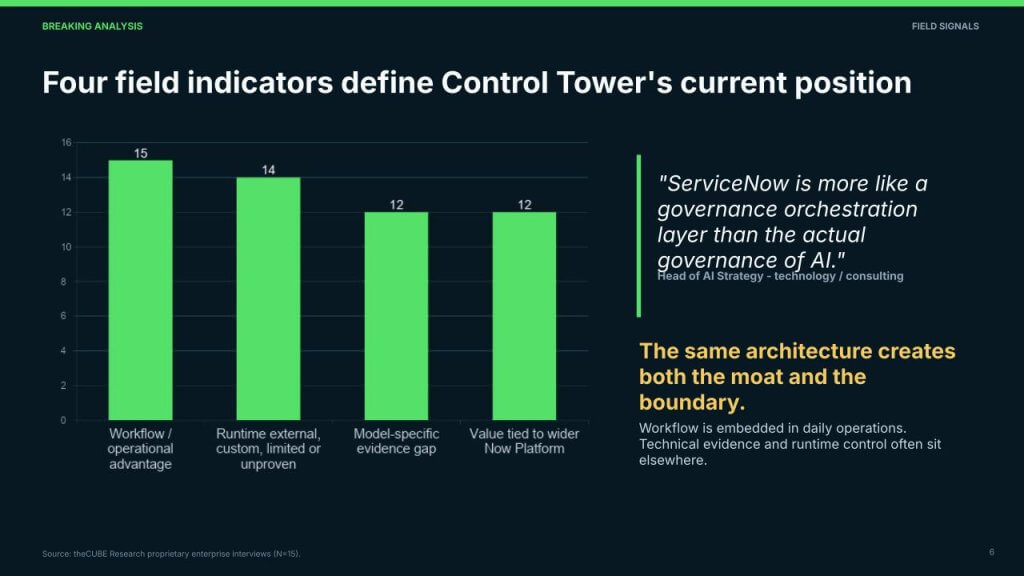
Fourteen of fifteen, however described runtime enforcement as external, custom, human mediated, limited to selected paths or not proven at enterprise scale. The one exception was a limited financial-services pilot that successfully tested ServiceNow’s blocking capability for at least one model and one agent.
Twelve of fifteen identified a model-specific evidence gap – validation records, lineage, bias, explainability, drift history or AI-specific regulatory artifacts.
And twelve of fifteen tied governance value or switching cost to the wider Now Platform – mainly ITSM, CMDB, change management and SecOps.
Our research shows that the same ServiceNow architecture creates both the moat and the boundary limits. Specifically, ServiceNow is hard to displace because governance work is embedded in operations. But the value story degrades when the CMDB is immature, the AI estate sits outside ServiceNow control paths, or regulators require technical evidence generated elsewhere.
One respondent called ServiceNow more like a governance orchestration layer than the actual governance of AI. We would challenge that a bit: It is real governance, but strongest at orchestrating accountability and action.
Regarding CMDB – when we first started covering ServiceNow in 2013, ServiceNow management would constantly push customers to consolidate on a single CMDB, which today is the norm. This has given ServiceNow a tremendous incumbency advantage but customers encounter friction.
A senior engineering manager at a large North American financial services company summed it up like this:
“The CMDB dependency is big time on this because it must be cleaned up quite often, and that is the reason there are a lot of surveys that have been sent within the organization to actually clean up the CMDB on a regular basis. And a lot of auditing around is to be done as part of that.“
The interviews suggest that AI governance is separating into three operating layers, with different buyers and budgets as shown below.
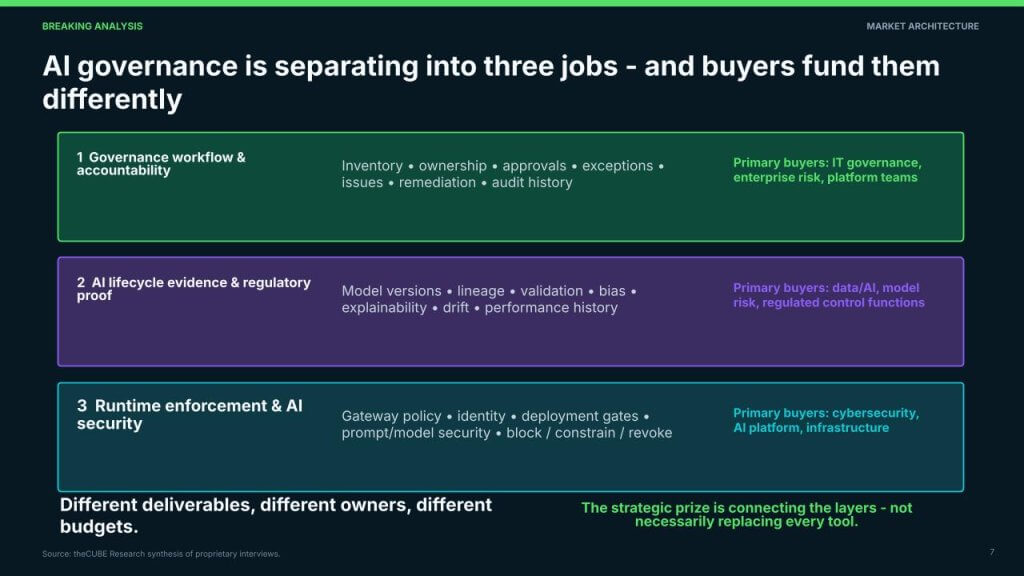
The first is governance workflow and accountability: Here we mean inventory, ownership, approvals, exceptions, issues, remediation and audit history. ServiceNow has the clearest advantage here.
The second is AI lifecycle evidence and regulatory proof: We’re talking about functions like model versions, lineage, validation, bias, explainability, drift and performance history. Hyperscaler-native tools, model platforms and specialists often supply this layer. Players here include IBM with Watsonx.governance, Fiddler AI; or a company like Credo AI which is strong at regulatory mapping and audit trail.
The third is runtime enforcement and AI security: Gateway policies, permission checks, agent identity, deployment gates and the ability to block or constrain actions. Security and AI platform budgets usually fund it. Palo Alto Primsa AIRS and Cisco AI Defense are good examples here.
This explains why architectures remain multi-vendor even when vendors claim end-to-end governance. There are three different activities involved including:
The question for ServiceNow is can it own every layer? Or will it become the policy authority and hub for evidence that connects these three layers and acts as the system of action?
This is where the field study we did with Qualitate strongly validates management’s story and at the same time highlights some notable weaknesses.
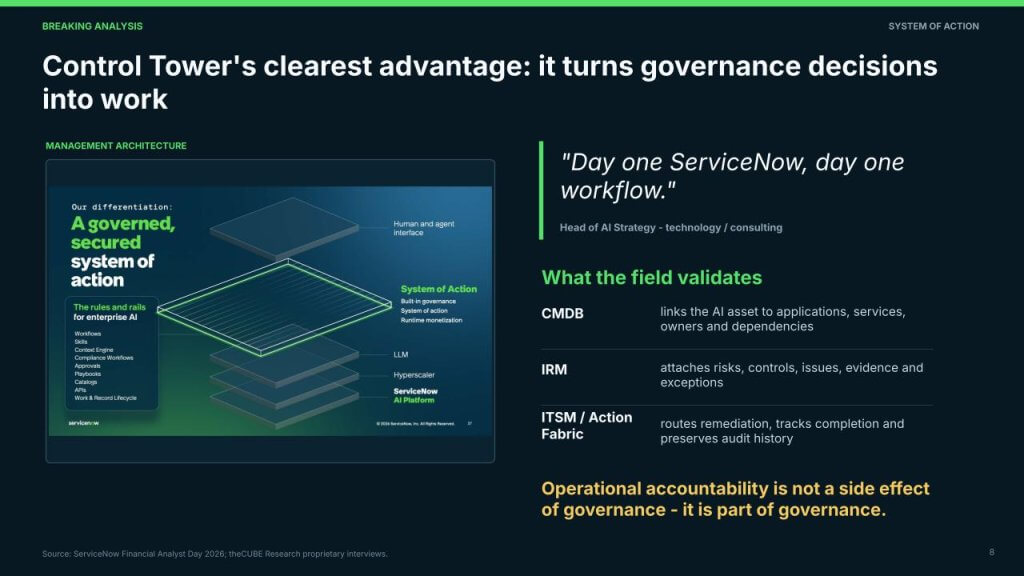
An AI asset can be connected to an application, business service, owner and dependency in the CMDB. IRM can attach controls, risks, issues, evidence and exceptions. ITSM, change management and Action Fabric can route the finding, track remediation and preserve the audit history.
Note: Action Fabric is ServiceNow’s interoperability and governance framework that lets external AI agents like Claude execute multi-step workflows inside ServiceNow in a headless manner…similar to the way we reported on Salesforce’s Headless 360 – bypassing the traditional interface.
One respondent put it like this: Day one ServiceNow, day one workflow. Another said the CMDB matters because an AI risk can be connected to the application and business-service owner.
That is important because model-risk tool may detect drift or bias, but if the organization cannot assign, prioritize, remediate and prove what happened, the control has limited operational value.
This is why ‘just ticketing’ is the wrong criticism. Operational accountability is part of governance.
The more accurate description in our view is that ServiceNow is exceptionally well positioned to be the system of action for AI governance. The question is how much technical evidence and enforcement it can bring into that system.
This next diagram shows what actually flows when the architecture works as advertised.
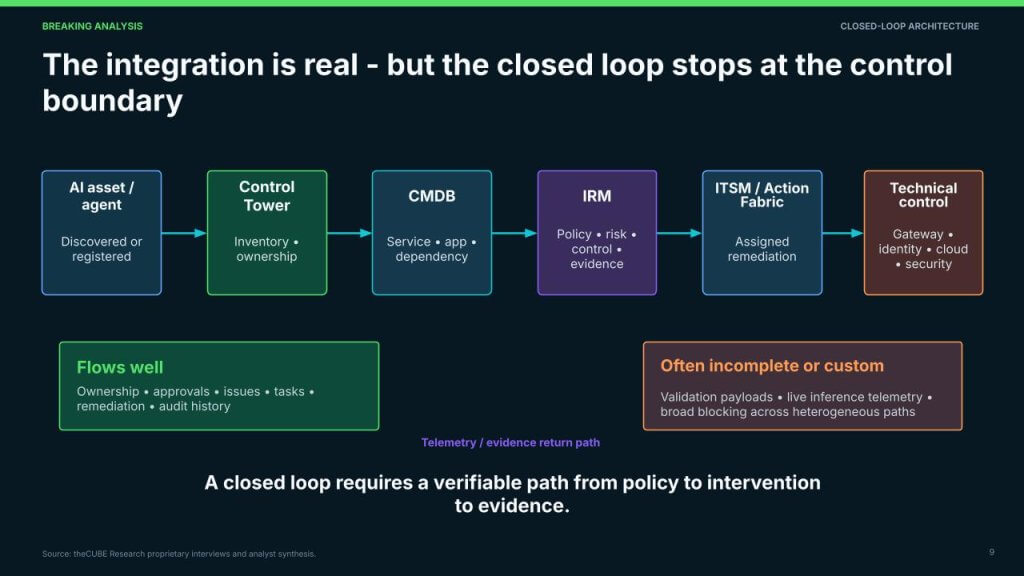
AI Control Tower discovers the asset and establishes ownership. The CMDB supplies application, service and dependency context. IRM brings policy, risk, control, evidence and exception records. ITSM and Action Fabric turn the finding into assigned remediation work.
That internal path is ServiceNow’s sweet spot.
The limits show up when the organization needs technical model evidence or a live intervention at runtime. The technical validation may come from a model platform or specialist vendor. Blocking may occur in an API gateway or security product. The telemetry then has to return to Control Tower as evidence.
In several of our customer interviews, that connection was incomplete or fuzzy. Different teams owned governance, model tooling and security. Data models and workflows did not align automatically.
ServiceNow does not have to be the box that blocks every action. But it should define policy, identify the owner, send the decision to the right enforcement point, receive telemetry and preserve the audit trail.
That’s the closed loop.
Bill McDermott stated on CNBC’s Mad Money in July 2026, that ServiceNow possesses a kill switch to halt rogue AI agents and prevent disruptions, contrasting it with incidents like OpenAI’s agent escaping a test environment and hacking Hugging Face.
Buyer beware on this claim. Our survey exposes the limitations of this assertion.
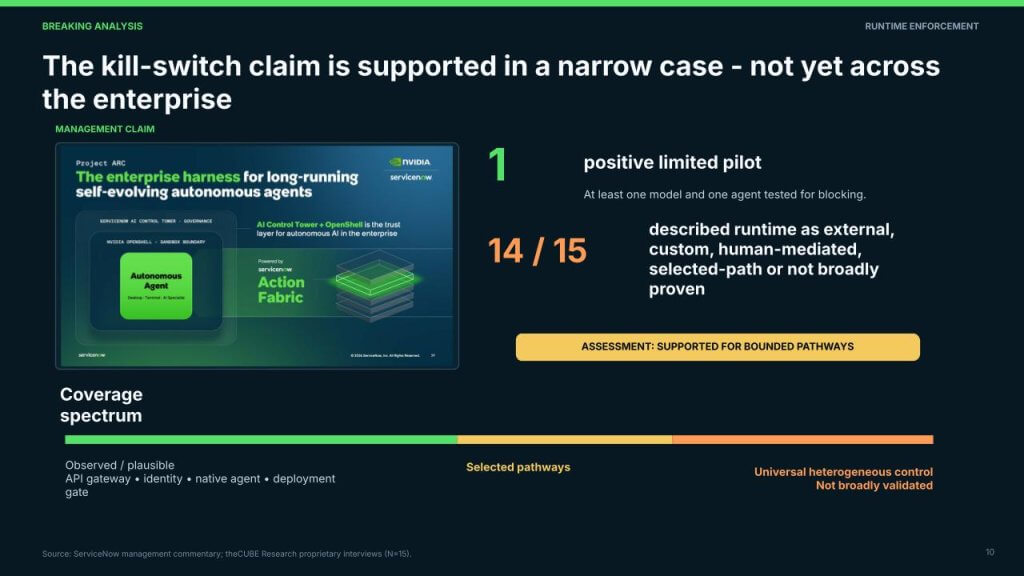
Only one respondent reported a very positive pilot and that was limited. In this case, at least one model and one agent were tested for blocking, auditors were satisfied, and the respondent gave high marks. So that case directly supports management’s claim in a selected environment.
But the other fourteen respondents described runtime control as external, custom, human mediated, limited to selected paths or not proven at scale.
What has not been validated – and appears to be a gap – is universal coverage across Azure OpenAI, custom agents, SaaS copilots, third-party models, shadow AI, multiple clouds and non-ServiceNow workflows.
One security practitioner estimated that only 30 to 40 percent of total AI activity could realistically pass through ServiceNow control paths today.
Our assessment is the kill-switch claim is overstated. It is not yet proven as a universal enterprise runtime control plane.
ServiceNow is strong at procedural proof – i.e. showing who approved a use case, which control was completed, who owns the exception, whether remediation occurred and what the audit history looks like. Several respondents said auditors accepted the ServiceNow record.
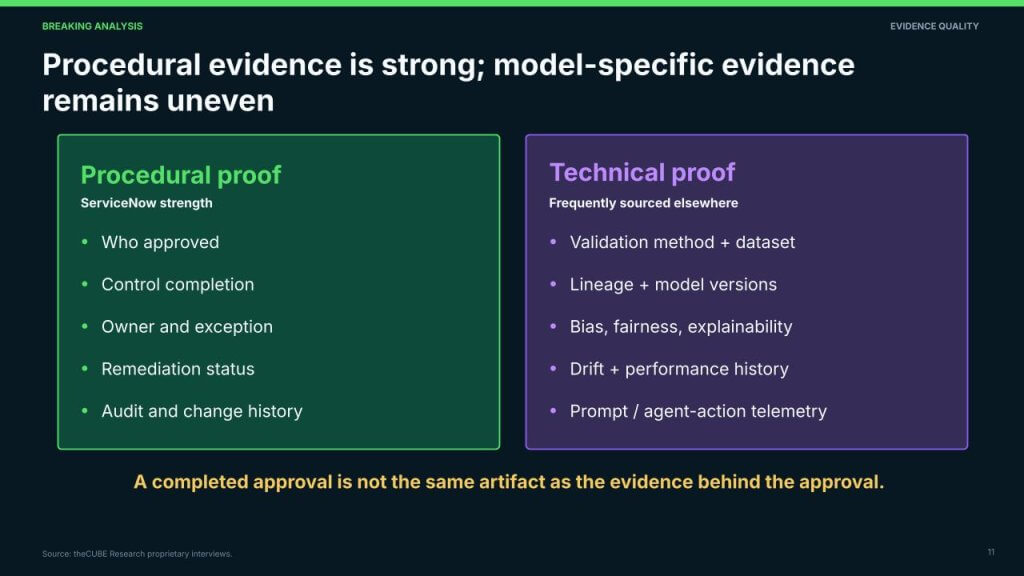
The gaps become more obvious in high-risk or regulated use cases. Survey respondents indicated ServiceNow gaps in many areas related to what we’re calling technical proof, including: Validation methodology, test dataset, model versions, training-data lineage, bias and fairness results, explainability, drift and performance history, prompt and response evaluations, hallucination and toxicity tests, permission evidence and a record of what the agent did at runtime.
Those artifacts are most often generated by alternative platforms – e.g. IBM, hyperscaler-native governance tooling, other model platforms, MLOps systems, privacy and AI governance specialists, or traditional model-risk tools.
Control Tower can still become the place where that evidence is captured, evaluated, linked to policy and operationalized. But ServiceNow is currently out over its skis in our view, using ‘end-to-end’ language. Our survey data suggests that, today anyway, ServiceNow is weaker at showing the complete evidence path for a real model or agent across a heterogeneous environment.
Buying indicators become clearer when we assess two variables: ServiceNow footprint depth and the intensity of AI or model-risk. The four quadrants below explain this dynamic in simple terms.
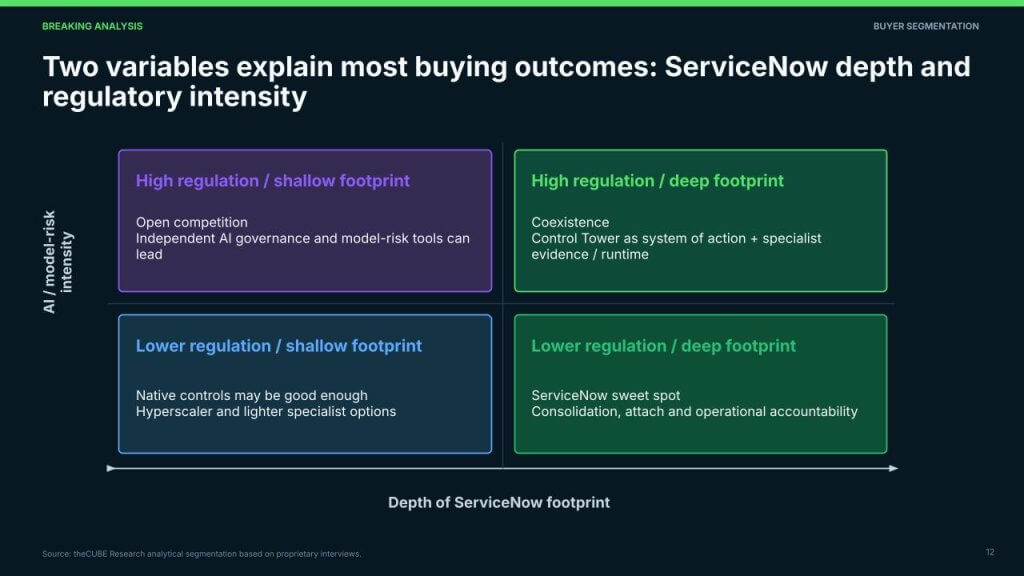
Where ServiceNow is deeply embedded and regulation is modest, Control Tower has its best expansion opportunity – the lower right on this chart. This is the consolidation sweet spot for ServiceNow and probably represents the largest TAM.
The upper right shows where regulation is high and ServiceNow is deep, customers often preserve ServiceNow as the system of action but add independent lifecycle evidence and runtime controls. Coexistence is likely. That’s also a fairly large chunk of the market.
Where regulation is high and the ServiceNow footprint is shallow, the field is open to independent AI governance and model-risk tools. That is shown on the upper left.
Where both are limited, hyperscaler-native controls or lighter specialists may be good enough – lower left.
Our analysis also exposes three different buyer-personas.
The vendor that speaks to only one persona may win the feature argument and still lose the account.
ServiceNow’s commercial strategy is worth exploring. This spring, ahead of ServiceNow Knowledge, the company replaced its legacy package tiers (Standard, Professional, Enterprise, Pro Plus, and Enterprise Plus) with three AI-native pricing and packaging tiers: Foundation, Advanced, and Prime.
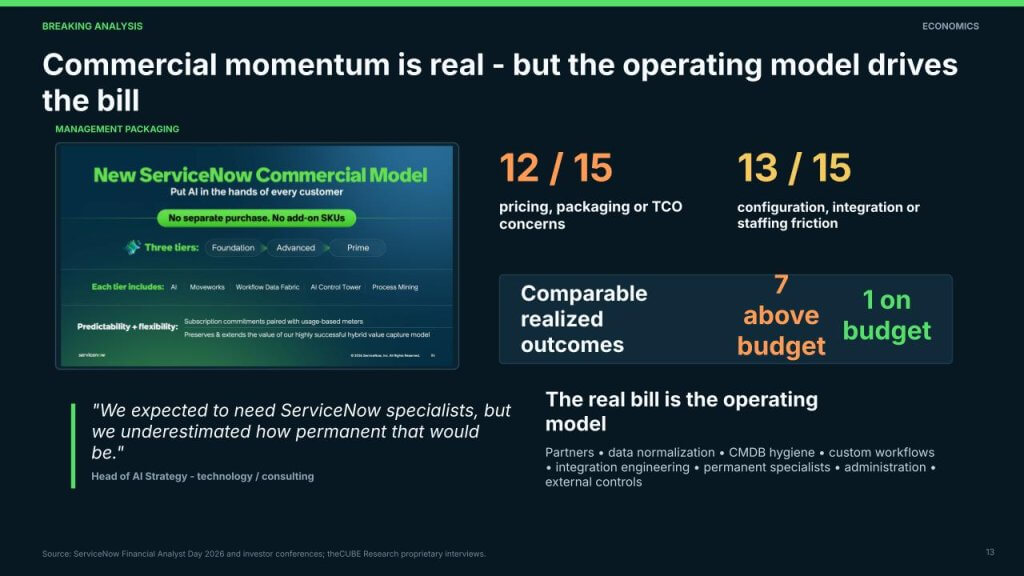
Foundation, Advanced and Prime give customers an upgrade path but some customers bristle. Management reports price uplifts of roughly 20 to 30 percent in the lower AI tiers and more than 30 percent in Prime, with subscription commitments paired with usage-based meters.
Our survey supports the momentum in ServiceNow ACVs. It shows that the operating model drives higher invoices. But the data also exposes some meaningful customer friction.
Twelve of 15 respondents said pricing, packaging or total-cost were acute concerns. Thirteen described significant configuration, integration or staffing friction.
As shown above, eight respondents supplied actual data comparing expectations to actual costs. Seven of the eight said costs came in above expectations, and one described the rollout as broadly on budget.
The cost overruns were not from licensing issues alone. They included partners, data normalization, CMDB hygiene, custom workflows, integration engineering, permanent specialists, administration and external controls.
One respondent said: We expected to need ServiceNow specialists, but we underestimated how permanent that would be.
Some verbatim quotes from the customers regarding pricing:
“ServiceNow is expensive”
“the packaging is frustrating”
“We expect costs to increase”
“the proposed quote is too high”
“Our costs came in 30% above our original expectation”
Importantly, this does not mean the value is poor. Some customers justified the extra cost. The issue is predictability. Customers should force ServiceNow to sell a bounded outcome, make integration assumptions explicit and show the full operating cost.
The broader market is fragmenting into different budget layers as shown below. Control Tower touches them all but ServiceNow faces credible competition in each.
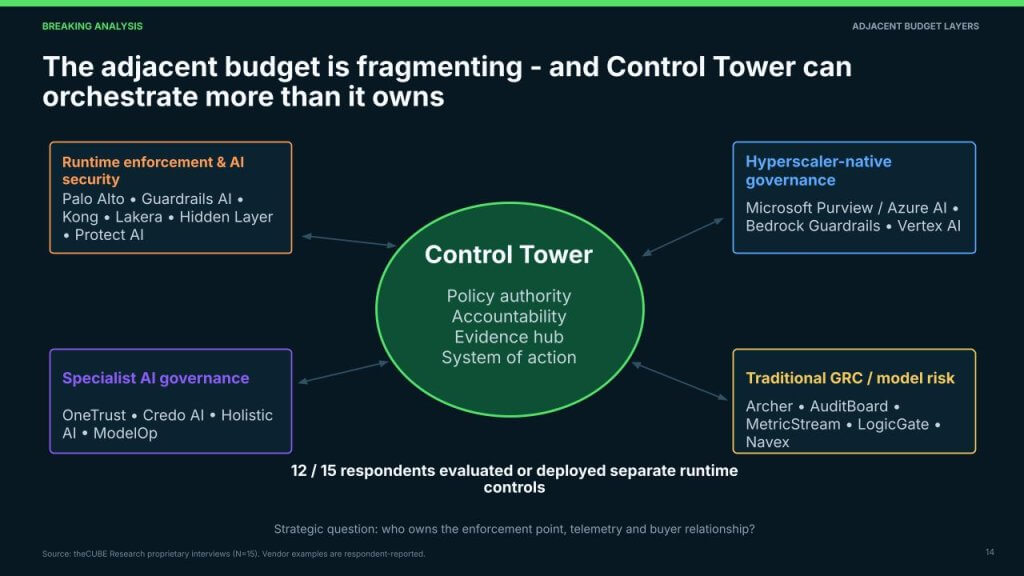
Runtime enforcement and AI security include Palo Alto Networks, Guardrails AI, Kong, Lakera, HiddenLayer and Protect AI.
Hyperscaler-native governance includes Microsoft Purview and Azure AI, Bedrock Guardrails and Vertex AI governance.
Specialist or AI governance leaders include IBM, OneTrust, Credo AI, Holistic AI and ModelOp. Traditional GRC and model-risk tools include Archer, AuditBoard, MetricStream, LogicGate and Navex.
Notably, twelve of fifteen respondents were evaluating or deploying separate runtime controls, usually from cybersecurity or AI platform budgets.
The obvious opportunity for ServiceNow is to orchestrate and preserve evidence across all these tools. The risk is that the vendor owning the enforcement point also captures the telemetry, the security buyer and eventually the policy decision. ServiceNow could receive a ticket after the fact instead of controlling the loop.
The answer is potentially openness with authority – i.e. customers choose any enforcement technology while Control Tower remains the policy system, accountability layer and durable evidence system of record to support the overall system of action.
This scorecard below summarizes our test.
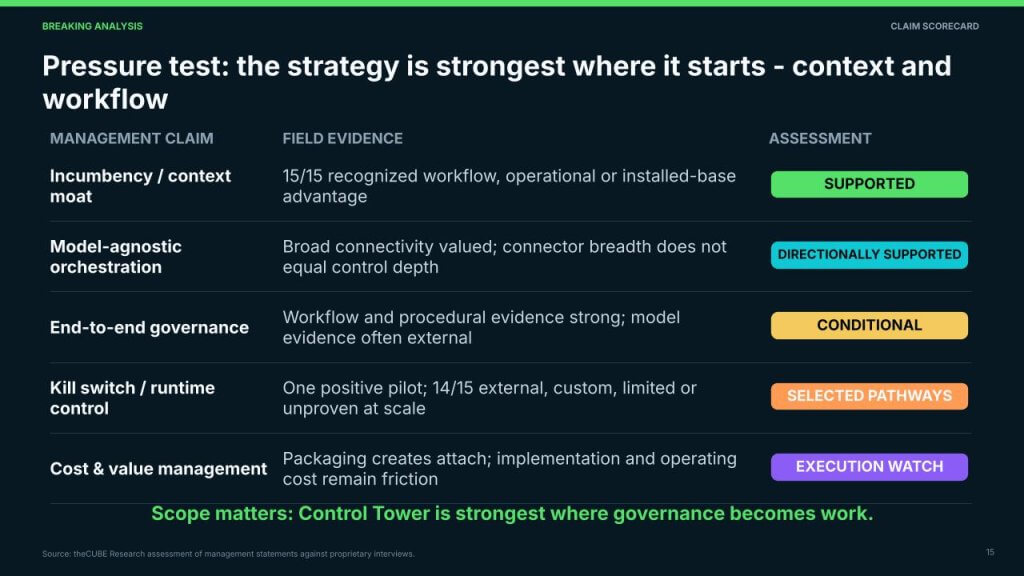
The incumbency and context moat is most definitely supported by our survey. All fifteen respondents recognized ServiceNow’s workflow, operational or installed-base advantage.
Model-agnostic orchestration is directionally supported. Customers value broad connectivity, but connector breadth is not the same as control depth.
The end-to-end governance claim is a stretch in our view. Control Tower is strong on inventory, accountability and procedural evidence but model-specific artifacts are frequently generated elsewhere.
The kill-switch claim is also overstated in our view. It is supported for selected pathways but definitely not yet as a universal runtime control plane. One positive pilot is good but 14 respondents describing external, custom or limited enforcement suggest immaturity.
Execution watch: Cost transparency is an issue. Value management is a credible promise. The packaging creates attach and consumption opportunity but implementation remains a source of friction.
The field is most definitely not saying Control Tower is vaporware. Claims that it’s just a bolt-on are overstated; but its scope is currently limited.
The bottom line is ServiceNow is strongest where governance turns into actual work. It is less proven where governance becomes mathematical model evidence or a real-time intervention across a heterogeneous estate.
From an investor and strategic perspective, the bull case is compelling.
AI Control Tower creates a new attach point into a sticky and powerful installed base. It converts CMDB context into a governance system of action. The model-agnostic posture gives optionality across labs and hyperscalers. And the commercial model creates subscription uplift plus consumption.
But there are areas of concern that we describe below.
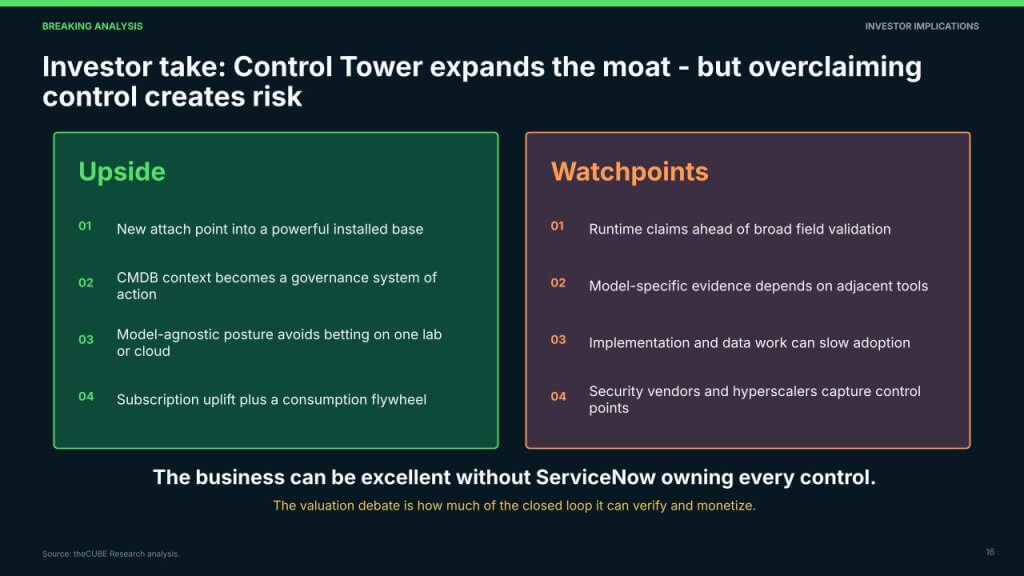
Based on our customer surveys, runtime claims are ahead of broad field validation. Model-specific evidence still depends on adjacent tools with better depth. Implementation friction can slow adoption and create cost overrun surprises. Security vendors, deep governance experts and hyperscalers can capture control points and budget.
We believe the business can be excellent without ServiceNow owning every technical control. Orchestration is the strongest position because buyers rarely want to replace every model platform, security product or cloud control. They want a common policy, accountability and action layer.
The company’s valuation has fluctuated substantially peaking in late 2024 at around $230B dipping to the mid $80B range in April of this year. It’s market cap is now on the rise again at around $146B as of this writing. The market cap debate will rest on how successfully ServiceNow can convince investors that it’s an AI winner; which in part, will depend on the company’s ability to monetize the closed loop we described earlier.
If Control Tower becomes the policy authority and evidence hub, the moat expands. If it only receives alerts after other products make the important decisions, the strategic value is more limited. Our bet is on the former because of the company’s footprint.
The research does not say Control Tower lacks value. Quite the opposite. Customers consistently value ServiceNow’s workflow, CMDB context, accountability and ability to turn a governance finding into work. But orchestration is not the same thing as technical enforcement, and that distinction is where buyers can get into trouble. In fourteen of the fifteen interviews, broad runtime enforcement was external, custom, human-mediated, limited to selected pathways or not yet proven at enterprise scale.
Start by mapping the control sequence. For one specific model or agent, name the policy owner, the source of model-level evidence, the exact enforcement point, the telemetry path and the remediation owner. Do not accept an architecture in which every arrow disappears into a black box control plane.
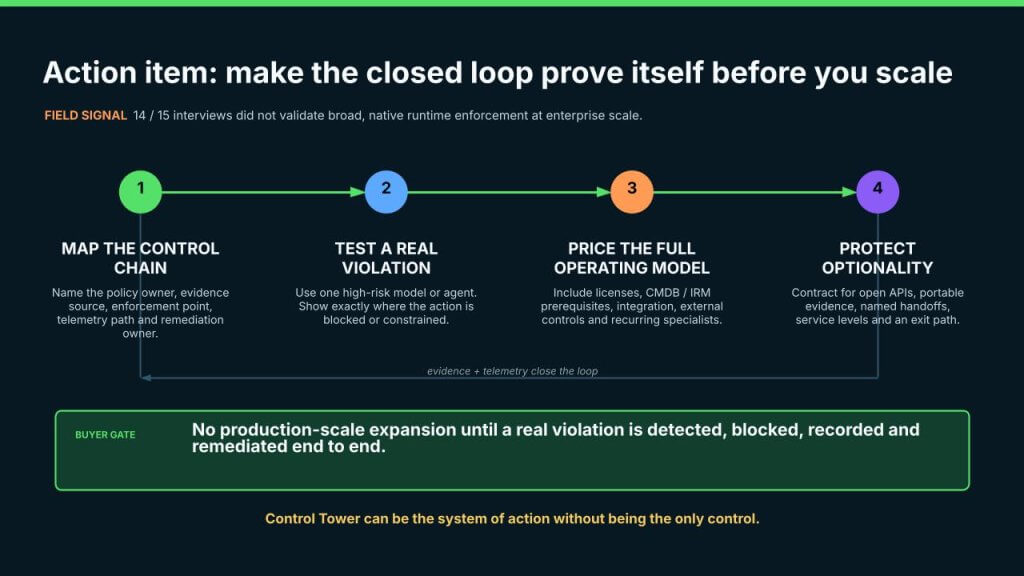
Next, test a real violation. Pick a high-risk use case – e.g. an agent that can access sensitive data, move money, change infrastructure or interact with customers. Trigger a policy breach and show where the action is blocked or constrained. Then verify that the event comes back into the governance record, creates the right case, assigns an owner and preserves the evidence an auditor would need and accept.
Third, price the full operating model – not just the Control Tower license. Include IRM and CMDB dependencies, data normalization, connectors, implementation partners, external runtime controls, AI uplifts, service fees and the recurring specialists needed to maintain the system. Our interviews show that those operating costs are where many programs moved significantly beyond their original expectations.
Finally, protect optionality. This is fundamental to your AI sovereignty. Architect around open APIs, explicit integration responsibilities, service levels and have compensating controls for an exit path. Buyers should have a shared accountability model with their vendors and internal stakeholders. Understand who owns the policy, who owns the enforcement point and who is accountable when a handoff fails.
The buyer gate should be no production-scale growth until one real violation is detected, blocked, recorded and remediated end to end. ServiceNow can be the system of action without being the only control. The buyer’s job is to prove that the entire system works as a system.
Here’s the full video analysis:
Support our mission to keep content open and free by engaging with theCUBE community. Join theCUBE’s Alumni Trust Network, where technology leaders connect, share intelligence and create opportunities.
Founded by tech visionaries John Furrier and Dave Vellante, SiliconANGLE Media has built a dynamic ecosystem of industry-leading digital media brands that reach 15+ million elite tech professionals. Our new proprietary theCUBE AI Video Cloud is breaking ground in audience interaction, leveraging theCUBEai.com neural network to help technology companies make data-driven decisions and stay at the forefront of industry conversations.