












Spectrum policy is one of the most difficult policy issues that Congress has to deal with, and for that reason the Communications Act of 1934 established the FCC as a non-political technical expert to handle the implementation of Congressional policy in the 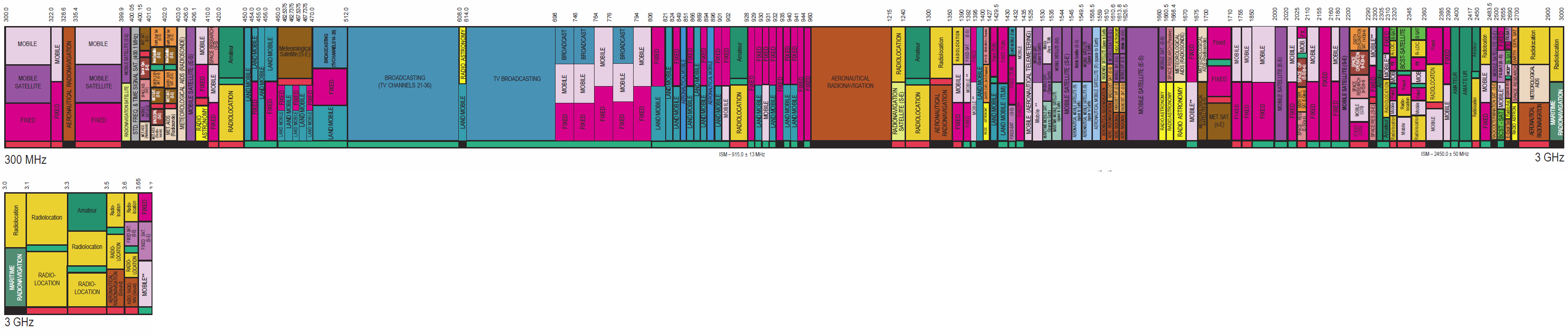 communications sphere. As things have developed, the FCC has become increasingly political, as we should expect from an agency whose commissioners are apportioned to the two parties according to which party wins the presidency. Congress was never shown any willingness to defer to the FCC on many matters of policy except when the same party controls both houses as well as the White House, but that’s consistent with the intent of the Communications Act. When we have divided government Congress hasn’t shown much willingness to defer to the FCC in purely technical matters as well, and that’s not good. The line between Congress and the FCC is often fuzzy.
Last week the House Technology and Innovation Subcommittee (of the Committee on Science, Space, & Technology) held a hearing on the spectrum crunch in an effort to get to the facts on a subject that’s become strangely controversial. As a witness, I filed written comments and delivered an oral summary on the key points. This being a geek committee hearing, I had PowerPoints, which you can see on the webcast.
The day of the hearing, there was a rather bizarre little story in the New York Times on the spectrum crunch on which the writer, former Wired staffer Brian X. Chen, turned to some colorful sources who aren’t up-to-date on the issues. For a very long time, various people have hoped that radio technology would permit multiple users to use common frequencies at the same time. We can do this partially (the CDMA technology in all 3G and 4G phones permits this kind of sharing,) we can’t do so without a loss of performance. (For a complete breakdown of what’s wrong with the article, see my post on Innovation Files; for the technical issues, see my testimony.)
It turns out there’s still not much understanding in policy circles about the multiple ways in which users share resources on networks. In fact, the fundamental distinctions between networks of different types such as the traditional telephone network, broadband networks, the Internet, and the mobile network relate to the manner in which users share network resources.
It’s fashionable in wireless policy these days to tout the benefits of “Dynamic Spectrum Access,” a form of network sharing in which the network and the connected devices hunt for unused spectrum before doing what all wireless networks do. The alternative is for the network to chose a frequency according to its license. It’s important to understand that DSA is an alternate form of licensing, not an alternate form of networking. You want DSA when there’s been a massive failure in spectrum licensing that you can’t correct any other way than to grab what looks like unused spectrum and temporarily erect a network on it.
This is something like searching your neighborhood for an unused car every time you want to take a trip. You may find one that hasn’t been driven for a week and take it just as the owner is heading for the door. All spectrum below 3 GHz has an “owner” already (except for explicitly unlicensed spectrum) so there’s always this potential issue with grabbing idle spectrum. There are additional issues related to services such as GPS in which the transmitter is very faint and far away and all the local users are passive receivers. LightSquared wasn’t allowed to use spectrum in the general vicinity of GPS because of finicky receivers that can’t observe their licensed boundaries.
[Cross-posted at High Tech Forum]
Commercial networks are good at sharing because they’re able to assume control over swathes of spectrum in which they operate and schedule transmissions in a scenario where the network knows who wants to do what and when. The typical cell tower is shared by 1000 users and millions of applications. The typical range of spectrum is used by less than 1,000 licensees across the entire nation, and most of them run a single application. So the efficient way to share spectrum is the way the commercial networks already do it.
For DSA to become generally useful, two things have to happen:
As I told the panel, “we’re not there yet” but we probably will be in 10 – 20 years if we start working on the problem seriously today.
Will we?
Support our mission to keep content open and free by engaging with theCUBE community. Join theCUBE’s Alumni Trust Network, where technology leaders connect, share intelligence and create opportunities.
Founded by tech visionaries John Furrier and Dave Vellante, SiliconANGLE Media has built a dynamic ecosystem of industry-leading digital media brands that reach 15+ million elite tech professionals. Our new proprietary theCUBE AI Video Cloud is breaking ground in audience interaction, leveraging theCUBEai.com neural network to help technology companies make data-driven decisions and stay at the forefront of industry conversations.