 AI
AI
AI
AI


AI

The theme of NTT Research Inc.‘s annual user event, Upgrade, in San Jose this week was “Research to Reality,” a reflection of NTT’s desire to balance the academic nature of research with the practicality of ensuring the outcome is something customers can use and benefit from.
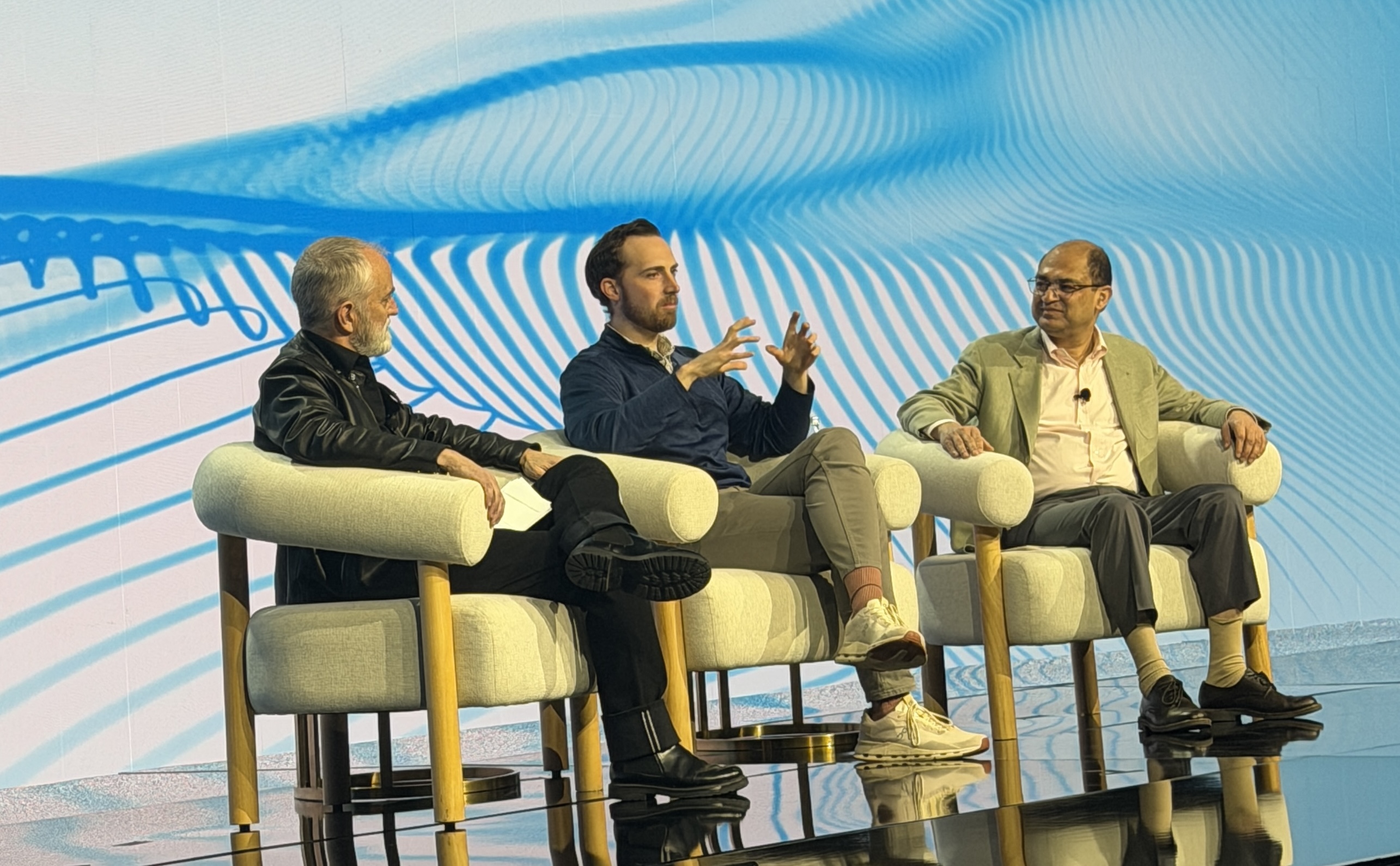
One of the more interesting sessions was a fireside chat moderated by Vab Goel (pictured, right), a founding partner at NTT Venture Capital; Chris Shaw (left), chief marketing officer of NTT Research; and Jordan Topoleski (center), chief operating officer of Cursor, an AI-powered code editor and one of the fastest-growing companies in the AI era. Given that coding has been one of the “low-hanging fruit” use cases for AI, I was interested in Topoleski’s perspective. Here are five takeaways from his session:
Topoleski stressed that AI is no longer a sidecar to development. Rather, it is fundamentally reshaping how software is built end-to-end. He described a dramatic inversion of the classic lifecycle curve: planning, design, testing and review are now the bottlenecks, not writing code.
“Writing code is no longer becoming the bottleneck,” he said. “AI can write 60% to 80% of the code, which means what starts to become the bottleneck are other parts of the organization, other parts of the software development lifecycle, the planning and the design process. The test and review process needs to be thought about in a different way.”
His message to chief information officer and chief technology officers was that adopting AI coding tools requires rethinking “what this software factory of the future is actually” and restructuring teams, processes and skills to align with that reality.
An interesting point Topoleski raised was that organizations need to rethink output metrics. He called the number of lines of code AI writes a vanity metric, and what should be tracked is whether the code is high-quality, secure and moving the business forward.
Topoleski used hard numbers to illustrate how quickly AI-driven development is scaling in the enterprise and within Cursor itself. “Twelve months ago, the average enterprise customer we worked with had about 6% of the code they pushed into production that was originated by Cursor,” he said. “Today, this number is over 60%. Internally at Cursor, after introducing cloud agents that can run multiple agents in parallel, we watched our code that goes to production written by AI go to 97.3%.”
He contrasted this with a year-ago baseline: “Literally a year ago, this was sub 10%.” That shift means organizations must now worry less about “Can AI write code?” and more about downstream effects, such as code review, continuous integration/continuous deployment, or CI/CD, and release workflows being overwhelmed by volume.
He even cited a large insurance company that went from shipping “something like 150,000 lines of code per week” to about 800,000 lines per week after rolling out Cursor, which, in turn, broke traditional code-review and pipeline assumptions.
A central theme was Cursor’s three “waves” of AI for software development, each expanding the scope of what AI can do.
Wave 1: Completion. Topoleski compared Cursor’s initial use to Gmail’s ability to complete emails. It uses AI to analyze what coders have done in the last 10 to 15 minutes and then predict the next line. This resulted in 10% to 15% productivity gains.
Wave 2: Agents as pair-programming colleagues. The next wave of use involved pairing an AI agent with a developer. The agent can crawl through all the code, consult an LLM to generate code, and apply it within the codebase, lifting productivity by 35% to 40%.
Wave 3: Cloud agents and orchestration. The third wave is where agents can run longer tasks and developers can run multiple agents in parallel in a cloud environment. Topoleski framed the new developer role as more managerial: “You’re actually focused on this more like a manager, where you’re orchestrating several of these agents in the way that you’re actually running software.” He even joked that “ultimately Cursor is an internal tools company that we’re using Cursor to build Cursor even better,” underscoring how deeply it’s dog-fooding these agent-based workflows.
Topoleski argued that the biggest determinant of ROI is not the model but leadership stance and organizational design. He said the first requirement is explicit top-down sponsorship and a clear company philosophy on AI use. He recounted a CTO town hall where the unasked question was: “If I use AI, am I going to be promoted, or am I going to be fired?” This is something I have heard from many people, and leaders must address it directly.
He laid out a practical adoption pattern and suggested starting by giving people room to experiment outside day-to-day pressure, such as running hackathons or taking a day away from work so teams can experience what using AI is like.
The point made above about tracking the right metrics is why Cursor built capabilities like “bug mod,” which runs a series of four or five large language models to proactively find bugs, quality assurance issues and other problems as code is being written. Topoleski said this can resolve about 60% of the issues it identifies. This quality layer creates confidence and is essential to sustaining AI-driven velocity.
From the investor and ecosystem perspectives, Vab Goel framed Cursor as one of “the most amazing, applied AI companies out there” and positioned the AI-for-software-development category as both enormous and already in production, not stuck in POC limbo.
He opened by outlining Cursor’s traction. He remarked, “Cursor is only a three-year-old company and has already reached $2 billion annual revenue run rate,” which he suggested is “probably the fastest company to reach $2 billion.” He went on to state that “about 70% of Fortune 500 companies are using Cursor,” with “2 million-plus software developers using the product weekly.”
Goel contrasted Cursor with the broader AI market, where there are many proofs of concept but moving them into production has been challenging, arguing that “Cursor has changed that for software development; it doesn’t get any better than being in production.”
Taken together, their conversation makes a strong case that AI-driven software development is already at an industrial scale, that the real competitive differentiation now lies in organizational design and workflow orchestration, and that Cursor is positioning itself as the platform layer where those capabilities converge.
Based on this, here are my recommendations to information technology leaders:
Lastly, it’s critical that developers and engineers have the time to experiment and try things out. Creating a digital twin of the environment has never been easier, so give people the freedom and time to try, fail, and try again. This will only create sustainable, long-term benefits.
Zeus Kerravala is a principal analyst at ZK Research, a division of Kerravala Consulting. He wrote this article for SiliconANGLE.
Support our mission to keep content open and free by engaging with theCUBE community. Join theCUBE’s Alumni Trust Network, where technology leaders connect, share intelligence and create opportunities.
Founded by tech visionaries John Furrier and Dave Vellante, SiliconANGLE Media has built a dynamic ecosystem of industry-leading digital media brands that reach 15+ million elite tech professionals. Our new proprietary theCUBE AI Video Cloud is breaking ground in audience interaction, leveraging theCUBEai.com neural network to help technology companies make data-driven decisions and stay at the forefront of industry conversations.