














 NEWS
NEWS
NEWS
NEWS
NEWS

The examination of ways to leverage new advances in data collection and management is pushing marketing in new directions, even as customers gain their own ways of putting that data to use. Bringing the two sides together is a challenge with big rewards for those who succeed.
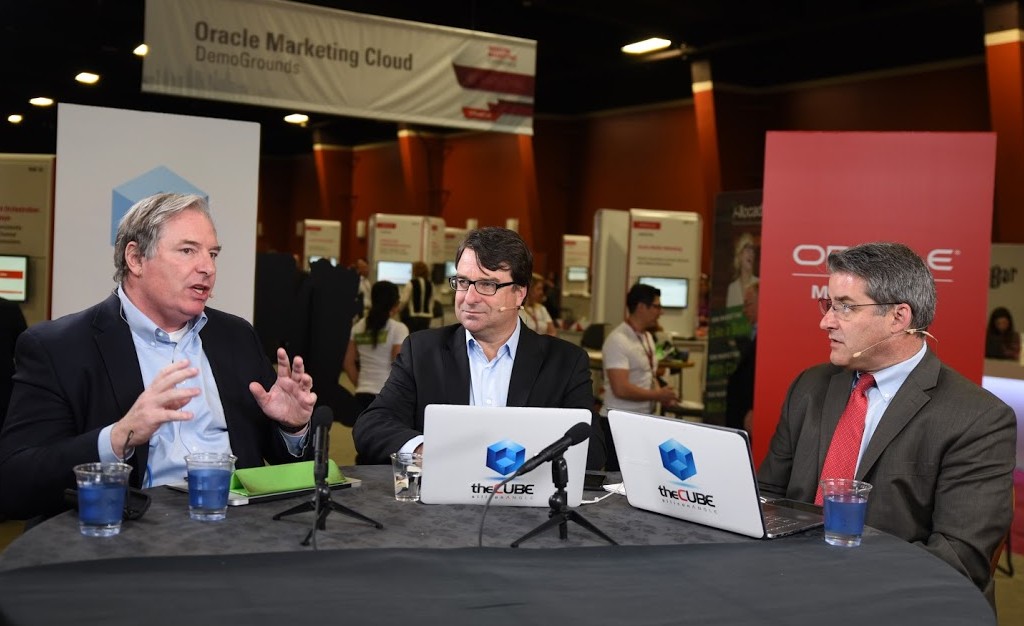
At the Oracle Modern Marketing Experience event in Las Vegas, John Furrier (@furrier), Peter Burris (@plburris), and Jeff Frick (@JeffFrick), cohosts of theCUBE, from the SiliconANGLE Media team, met to discuss the perceived friction growing between technology and marketing departments, the impact of cloud services on user experiences, and the value of customer data.
Furrier outlined the situation as he saw it early in the conversation: “Marketing is plagued by this digital transformation problem, which is the customer experience now is a full digital progression; it’s now a world where expectations are such where they want things not just stopping at an e-mail form and some legion tactic, and then pass on to an analog sales rep.”
Burris agreed, providing his own take on the way things were shaping up: “Now with mobile, with social, with IoT and other technologies, the customers as they do things are now throwing off gems of information that these technologies, if properly set up, properly implemented, properly managed, can then sweep up and turn into better brand experience on a per-customer basis.”
As Furrier put it, in short, “The users’ experiences are being redefined.”
But this doesn’t seem to be a one-way change, according to Burris, who said, “I think what’s going is that as customers demonstrate a willingness to participate … they’re expecting some sort of quid pro quo back. … The customer doesn’t want to just buy. They want to do a better job of understanding, of evaluating, they have a real life-cycle and ultimately using and applying,”
A very large part of the drive behind these changes comes from the growth of cloud adoption and integration, Burris said.
“There is a fundamental shift in perspective that is made possible by the confluence of these technologies and new customer behaviors, and that fundamental perspective, that shift is, that it used to be that the assumption was that the value was exchanged: By buying something, I got value. … The reality today … the cloud is translating everything into services. It’s not about what you buy; it’s about what you do.”
As Burris continued, he noted that although there is a significant importance to the bottom line of retail companies involved in these sorts of developments, the marketing departments are getting some of the biggest opportunities to engage. “The cloud provides that extended ‘any time, anywhere’ reach that now is possible, and it wasn’t possible when you were running your own networks. … With the cloud, you have reach anywhere. … The fundamental proposition of the cloud to marketing is: Your customers are everywhere; if you wanna be with them everywhere, the cloud provides that solution.”
For all of the excitement around these changes, as well as accounts of “shadow marketing” to complement “shadow IT,” the ultimate decisions are still dependent on the behavior of people, summed up by Frick with the statement: “At the end of the day, the processes of the people are harder to change.”
Watch the full interview below, and be sure to check out more of SiliconANGLE and theCUBE’s coverage of Oracle Modern Marketing Experience. And make sure to weigh in during theCUBE’s live coverage at the event by joining in on CrowdChat.
Support our mission to keep content open and free by engaging with theCUBE community. Join theCUBE’s Alumni Trust Network, where technology leaders connect, share intelligence and create opportunities.
Founded by tech visionaries John Furrier and Dave Vellante, SiliconANGLE Media has built a dynamic ecosystem of industry-leading digital media brands that reach 15+ million elite tech professionals. Our new proprietary theCUBE AI Video Cloud is breaking ground in audience interaction, leveraging theCUBEai.com neural network to help technology companies make data-driven decisions and stay at the forefront of industry conversations.